
Jazz Album Review: Trumpeter Woody Shaw’s Columbia Years, Revisited
By Michael Ullman
A rich six-disc set documents a fiercely original voice at the height of its powers.
Woody Shaw: The Complete Columbia Albums Collection (six discs, Columbia 86979- 18902)
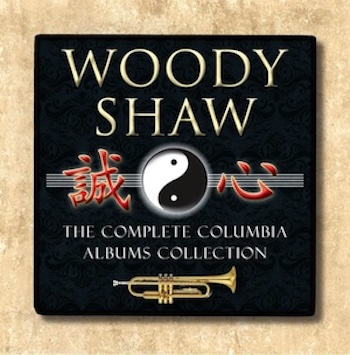 Born in North Carolina on Decenber 24, 1944, trumpeter Woody Shaw, who also played cornet and flugelhorn, was raised in Newark where his father (Woody I) was a member of the gospel group the Diamond Jubilee Singers. It was just luck that Woody III became a trumpeter, though fate probably decreed that he would be an original. As a child, Shaw was attracted to the violin and the saxophone, but those instruments were taken in the school band where he would receive his early training. Initially, he disliked the “tinny” instrument he was left with. Later, it seemed meaningful to him that, after a trial period with a bugle, he picked up the trumpet in June 1956, the year that his great predecessor trumpeter Clifford Brown died.
He was precocious. Shaw was still a teenager when the progressive saxophonist Eric Dolphy, already a legend, drafted him for the July 1963 sessions that would be issued as Iron Man and Memorial Album, sessions on which Dolphy played alto sax, flute, and bass clarinet while Shaw stuck to the trumpet. With those sessions, Shaw was launched. On October 1, 1965, when he was still 20, Woody Shaw took part in a soon-to-be famous Horace Silver session: Cape Verdean Blues. He still couldn’t enter clubs legally when he recorded another seminal session, organist Larry Young’s Unity, made on November 10, 1965. The next year he also participated in the Chick Corea sessions that produced one of that leader’s most fascinating early recordings: Tones for Joan’s Bones. No matter how complicated the arrangement, the young trumpeter was unflappable.
Shaw’s bright tone and unforced virtuosity fit in every progressive group. In 1967, he was on Jackie McLean’s ‘Bout Soul and Demon’s Dance. The next year he played trumpet with sessions led by hard bop legends Hank Mobley, Andrew Hill, Booker Ervin, and McCoy Tyner. In 1969 he recorded with Art Blakey and repeatedly with Andrew Hill. With Miles Davis he played on the first version of Davis’ In a Silent Way. He was working full throttle in the studios: in 1970 he made sessions that produced some of my favorite albums, including Pharoah Sanders’ Summun Bakmun Umyun, Hank Mobley’s Thinking of Home, and Joe Henderson’s If You’re Not Part of the Solution, You’re Part of the Problem. In December he led an all-star cast in his own Contemporary album Blackstone Legacy. Other highlights of the period include Shaw’s The Moontrane (1974) for Muse.
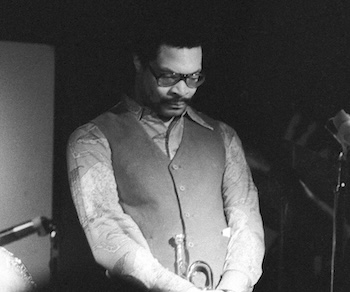
Trumpeter Woody Shaw. Photo: Michael Ullman
Financially, as well as in terms of exposure, his signing in 1977 with Columbia Records was a step upward for Shaw He had a uniquely generous patron: reportedly, Miles Davis recommended him to his label and sponsored him. Shaw’s first Columbia record, and the first album in this new collection, was Rosewood, recorded in a series of sessions in December. It took off: voted the Best Jazz Album of 1978 by down beat readers, it was nominated for two Grammys. In a period in which Miles Davis was temporarily inactive, Woody Shaw was also voted the best trumpeter of the year.
The six albums reproduced here were recorded between 1977 (Rosewood) and 1981 (United). Already known as a soloist and composer when the series began, Shaw shows off his arranging skills here on ensembles that range from sextets to the dozen musicians on Woody III, whose cover shows Woody II holding his baby Woody III. Recorded in August 1978, Stepping Stones Live at the Village Vanguard and Stepping Stones Bonus Tracks were recorded in August 1978; four of the long cuts on the latter were previously unissued. They are among the most interesting sides. Shaw plays a sixteen-minute version of Miles Davis’s “Solar” without ever sounding like the master. Despite its mid-tempo, Davis’s version of “Solar” seemed somehow introverted. Not Shaw’s. He might as well have been singing it. His arrangements often involve intertwining passages with his saxophonist Carter Jefferson: the rest of the band consists of pianist Onaje Gumbs, bassist Clint Houston, and drummer Victor Lewis.
I am a particular fan of Woody III from January 1979. It includes the initially mournful “New Offerings,” and a piece called “Other Paths” that begins with a longish solo by bassist Buster Williams that is, incidentally, beautifully recorded. Shaw enters with his bright, unmuted sound. On “Other Paths,” he interrupts a scale passage with a high note that’s almost a shriek. Shaw can be surprising. His solos ebb and flow subtly, but he’s mostly straight ahead. The fifth disc reproduces the album For Sure, with strings varying the texture. Disc six reproduces the disc United, from March 1981. With trombonist Steve Turre and alto saxophonist Gary Bartz on two numbers, United opens with the playful Wayne Shorter number that gives the album its title, “United,” which was first recorded by Art Blakey in 1961: it was well worth reviving.
This collection of mostly hard-to-find music fills gaps in our documentation of an important and satisfying career. It still sounds up to date.
Michael Ullman studied classical clarinet and was educated at Harvard, the University of Chicago, and the U. of Michigan, from which he received a PhD in English. The author or co-author of two books on jazz, he has written on jazz and classical music for the Atlantic Monthly, New Republic, High Fidelity, Stereophile, Boston Phoenix, Boston Globe, and other venues. His articles on Dickens, Joyce, Kipling, and others have appeared in academic journals. For over 30 years, he has written a bimonthly jazz column for Fanfare Magazine, for which he also reviews classical music. He is emeritus at Tufts University, where he taught mostly modernist writers in the English Department and jazz and blues history in the Music Department.
Tagged: "Woody Shaw: The Complete Columbia Albums Collection"
3 Comments
Leave a Comment

These were also on a great Mosaic box set in 1992.
One of the Mosaics I didn’t get!!! somehow.
This is wonderful. Who produced and compiles