Classical Music Album Review: Mahler’s Fifth, Without Urgency
By Jonathan Blumhofer
Andris Nelsons and the Vienna Philharmonic deliver a polished but curiously inert reading of a symphonic powerhouse.
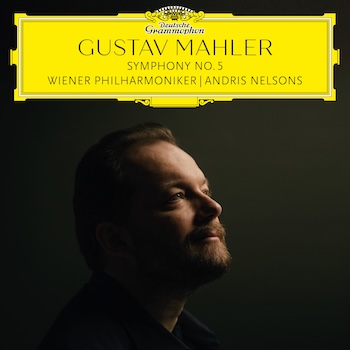
The 2020s are shaping up to be quite the decade for Mahler cycles: Semyon Bychkov and the Czech Philharmonic Orchestra just finished one, Paavo Järvi and the Tonhalle-Orchester Zürich are a third of the way into theirs, and Sir Simon Rattle and the Bavarian Radio Symphony Orchestra are gradually working their way through the set, too. Now Andris Nelsons and the Vienna Philharmonic Orchestra are offering their own traversal.
Nelsons and the Viennese have been doing a lot together in recent months. When the conductor was terminated as music director of the Boston Symphony Orchestra in March, in fact, the news broke as he was leading the Philharmonic on an extended American tour. A few weeks later, the ensemble named him an honorary member.
The last is a pretty big deal: Leonard Bernstein and Pierre Boulez count among the elect. Interestingly, both of those maestros also recorded Mahler’s Symphony No. 5 with the VPO (Herbert von Karajan, a Philharmonic Honorary Conductor, taped that work with the Berliner Philharmoniker). Given all the attention surrounding Nelsons of late, it would be nice to say that his take on this turn-of-the-century chestnut ranks next to either of theirs.
Unfortunately, it doesn’t. Instead, this is a Mahler Fifth that is almost defiantly turgid and dull.
The opening funeral march, for instance, is one long snooze, lacking turbulence and urgency. Forward momentum is absent, too, since Nelsons’s habit of stretching out his lugubrious phrases undercuts any tendency the music might have to go somewhere. Even when the orchestra kicks up a din in the “Plötzlich schneller” section (one that, in this recording, seems to omit the upbeat into it), their playing sounds leaden and earthbound.
Nor is there much sense of vehemence or fury on display in the second movement. In place of what Mahler’s indications suggest should be going on, the stormy sections are sluggish and tepid, the “Bedeutend langsamer’s” lyricism sounds more like a romance than a lament, and the anticipatory reveal of the finale’s chorale is laggard instead of cathartic.
Welcomely, the Scherzo’s refrains (which, ironically, Mahler marked “nicht zu schnell”—not too fast) come out with something approaching liveliness. But whatever gets worked up in those parts tends to unwind completely during the more intimate spots that come between. Suffice it to say, maintaining a consistency of intensity between loud and soft passages (as well as fast and slow ones) is not a strength of this interpretation.
The last two movements are cut from similar cloth: the Adagietto is slow and lacks heat while the finale drags and wants for abandon. Whatever the shortcomings of Boulez’s more clinical approach to this music, at least his rendition of the rondo possessed a measure or two of spirit. So, for that matter, did Ozawa’s more obscure take with the BSO. With Nelsons, not so much.
If there’s a bright spot to this effort, it is the Philharmonic’s tonal blend in the Scherzo and the finale. Even if the orchestra isn’t entirely convincing in those sections’ explosive climaxes, the plushness of their sound is becoming.
That said, Nelsons’ approach to this score is mystifyingly tedious. Certainly, there’s room for flexibility in Mahler—just listen to Barbirolli, Klemperer, Walter, Tilson Thomas, Abbado, or…well, just pick your conductor.
But the problem here isn’t solely about tempo (though, incredibly, the current release clocks in at four minutes over Bernstein’s spacious 1987 recording with the Philharmonic). Instead, the issue seems more elemental. “Es ist Mahler dass fehlt!” the older conductor grumbled at the VPO in an early-‘70s rehearsal of this very score when they weren’t bringing the right degree of style to the music: “It’s Mahler that’s missing!”
It’s hard not to come to the same conclusion about this recording.
Jonathan Blumhofer is a composer and violist who has been active in the greater Boston area since 2004. His music has received numerous awards and been performed by various ensembles, including the American Composers Orchestra, Kiev Philharmonic, Camerata Chicago, Xanthos Ensemble, and Juventas New Music Group. Since receiving his doctorate from Boston University in 2010, Jon has taught at Clark University, Worcester Polytechnic Institute, and online for the University of Phoenix, in addition to writing music criticism for the Worcester Telegram & Gazette.