Film Review: “Mare’s Nest” — Don DeLillo Gets Played
By Peter Keough
This ambitious adaptation finds its power in images, not in the novelist’s dense and elusive language.
Mare’s Nest. Directed by Ben Rivers, adapted from Don DeLillo’s play The Word for Snow. At the Brattle Theatre, June 26 through July 2.
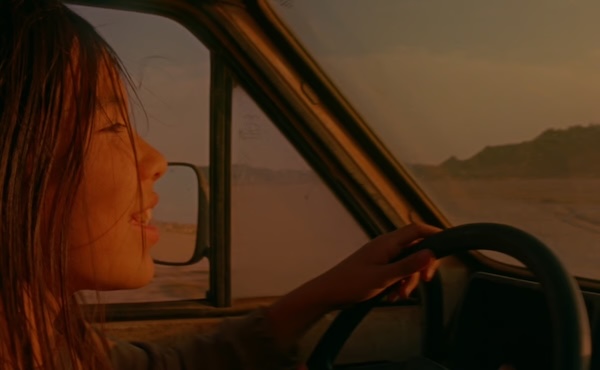
A scene from Mare’s Nest. Photo: Ben Rivers
Don DeLillo, one of our greatest living novelists, has not fared well on the big screen. Neither David Cronenberg’s Cosmopolis (2012) nor Noah Baumbach’s White Noise (2022) served either the author or the filmmakers very well. Adaptations of Underworld (1997) and The Silence (2020) were announced in 2021 and have not been heard of since. So why not try one of his rare plays?
DeLillo’s one-acter The Word for Snow (2007) paralleled the breakdown of the environment with the breakdown of language. Critics felt it didn’t do justice to either theme. But this adaptation by Ben Rivers, who is a painter as well as a filmmaker, brings a vivid visual sense to a stage-bound production, though it fails to do justice to the author’s dense linguistic preoccupations.
It opens with a close-up of its most appealing character: a turtle, perhaps an allusion to the giant one carrying the world in Hindu cosmology or, for Terry Pratchett fans, in Discworld. Be that as it may, the creature has been spared death by Moon (Moon Guo Barker), a young girl who has crashed the car she has inexplicably been driving to avoid hitting it. The price the turtle must pay for this mercy is to listen to Moon blandly recite a fanciful explanation of why the creature has ended up in the middle of the road, a tale that begins with the spawning of the universe’s first “molecule.”
Moon, called The Pilgrim in DeLillo’s original, wanders what appears to be a post-cataclysmic world in which only children have survived, a landscape of ruins and deserts which Rivers evokes with exquisitely shot locations in Spain’s Minorca and Monegros Desert and in the Snowdonia National Park in Wales.
Unfortunately, her wanderings take her to a studio setting of a mountaintop retreat where she sits before a fire with a “professor of eschatology” and a “translator,” also played by two young girls, who parrot DeLillo’s locutions about the meaninglessness of meaning and the hopelessness of the world situation. I don’t know how this played on stage, but banal profundities like “Time is a lie” or “She spits out theology with little bits of scream between her teeth” or “The word for snow will be the snow” are not improved when recited by apparently non-comprehending nine-year-olds.
And on and on for twenty minutes or so. But the film bounces back a bit in the segment “EARTH NEEDS MORE MAGICIANS – MOON JOINS SOME LOCAL RITUALS” (the titles are written in chalk on a blackboard – a self-consciously cute touch) where Rivers demonstrates his erratic shifting from the sublime to the sophomoric. In it Moon follows a child to her neolithic-looking community in the mountains where a stunning shot taken from inside a cave shows a loose procession of ragged children and a desultory mule in idyllic dusk light. A Lord of the Flies-like dance around a campfire follows and then all assemble in a granite amphitheater in front of a makeshift movie screen where, backed by a kid playing a drum kit (lots of percussion in this movie), a film with self-referential flaring and leaders is being shown.
A Minotaur (actually a kid in a crude bull’s head) appears on screen and is baited by the kids until one is gored to death (the violence happens offscreen). Bad luck for the bull, who’s led off to Minorca’s Lithica Labyrinth, one of Rivers’s inspired location choices. Though its images are striking, this segment plays like a combination of the early Star Trek episode “Miri” (1966) and Pasolini’s Medea (1969-70) and Oedipus Rex (1967).
The film’s strongest chapter “GOLDEN CITIES – MOON WANDERS INTO THE PAST AND IS NOT IMPRESSED” is shot in black and white and opens with a surreal landscape hosting eerie cylindrical monoliths. Moon enters a Morlock-like shelter of sorts and investigates it by torchlight. There she finds perfectly preserved corpses, the film’s only adults, frozen Pompeii-like at the moment of death after some unknown catastrophe, and caught in the final acts of love, despair, and violence. Though wordless, the sequence is far more eloquent than any words can convey. Had Rivers sustained this vision throughout, this would have been a great film; as it is, it remains the best screen adaptation of a DeLillo work to date.
Peter Keough writes about film and other topics and has contributed to numerous publications. He was the film editor of the Boston Phoenix from 1989 to its demise in 2013 and has edited three books on film, including Kathryn Bigelow: Interviews (University Press of Mississippi, 2013) and For Kids of All Ages: The National Society of Film Critics on Children’s Movies (Rowman & Littlefield, 2019).