
Classical Album Review: “Guitar America 250 — Revolutionaries and Rockstars”
By Jonathan Blumhofer
Guitarist Aaron Larget-Caplan’s ambitious survey reframes the American story through guitar, poetry, and protest.
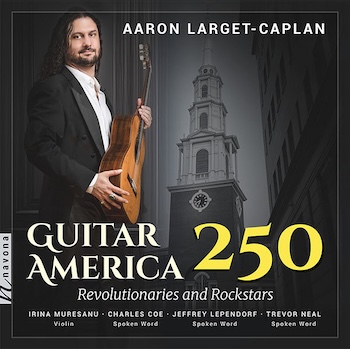
Though it may sometimes seem otherwise, nobody’s got a monopoly on the American story—in part because there is no single tale to be told.
For proof of this, look no further than Aaron Larget-Caplan’s Guitar America 250: Revolutionaries and Rockstars. Bringing together 200+ years of song, verse, and musical experimentation, the album marks the nation’s semiquincentennial through, on the one hand, a warm dose of traditional patriotism. On the other, it embraces, sometimes with admirable subtlety, the United States’ heritage of dissent and protest. Along the way, it makes room for several unfamiliar voices (as well as some more familiar names) to speak, sometimes literally.
The latter emerge in the form of poetry interspersed between musical numbers. Those include Frances Ellen Watkins Harper’s “Songs for the People” and Walt Whitman’s “Proud Music of the Storm,” timely, aspirational texts read, respectively, by Trevor Neal and Charles Coe. An excerpt from John Cage’s “Mureau” (recited by Jeffrey Lependorf) meditates on the natural world, while Larget-Caplan’s reconfiguration of the Bill of Rights underlines some of the contradictions at the heart of the American experiment.
Far from disrupting the flow of the larger project, these spoken insertions tend to reinforce (and are reinforced by) the music surrounding them, most of which has been arranged by Larget-Caplan. “Songs for the People,” for instance, is framed by a pair of anthems—“The Star-Spangled Banner” and “Lift Every Voice and Sing”—and “America the Beautiful.” “Proud Music of the Storm” falls between Irving Berlin’s “God Bless America” and Paul Simon’s “America.” The Cage text is sandwiched between excerpts from the composer’s Apartment House 1776.
That much of the music is reflective in tone makes for a welcome corrective to the bombast and sentimentality that often accompanies July 4th celebrations. “God Bless America,” with its tremolo figurations, comes out particularly well. So—surprisingly enough—does the National Anthem. At the other end of the spectrum, Joseph Brackett’s “Simple Gifts” is unexpectedly robust and dance-like.
Larget-Caplan’s repertoire also mines some less expected terrain. You’d perhaps expect “The Battle Hymn of the Republic” or “America” (from West Side Story) to make appearances, and they do. But there’s also a rendition of George F. Root’s Civil War classic, “The Battle Cry of Freedom,” as well as a peppy arrangement of George M. Cohan’s “Over There.” Alan Hovhaness’s coyly limber Mystic Flute makes for an apt lead-in to Eddie Van Halen’s sweet, swaying 316.
A pair of works written for the guitarist—David Liptak’s Freight (after Elizabeth Cotton) and Ian Wiese’s Midnight Train—provide, respectively, some refreshing plays of dissonance and moments of hypnotic pause (the latter is, improbably, an homage to the Red Line’s Braintree jag). Meantime, Larget-Caplan and violinist Irina Muresanu deliver a beautiful account of Florence Price’s Adoration.
In all of his arrangements, Larget-Caplan’s command of both his instrument’s capabilities and his materials is first-rate. Nothing borders on predictable or cliché; harmonic turns and percussive effects in “The Battle Hymn of the Republic” are particularly ear-catching.
But nothing quite tops the guitarist’s reworkings of Cage’s bicentennial homage, whose adaptations of music by William Billings and James Lyon are radiant and haunting. Better than anything else here, these two tracks—“Judea” and “O Give Thanks”—call to mind the fragility of the American democratic experiment while also emphasizing its underlying resilience and endurance.
Jonathan Blumhofer is a composer and violist who has been active in the greater Boston area since 2004. His music has received numerous awards and been performed by various ensembles, including the American Composers Orchestra, Kiev Philharmonic, Camerata Chicago, Xanthos Ensemble, and Juventas New Music Group. Since receiving his doctorate from Boston University in 2010, Jon has taught at Clark University, Worcester Polytechnic Institute, and online for the University of Phoenix, in addition to writing music criticism for the Worcester Telegram & Gazette.
Tagged: "Guitar America 250: Revolutionaries and Rockstars"
1 Comment
Leave a Comment
A very thoughtful review.
And as someone who has listened to this wonderful album many times, I couldn’t agree more.