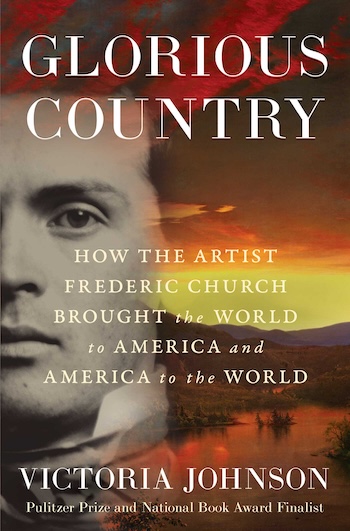
Book Review: Frederic Edwin Church, America’s Master of Grandeur
By Peter Walsh
Victoria Johnson’s lively biography celebrates Frederic Church’s ambition, while overlooking some of the broader shifts that dimmed his legacy.
Glorious Country: How the Artist Frederic Church Brought the World to America and America to the World by Victoria Johnson. Scribner, 448 pages, $35.
In the summer of 1966, when I was fifteen, I came across a lavishly illustrated, unsigned article in a recent issue of LIFE magazine. It has haunted me ever since. “Must this mansion be destroyed?” read the headline.
The mansion in question had been built by an artist I had never heard of: Frederic Edwin Church. It was, LIFE said, “a century-old refuge of art and splendor” now in mortal peril.
After he died in 1900, Church’s heirs had kept the house, a Persian fantasy perched high over magnificent Hudson River Valley views, and its equally exotic contents, very nearly as Church had left them. But those heirs had died and the new heir planned to auction off everything inside and subdivide the extensive and carefully landscaped acreage.
A small preservation group led by a Church scholar, determined to save the estate as it was, had raised money to buy it intact. But their option expired in just a few weeks and they had less than half the funds they needed. “Only quick action by Americans can save the exotic home of the celebrated 19th Century landscapist F.E.Church,” the article read. It was presented as a final, desperate appeal.
Years passed before I learned the dramatic resolution of this cliffhanger, decades went by before I visited the place in person. In the meantime, Church’s long-lost fame had been largely restored.
In her new biography of Church, who was born in Hartford, Connecticut two centuries ago this year, Victoria Johnson, professor of urban policy and planning at Hunter College, describes Olana as “the apotheosis of Church’s creative genius.” The word “genius” reverberates throughout her text; she can hardly praise Church’s talent and accomplishments enough. Her briskly written, sometimes breathless narrative keeps the reader entertained and engaged, though at times her enthusiasm for her subject threatens to overwhelm her scholarly distance and objectivity.
The book, however, has none of the standard romantic clichés of the typical artist biography. Church is not a tortured, impoverished soul in a garret, his talent unrecognized until after his death. There are, in Johnson’s account, no tempestuous love affairs, no string of abandoned wives and mistresses, no despairing spouse or disapproving family, no neglected and alienated children, no bitter, obsessive feud with a fellow artist, no alcohol-soaked binges leading to near-fatal brawls, no self-doubt, no self-destructive behavior, no suicide.
Instead, Church appears almost as a flawless paragon, the reverse of the mad, destructive genius so beloved by romantics. On these pages he remains unfailingly charming, supremely self confident, hard-working, persistent, adventurous, fearless, athletic, and even-tempered. Johnson portrays a loyal friend and companion, happily married to a beautiful and supportive wife from an affluent family, who bore him six children. Deeply religious, he held daily Bible readings in his home with his many distinguished guests.
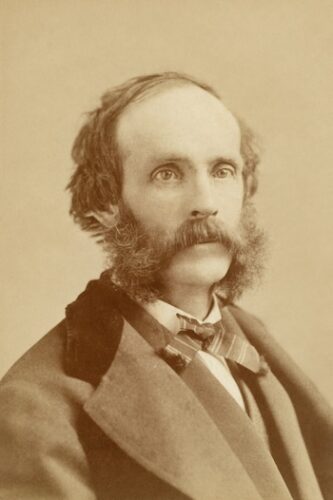
Frederic Edwin Church in 1868. Photo Napoleon Sarony
Famous and successful when barely out of his teens, Church was soon able to command astronomical sums for his paintings, compile a considerable fortune from his work and inheritance, and was considered such a model of civic duty, competence, and incorruptible virtue that his distant cousin Frederick Law Olmsted asked him to join four other commissioners charged with overseeing New York’s parks and squares. Church also became part of a group of millionaires and leaders of New York institutions that planned the creation of the Metropolitan Museum of Art. He later became one of the museum’s first trustees and donated several of his collections to it.
Johnson’s narrative opens with the arrival of the eighteen-year-old Church at the Hudson Valley home and studio of Thomas Cole, widely recognized as the “father” of the Hudson River School. The young artist was beginning a critical apprenticeship with Cole, arranged with the help of family friend and important Hartford collector, Daniel Wadsworth, a step that made his career. The before-Cole life—Church’s childhood and early teen years in Hartford—is given only two scant pages in a 426-page volume. Much of that consists of legends— standard tales of precocious, youthful genius.
Johnson quickly dismisses Joseph, Frederic’s father, a wealthy Hartford businessman descended from one of Connecticut’s oldest families, as “straight-laced.” Both parents play only minor, walk-on parts in Church’s story. When Joseph dies at 82, Johnson cites his local obituary, which says he “had spent his whole life working, investing, and making money.”
The senior Church had wanted his only surviving son to go to college and join him in business. But, in the end, he didn’t stand in the way of Frederic’s chosen career. It was Joseph who paid for art lessons in Hartford and covered the fees for the Cole apprenticeship. Presumably, he is also a source of Church’s deep Christian piety and upright character.
Johnson spends less time on Church’s hometown of Hartford than she does in describing battles of the Civil War, which forms a backdrop to her chapters on his early career in New York. Church, who neither volunteered nor was drafted, had no direct connection to the conflict, though he alludes to it in his paintings. This despite the fact that, as Johnson’s brief references make clear, Hartford was one of the three main geographic touchpoints of the artist’s life (the other two were New York City and the Hudson Valley), places he returned to decade after decade. Hartford was the source of both life-long friendships and important patronage, including Daniel Wadsworth and Elizabeth Jarvis Colt, one of the country’s wealthiest women thanks to her late husband’s thriving arms business. During the time span of this biography, Hartford became the richest city in the United States and one of the most culturally sophisticated. It opened a public art museum, the Wadsworth Atheneum, almost thirty years before New York. But the city plays almost no visible role in this book.
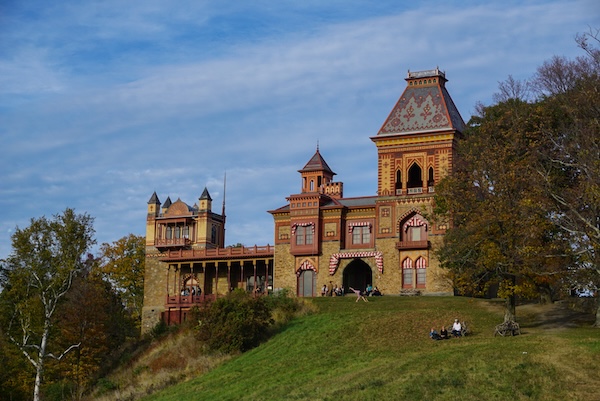
Olana, the 250-acre home, studio, and designed landscape of Frederic Edwin Church. Photo: Wikimedia
“Frederic left childhood behind the day he set out from the gentle Connecticut River Valley for a village at the edge of the American wilderness,” Johnson writes. She implies that Cole, as Church’s most important teacher, was his true spiritual father. Even after his mentor’s early death two years later, Church remained close to Cole’s family, as close, Johnson suggests, as to his own. Church chose to settle permanently nearby the Coles when he bought the working farm that grew into Olana.
Without the usual artist psychodrama to frame her story, Johnson instead describes Church’s many extraordinary adventures. The artist appears in her book as a kind of Victorian Indiana Jones, in search of spectacular views instead of the Lost Ark. After long hikes through Hudson River School wilderness in New England and upstate New York looking for subjects, he turns to truly dangerous sketching expeditions, often with male friends, to increasingly inaccessible locations.
Johnson describes Church’s perilous treks along Andean mountain pathways too narrow for mules, through dense jungles infested with disease, up the sides of active volcanoes, across rivers and wilderness with no help of rescue if he missed a step or fell ill. Out in the wild, Church often followed in the footsteps of his explorer hero, the naturalist Alexander von Humboldt, a generation before.
After exploring northern New England and South America, Church sailed north to the ice flows off Newfoundland, where he recorded glittering, towering icebergs in an unforgiving sea. He dodged heavily armed Bedouin tribesmen to reach the fabled rock-cut monuments in the remote desert city of Petra, visited Alexandria, Jerusalem, Damascus, Beirut, Baalbek, and Athens, Rome, Paris, and London all with his wife, mother-in-law, and one-year-old son in tow. Despite the obvious hazards, he forged on fearless and determined, with hardly a scratch to show for all the danger he faced.
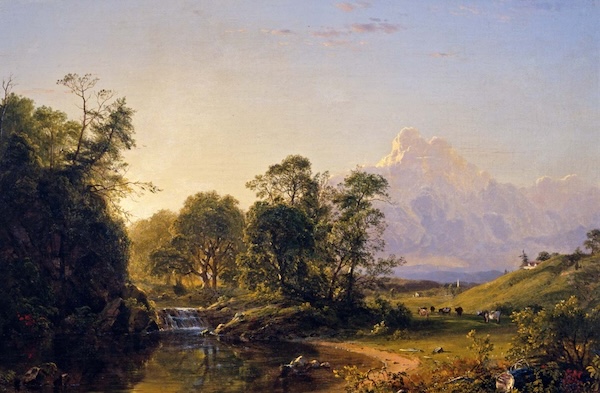
Frederic Edwin Church, Otter Creek, Middlebury, Vermont, 1854. Photo: Middlebury College Museum of Art
Making ample use of his copious correspondence, notes, annotated sketches, and plein air oil studies, Johnson describes not only his journeys but Church’s working methods, almost stroke by stroke, as if she were looking over his shoulder. Throughout, she supplies a vividly dramatic recreation of Church in the field, in hot pursuit of the sublime.
Peaceful, silent, and almost uninhabited, the classic Hudson River School painting surveys a sacred, Edenic landscape, endowed with the symbols and moral values of the early American republic, as if the Fall had never occurred or as if Noah and his menagerie had never left the Ark. It is no coincidence that the rise of the Hudson River School coincided with a rebranding of the frontier—from a blank space on the map to a refuge for those seeking, however briefly, escape from the smells, noise, congestion, and polluted air of rapidly expanding American cities. Fashionable hotels and country villas, such as Olana, were perched on mountain slopes and summits to capture fresh air and unspoiled views. Hudson River School paintings, in turn, made it possible to carry that experience back to urban interiors, as if the large canvases hung in drawing rooms opened directly onto the hills of New Hampshire, the mountains of Maine, or Niagara Falls.
Church expanded this formula by introducing the melodramatically exotic. Vast, meticulously painted canvases like The Heart of the Andes or The North transported viewers to places they had never seen: the steaming jungles of Honduras or the penetrating cold and terrifying grandeur of sub-Arctic ice flows. The sheer scale of his work helped envelop viewers in what they beheld; one critic, encountering a tropical scene, claimed he could almost feel the steamy heat rising from it.
To help sell his work, Church developed a branding strategy that feels strikingly 21st-century. As he prepared, in his Manhattan studio, for expeditions into remote landscapes, reports of his plans began to circulate in the New York papers. After months in distant and unfamiliar terrain, he would return to the city amid considerable fanfare. While he gradually assembled his studies and field notes into a carefully composed monumental canvas, tourists, art students, fellow artists, newspapermen, collectors, and the merely curious flocked to his studio to watch him at work—at a time when studios functioned as much like public marketplaces as they did private workspaces. Though Church disliked the distraction, the steady stream of visitors helped generate anticipation for the impending masterpiece.
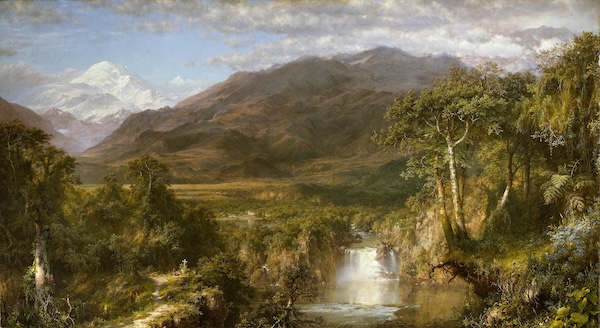
Frederic Edwin Church, Heart of the Andes, 1859. Photo: Wikimedia
When a new painting was finished, it would go on view at a local venue—often the Broadway branch of the major Parisian dealership and publishing house Goupil & Cie. Crowds gathered, and glowing reviews appeared in the New York press. The work would then travel to other cities, sometimes even to Europe (where Queen Victoria became an admirer). An engraved reproduction followed, widely distributed. Meanwhile, Church negotiated the sale of the now-famous original to a wealthy collector for a princely sum, after which it would hang prominently in a private home. Then the cycle began again.
Church’s career in the still-raw, rambunctious, and unfinished New York art world often seems almost charmed, as if by Hudson Valley fairies. He achieved both commercial and critical success almost from the moment he arrived in the city. Johnson quotes more critics proclaiming him “America’s greatest artist” than I would have guessed were active in mid-19th-century New York. The golden glow surrounding him endured well into middle age.
He and his wife were devastated by the deaths of their first two children—a toddler son and an infant daughter—from diphtheria. Yet, as Johnson recounts, they recovered sufficiently to build a full life again, raising four more children on the estate and working farm they would later name Olana, after Strabo’s account of a Persian fortress set on a hill overlooking a river.
Johnson treats the First Impressionist Exhibition in Paris as a sign of changing times, but devotes little more space to this new mode of painting than to Church’s childhood. She largely sidesteps the sweeping shifts in taste that, for generations, eclipsed not only the Hudson River School but American art more broadly.
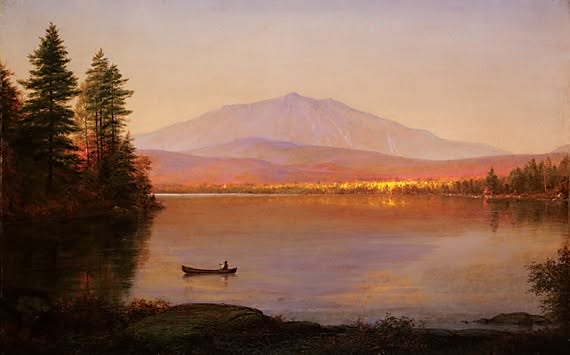
Frederic Edwin Church, Mount Katahdin from Millinocket Camp, 1895. Photo: Wikimedia
Early in the 19th century, wealthy American collectors were attracted to patriotic themes that reflected their homespun values and collected art that expressed them. They thought the works of the great European masters, which they saw in European museums and aristocratic collections, would never be available to them at any price. But, by the time the Gilded Age rolled around, some Americans with a taste for European art had grown so fantastically wealthy—and many European aristocrats had such a need for quick cash—that a market opened up. Agents like Joseph Duveen and Bernard Berenson helped make the necessary connections.
Before long the cream of European art was crossing the Atlantic to the new, Beaux Arts mansions of collectors like Henry Clay Frick, J.P. Morgan, Andrew Mellon, Andrew Carnegie, Samuel Kress, and Isabella Stuart Gardner. Even the grandest works by Church and his sometime rival, German-American Albert Bierstadt, once eagerly acquired for fantastic sums by an earlier generation of collectors, couldn’t compete with Rembrandts and Raphaels in the bragging rights of high society. The dramatic landscapes of the old Hudson River School now sold at steep discounts in a transformed market. It would be generations before American artists could fetch such prices again.
Other things were changing as well. American art students, now studying in Paris rather than upstate New York, were drawn to new artistic movements and began adopting the Impressionist style. They learned to capture fleeting effects of light and atmosphere en plein air; more importantly, they learned to paint modern life.
Church and Bierstadt had created panoramas of awe-inspiring vistas in remote locations, whose inaccessibility, timelessness, and isolation were central to their appeal. The Impressionists, by contrast, painted scenes anyone could reach by regularly scheduled train: tourist sites in Paris and Normandy, city parks and nightclubs, the industrializing suburbs, fashionable idlers on the boulevards, performers in the glare of the dance hall stage, trains and stations, department store clerks and artisans enjoying themselves at raucous weekend resorts along the Seine.
Church, alas, never understood any of this. He saw the new movement, Johnson says, as “superficial”; its effects were “crude,” and it was not destined to “leave any mark on the history of art.” To me, Church’s grand, tightly controlled, and highly finished paintings continue to delight. But it is his little seen oil sketches that I find to be his most satisfying work. Brilliantly colored, brushed in the open air with energy, haste, and a sharp, quick eye for passing effects, with no time to rearrange nature in the most dramatic or pleasing way, they are also the works that come closest to the ideas coded in Impressionism.
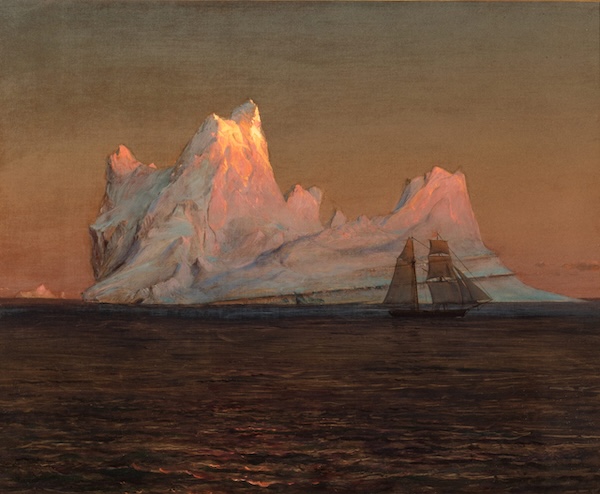
Frederic Edwin Church, The Iceberg, 1875. Photo: National Gallery of London
In his later years, as his health deteriorated, Church withdrew to Olana, where he concentrated, in particular, on the landscapes around the house, opening them up to frame spectacular views across the Hudson Valley. The large picture windows in the main house did the same, as if the whole estate could go on creating Hudson River paintings long after Church himself was gone. His market fading, Church’s last work retreated even further from the increasingly industrialized and commercialized landscapes that actually existed in the United States. His paintings included more studies of classical ruins on the edge of the eastern Mediterranean, gilded by a glowing sunset, as if forever sealed off from time and change.
Meanwhile, a new generation of American artists—Edward Hopper, Rockwell Kent, Georgia O’Keeffe, Marsden Hartley, John Marin, Charles Sheeler, Charles Birchfield—had already been born. In the new century, they embraced the contemporary American landscape as it was actually lived and understood, warts and all.
All great art movements have a habit of coming around again. Church and all his artistic world had almost been forgotten before Olana reached LIFE magazine. But by the time Nelson Rockefeller, then governor of New York State, arrived by helicopter at the estate to announce its designation as a state historic site, the efforts of wide range of talented, powerful cultural celebrities, from Lincoln Kirstein to Philip Johnson to Jacqueline Kennedy, had revived interest not only in Olana but in Church himself. This new biography is just one part of the aftermath.
Peter Walsh has worked as a staff member or consultant to such museums as the Harvard Art Museums, the Museum of Fine Arts, Boston, the Davis Museum at Wellesley College, The Metropolitan Museum of Art, the National Gallery of Art, and the Boston Athenaeum. He has published in American and European newspapers, journals, and in scholarly anthologies and has lectured at MIT, in New York, Milan, London, Los Angeles, and many other venues. In recent years, he began a career as an actor and has since worked on more than 100 projects, including theater, national television, and award-winning films. He is completing a novel set in the 1960s.