
Television Review: “Song of the Samurai” — A Lush, Kinetic Take on Japan’s Shinsengumi
By Sarah Osman
HBO’s adaptation blends historical grit with balletic fight choreography, elevating the live-action anime genre.
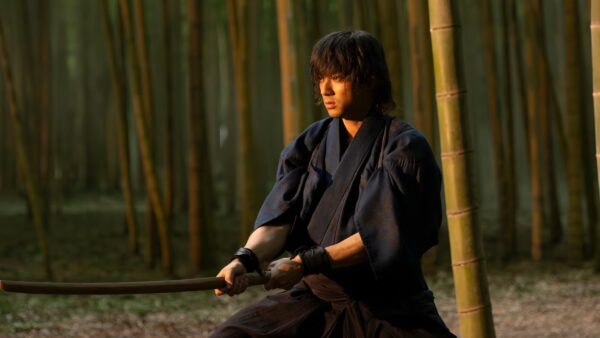
A scene from Song of the Samurai. Photo: HBO
Let’s be honest: there haven’t been that many great live-action adaptations of manga or anime. That all changed when Netflix dropped its live-action take on One Piece, a beloved long-running anime. Now, another series (on HBO) has joined One Piece’s ranks: Song of the Samurai.
Based on Shinya Umemura and Eiji Hashimoto’s manga series Chiruran: Shinsengumi Requiem, which received a brief anime adaptation in 2017, Song of the Samurai revolves around the Shinsengumi, a special police force formed in late 19th-century Japan. Tonally, Song of the Samurai is very different from the quirky One Piece, primarily because the series is based on real historical events. Despite its real-life roots, Song of the Samurai still provides some fun moments, thanks to its tight-knit clan of complex characters.
The live-action series follows Hijikata Toshizo (Yamada Yuki), a historical figure who was a member of the Shinsengumi. When we first meet Toshizo, he’s a smart-ass street peddler who bursts into random dojos and commences fighting with the school’s leading teacher. By winning the wagers, he garners some much-needed moolah and boosts his strength. One day, he clashes at the Shieikan Dojo, where he finally meets his match. Toshizo decides that he will stick around Kondo Isami (Nobuyuki Suzuki) and his ragtag team of students.
Meanwhile, war is brewing. The group is invited to the Kobusho military academy for training. Brutality, tests of loyalty, and mayhem are sure to ensue (I only received the screener for the first episode, but this is the territory into which the series will most likely go).
I immediately noticed Song of the Samurai’s visual beauty. Its cinematography is on par with most Oscar-nominated films. Sweeping shots of Kyoto are intermixed with stunning fight sequences. I loved the juxtaposition of fresh cherry blossoms as a background for samurai sword fights. Unlike a lot of recent action fare, Song of the Samurai doesn’t suffer from dull lighting; the actors are strikingly illuminated during their fight scenes.
As a dancer, I tend to pay close attention to choreography, and the complex fight scenes in Song of the Samurai blew me away. Each one feels like a lush ballet rather than a cheesy kung-fu clash, which is what Song of the Samurai could have served up — in the wrong hands.
I am not very familiar with anime archetypes, so I can’t talk about how closely the characters in Song of the Samurai fall into these categories or reflect various manga personas. I was drawn to these characters. Each member of the Shieikan Dojo has a distinctive personality. There is nothing cartoonish about these figures; the protagonists may be introduced with one-offs like, “he was gentle but deadly with a sword,” but we see that they’re so much more than that. Toshizo could come across as just an obnoxious hothead, but Yuki infuses him with good-natured humor and a willingness to learn. The students yearn to be wealthy and renowned, yet they gather together for family dinners. Amongst themselves they tease and fight, but they have each other’s backs. Unlike corporations that claim to feel “like family,” these guys have really bonded.
Towards the middle of the episode, we learn that a hothead student has killed a samurai-in-training — but not for the reason you are initially led to think. This subplot is heart-wrenching, underlining that this world is far more complicated than you might think.
One concern about Song of the Samurai: its lack of female characters. Granted, the series wants to be historically accurate, so the absence of female samurai makes sense. But the omission is glaring; maybe a woman samurai will show up later on.
If anime and manga are going to be given live-action adaptations, Song of the Samurai shows how it can be done successfully. This is a sweeping epic that examines a fascinating part of Japanese history and takes the time to delve into the psyches of its characters. Let’s have more songs from these samurai, please.
Sarah Mina Osman is based in Los Angeles. In addition to The Arts Fuse, her writing can be found in The Huffington Post, Success Magazine, Matador Network, HelloGiggles, Business Insider, and WatchMojo. She has an MFA in Creative Writing from the University of North Carolina Wilmington and is working on her first novel. She has a deep appreciation for sloths and tacos. You can keep up with her on Instagram @SarahMinaOsman and at Bluesky @sarahminaosman.bsky.social.