
Theater Reviews: Two Shows on Broadway Attempt to Capture the Dark — “The Lost Boys” and “The Rocky Horror Show”
By Christopher Caggiano
Two beloved cult properties arrive on Broadway with formidable casts and decades of devotion behind them — but conjuring darkness turns out to be harder than it looks.
Broadway has never been especially hospitable to creatures of the night. The Rocky Horror Show bombed in its original 1975 Broadway outing, closing after 45 performances before finding immortality as a midnight movie ritual. Vampire musicals have fared no better on Broadway, representing a parade of elaborately mounted productions that opened and closed before the blood dried.
This spring, both are back for another attempt. A starry Roundabout revival of The Rocky Horror Show has arrived at Studio 54, and The Lost Boys — the beloved 1987 vampire film — has taken up residence at the Palace Theatre. Both came with enormous expectations, impressive casts, and the weight of decades of cult devotion. And both discover that the monsters are the least of their problems.
The two shows fall short in different ways. Rocky Horror is trapped by its own legend: the success of the movie was more about the culture that grew around it than the material itself. The Lost Boys has a different problem: the first act is satisfyingly creepy and seems to be building toward something explosive, but then the second act dissolves into silliness and limps to a flat, anticlimactic finish.
The Lost Boys
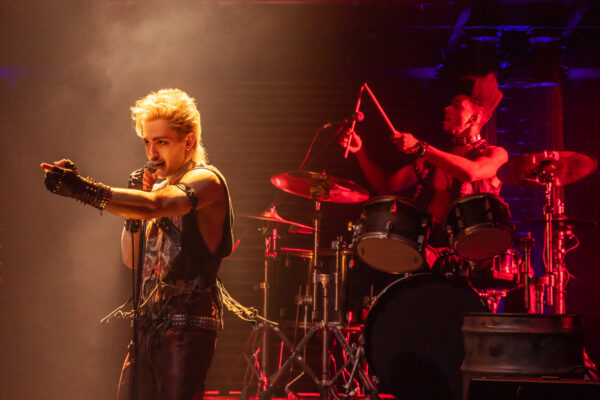
Ali Louis Bourzgui and Dean Maupin in The Lost Boys at the Palace Theatre. Photo: Matthew Murphy
When The Lost Boys was announced for Broadway, theater circles buzzed about the supposed curse of the vampire musical. The evidence: Lestat, which stank up the very Palace Theatre where Lost Boys now plays; Dracula, the Frank Wildhorn debacle (but then, “Frank Wildhorn debacle” is redundant); and Dance of the Vampires, the hilariously catastrophic flop that somehow convinced Michael Crawford to make a fool of himself in a cape.
Yeah, well, curse schmurse. Curses don’t close shows: terrible writing does. Lestat, Dracula, and Dance of the Vampires didn’t fail because there’s a supernatural hex on the genre. They failed because they sucked, pun intended. All The Lost Boys needed to do to break the “curse” was not suck. Good news: it doesn’t. The not-so-good news is that it takes a lot more than not sucking to become top-drawer musical theater.
The book is by David Hornsby and Chris Hoch, both veteran actors making their Broadway librettist debuts. Hoch, notably, appeared in Wildhorn’s Dracula, which gives him a personal stake, as it were, in breaking the curse. The show is not without a touch of self-awareness: at one point, a character observes that “turning a movie into a musical reeks of desperation.”
The line garners a laugh, but it also sets a bar the show only partially clears. The main problem is inconsistent tone. Act 1 tracks young Michael’s restless drift from his family into the orbit of the local vampire den, culminating in his induction. The first half is tense and foreboding in ways that seem to be promising a full-scale battle royale. Unfortunately, Act 2 abandons the menace almost entirely, surrendering the story to Michael’s geeky brother Sam and some genuinely irritating local teens who are self-appointed vampire hunters. The story collapses into comic ridiculousness and the momentum never recovers.
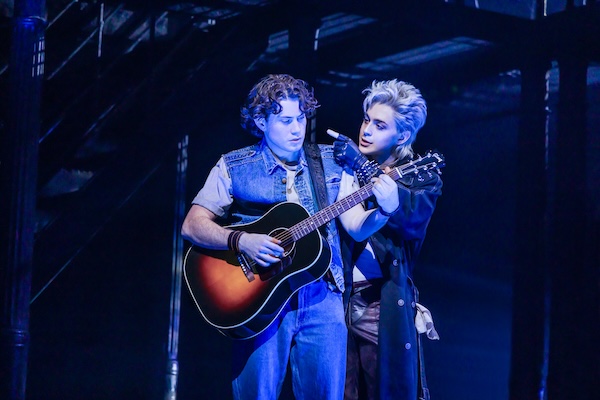
LJ Benet and Ali Louis Bourzgui in The Lost Boys at the Palace Theatre. Photo: Matthew Murphy
The score is by The Rescues, a Los Angeles indie pop/rock band with no prior Broadway credits. They may be Broadway newcomers, but they seem to have done the homework. Most of the songs are refreshingly contextual: the lyrics actually advance the story and deepen character, which is rare for Broadway dilettantes.
Michael’s first number demonstrates the instinct immediately: “Lose Myself” starts as a generic “I Want” song for Michael but expands into a full musical sequence tracking his dissatisfaction and the desire to find something new and dangerous. It’s not a park-and-bark power ballad, and the show is better for it. The central lovers — Michael and local demi-vampire Star — have some pretty effective duets, and there is a standout group a cappella moment that briefly suggests what the show might have been throughout.
The cast is led by the always reliable Shoshana Bean, who delivers yet another powerhouse performance, strong and deeply moving as Michael and Sam’s mother. Ali Louis Bourzgui is genuinely menacing as the vampire leader. Less successful is LJ Benet as Michael: overly mopey and sour-faced in ways that work against the show’s ability to generate either sympathy or stakes.
The production is visually spectacular. Scenic designer Dane Laffrey makes full use of the enormous Palace Theatre, building a world of platforms and levels that cables and hydraulics bring thrillingly to life, with set pieces flying in from above and platforms rising from beneath the stage, enabling scene-to-scene shifts of impressive efficiency. Aerial design by Gwyneth Larsen and Billy Mulholland gives the flying sequences a genuine charge, though there was one moment when the support cables became glaringly visible. It’s an easily avoidable lapse in an otherwise polished physical production.
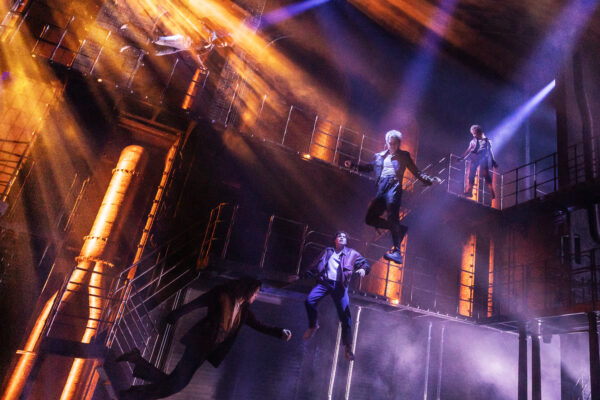
LJ Benet, Ali Louis Bourzgui, Brian Flores, Dean Maupin, and Sean Grandillo in flight in The Lost Boys at the Palace Theatre. Photo: Matthew Murphy
Director Michael Arden allows for some questionable silliness on the stage, particularly regarding costumes. Jokey vampire attire on the supporting cast during “My Brother Is a—”, and superheroes-in-capes for Sam’s Act 2 number (“Superpower”), are among the tacky touches that puncture the ominous atmosphere the show works so hard to establish. After Once on This Island, Parade, and Maybe Happy Ending, it appeared as if Arden could do no wrong. But after the disastrous Queen of Versailles earlier this season and now The Lost Boys, we are learning the limits of Arden’s abilities.
After an Act 1 that seems to be building toward a grand conflagration, the show’s climax lands with a thud. Despite the physical space and the fly infrastructure at the ready for staging a full-scale confrontation, the denouement is resolutely earthbound, both literally and figuratively. The bad guys are dispatched with laughable speed and a near-total absence of drama. The show descends into maudlin sentimentality in its final number. Then after the bows, those still at their seats are treated to an unnecessary and confusing “after the credits” sequence that appears to be setting up a sequel. And if there’s a genre more cursed than vampire musicals, it may be musical sequels.
The Rocky Horror Show
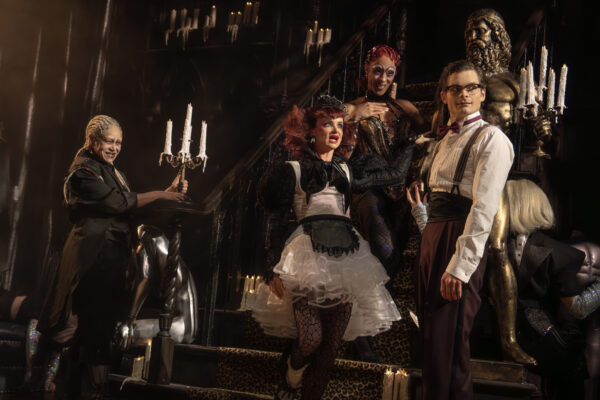
A scene from The Rocky Horror Show. Photo: Joan Marcus
Like many awkward, marginalized, queer teens in the early 1980s, I was devoted to The Rocky Horror Picture Show. (I was a regular Frankie fan, you might say.) My high school friends and I would lie to our parents about whose house we were sleeping at, then descend upon the now-defunct Exeter Street Theater in Boston’s Back Bay in full costume, sometimes even joining the shadow cast performing in front of the screen. We’d shout callbacks at the screen, competing to see who could land the snappiest line. (We didn’t throw toast or use squirt guns. That was for the virgins.) So, if anyone falls within the target audience for a Broadway revival, it’s probably me.
But here’s the dirty little not-so-secret about Rocky Horror. It’s not very good. Even at 17, I understood that Rocky Horror was more about the ritual than the content itself. Sure, it starts off with genuine energy — especially the sequence that flows from “Time Warp” all the way to “Hot Patootie” — and the freewheeling sexuality was genuinely liberating amid the pall of the Reagan years. In the current reactionary political environment, it’s at least nice to see a show embracing a broad range of sexuality.
But the story loses momentum toward the end. Like, completely. When my friends and I were at a Rocky showing, we were always packing up right after the floor show, aka “Rose Tint My World.” The appeal of Rocky was always about the community, about finding something special that seemed just for us, a place to belong. But that’s not on the screen. It’s in the audience.
So, when I learned that the producers of the current revival were actively discouraging audience partici…pation (sorry), I knew we were in for some trouble ahead. And I was right to worry. As this Broadway version amply demonstrates, Rocky Horror without the extras is just plain blah. At my performance, the only cast member who got any sass from the audience was Rachel Dratch, which she handled with aplomb, but for me it was a tantalizing reminder of what was missing from the production.
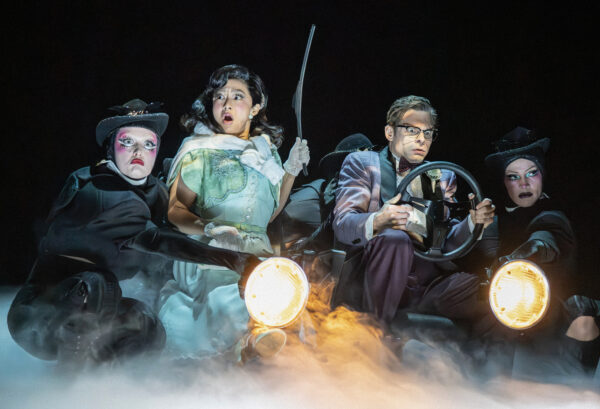
A scene from The Rocky Horror Show at Studio 54. Photo: Joan Marcus
The production is ensconced at Studio 54, whose history of ’70s decadence admittedly adds a great deal to the louche atmosphere. The quirky design by dots extends into the theater and even into the lobby. Some of this is fun, some of it is kitschy, and some of it is decidedly tacky, like the strings of green lights wrapped around the silver ducts lining the walls of the theater.
Director Sam Pinkleton, whose sharp comic instincts are all over Oh, Mary!, approaches Rocky Horror with a far blunter instrument. There doesn’t seem to be a unifying vision, other than let’s be outrageous and project everything to the back row. (Yay, back row! I promise I’ll stop…)
I must say that the talented cast for this production deserves better material. Luke Evans really can sing, and he brings a lot of his own charming personal touches to the role of Frank N. Furter. The show perked up noticeably when Evans made his entrance, and not just because his costume reveals quite a bit of his extremely attractive physique.
Josh Rivera is quite dynamic and lovable as Rocky. Harvey Guillén is terrific as Eddie, but a bit too smarmy as Dr. Scott. Stephanie Hsu is overly vulgar and unsubtle as Janet. Andrew Durand as Brad plays it a bit too straight, and winds up being upstaged by practically everyone else in the cast. The production overall gives the impression of a lot of very talented people working too hard to make a mediocre piece work as “legitimate” theater.
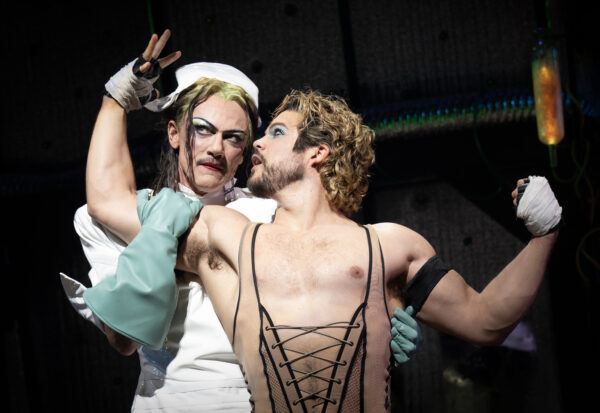
A scene from The Rocky Horror Show at Studio 54. Photo: Joan Marcus
It was also a mistake for this production to include the songs “Once in a While” and “Superheroes.” Both are dull and do little for the show. The former was filmed but cut from the movie; the latter was usually edited out for the screenings I attended. Their inclusion here feels less like artistic choice than completism.
Neither The Lost Boys nor The Rocky Horror Show is a disaster. Both are tantalizingly close to working, yet fall short in ways that feel avoidable. The Lost Boys has a first act that genuinely delivers, but it proceeds to squander all that goodwill. Rocky Horror, meanwhile, is more frustrating, because the disappointment was entirely preventable. The show has always needed the audience to complete it: the callbacks, the costumes, the collective foofaraw. That’s not a bug, it’s the whole point. A production that actively discourages that participation isn’t presenting Rocky Horror; it’s presenting a polished facsimile.
Both shows will find their audiences, and in fact already have. The Lost Boys appears to be selling quite well, and Rocky Horror just extended its limited run through November. But for those of us who remember what these properties mean to their fans, in darkened theaters and at midnight screenings, the experience of watching Broadway try to capitalize on them is more melancholy than celebratory. Some creatures are better left in the dark.
Christopher Caggiano is a freelance writer and editor living in Stamford, CT. He has written about theater for a variety of outlets, including TheaterMania.com, American Theatre, and Dramatics magazine. He also taught musical-theater history for 16 years and is working on numerous book projects based on his research.
Tagged: "The Lost Boys", Ani Taj, Broadway, Chris Hoch, David Hornsby, Josh Rivera, Luke Evans, Michael Arden, Rachel Dratch, Richard O'Brien, Sam Pinkleton, Shoshana Bean, Studio 54, The Rescues