
Film Commentary: “Cuckoo’s Nest” in the Age of Trump — Viewer Beware!
By Bob Katz
What happens when the rebel archetype outlives its ideals — and finds new, troubling champions.
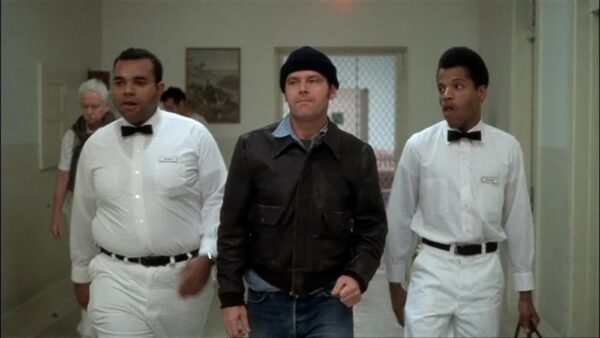
Jack Nicholson in a scene from One Flew Over the Cuckoo’s Nest. Photo: United Artists
Until recently, I’d not watched the 1975 movie One Flew Over the Cuckoo’s Nest, which, in addition to winning Oscars for best picture, director, and actors (male and female), was widely praised for capturing the anti-establishment zeitgeist of the tumultuous Vietnam-Woodstock-Watergate era.
Why had I bypassed the film? Probably because, having read the Ken Kesey novel on which it’s based, I figured I already knew its essential elements.
I knew the story was set in the insular world of a gloomy state mental hospital.
I knew the patients were docile, downtrodden shadows of the independent men they once were.
I knew the hospital was run by the domineering Nurse Ratched, a rigid, humorless control freak.
I knew that upon the arrival of the hospital’s newest patient, a cunning, free-spirited brawler named Randle McMurphy, the drama would build to a harrowing showdown.
What I could not have foreseen, and am still having trouble grasping, is how the very themes that won Cuckoo’s Nest near-mythical status as an essential expression of 1960s anti-authoritarianism — trumpeting individualism over bureaucracy, liberation over subjugation, innovation over regimentation — could be hijacked so successfully by the pro-authoritarian MAGA right that, by 2026, the script would get completely flipped.
It was as if blustery McMurphy had passed the torch, while no one was looking, to his rightful heir, Herr Trump.
And Nurse Ratched? Check your program notes. That role is now being performed by the EPA, FDA, FTC, CDC, OSHA, and more.
How’d it happen? How did the counterculture’s noisy rejection of The Establishment get repurposed as deregulation for dummies? How did Tune In, Turn On, Drop Out give way to Drill Baby Drill?
Revisiting Cuckoo’s Nest may shed some light.
Ever since its original release, Cuckoo’s Nest has been enthusiastically touted as a trenchant parable of its era. “It’s a film about rebellion,” gushed Empire Magazine in reviewing the 50th-anniversary remastered version, “made amid one of the most rebellious periods in Hollywood history.”
“McMurphy succeeds,” proclaimed critic Roger Ebert in a 2003 review on his website RogerEbert.com, “because he represents that cleansing spirit that comes along now and again to renew us.”
And the movie’s significance as a worthy metaphor was not limited to American perspectives. “The film’s anti-establishment meaning transcended geographies,” wrote Luiza Świerzawska in The Independent, with reference to the movie’s impact on audiences in Poland during the Soviet occupation. “What ensues is a brilliant take on oppressive systems and their reliance on fear as a tool to keep everyone in check.”
Well, that was then.
If the movie is indeed a parable, then I’m afraid the way our radically altered political landscape has reassigned the roles of hero and villain may also be a parable — a troubling one at that.
McMurphy’s no Joe Hill. Or Che Guevara. Or Norma Rae. He’s a charismatic rascal with a talent for disruption and the audacity to give it a shot. Building a better society? Not his thing.
McMurphy does attempt to foment an insurrection and, yes, his objective is to free the miserably oppressed inmates from Ratched’s iron grip. Right on, as far as that goes.
Yet the hospital privileges that McMurphy strenuously rallies fellow patients to demand — fewer rules, permission to gamble for hard cash, access to women and liquor — are precisely the privileges he seeks for himself.
Impudent rogue stumbling upon a cause that serves his private agenda, then channeling his considerable energies into becoming leader of that cause.
Sound familiar?
Viewing the film in the context of the Trump era, what leaps out is how the core character traits of that cinematic icon of stubborn defiance, Rebel Without a Cause, can be outfitted so easily to appear high-minded, inspiring, noble, even heroic.
One rebel yell is as good as another, it seems, so long as production values are state-of-the-art, so long as the riled-up dude with the steely squint looks the part. Fun-loving bad boys shucking off the chains imposed by a repressive society threatened by their rapscallion ways is a good old story for a good old reason: audiences aren’t confused about who to root for.
Neither, sadly, are voters.
The devious genius of the political right has been to preserve the box office glamour of the brash rebel hero — the swagger, the stare, the hair — while redirecting outrage best aimed at unscrupulous enemies of the people (repressive autocrats like Ratched) onto legitimate defenders of the public interest (government regulatory agencies).
Quite the trick, you have to admit.
But viewer beware!
One Flew Over the Cuckoo’s Nest, the movie (available on digital platforms), should now come with a red-flag warning label: Trump-era atrocities may spoil your ability to find amusement in an organized assault on governance and the rule of law.
Enjoyment of that storyline was a luxury of an earlier age.
Bob Katz is the author of the novels Waiting for Al Gore and Third and Long, winner of the 2011 Independent Book Publishers Association fiction award, and the nonfiction titles Elaine’s Circle and The Whistleblower. BobKatz.info
9 Comments
Leave a Comment
Excellent Bob.So accurate.
Interesting and salient point! This reminds me of the teens and twenty-year olds who fell for the Ayn Rand novels. (I was one of them.)
What you say is, of course, true, but has been evident for some time.
Reading Naomi Klein’s book Doppelganger secured the fact for me that so much in politics and culture has been turned upside down, repurposed, or has negatively evolved to embody its opposite. The mirror world she describes would say many of the countercultural impulses of the 1960s, like distrust of institutions, suspicion of centralized power, obsession with personal liberation, alternative spirituality, and anti-establishment rhetoric, were absorbed, distorted, and repurposed by the contemporary right.
“Freedom” and “questioning authority,” once associated with our idealistic youth, mutated into conspiratorial individualism and reactionary politics. The old slogan of “don’t trust the system” is weaponized against science, journalism, public health, and democratic institutions themselves. Social media and online ecosystems collapse ideological boundaries. “Blow up the system” can move left or right depending on who channels the anger, fear, and dislocation underneath it.
Since when is an anti-hero also supposed to be a do-gooder?
All good points, Tim. For me, a proud alum of the anti-establishment culture ostensibly characterized by Cuckoo’s Nest, the surprise on viewing the film in the Trump Era was to witness that shift you cite as a starkly displayed object lesson. Like, it’s smack in your face: Jack Nicholson’s sneer, pure rebelliousness, could map almost exactly onto POTUS. But that sneer requires a significant foil to appear something other than merely petulant. I would argue, although with some equivocation, that the “question authority” slogans, born of Vietnam and Watergate, did not lead naturally to the glut of MAHA MAGA Know-Nothing Nutcase conspiracy adherents but were cultivated and coaxed in that direction by folks who know what they’re doing. And know their audience. Nurse Ratched swapped out for Dr. Fauci? Really?
I agree. I think we hang on nobly to our ideals, which were turned upside down by “folks who know what they’re doing.”
Great piece! It perfectly captures Trump’s allure for many, and how the zeitgeist of rebellion has changed since back then. Left unsaid, I think, is the implication that Trump’s voters are mentally ill, at least if you follow the comparison to its logical conclusion.
Glad you pointed this out, Bob. Great piece.
One thing which is interesting about this film is how one of the central themes is lost on Americans.
Americans certainly overly freaked out about the threat of Communism but we never actually had to live under it.
Milos Foreman was Czech, and he knew about what living under Communism was really like, so that was what stern totalitarian Nurse Ratchet symbolized for him. A lot of his movies, come to think about it, are about eccentric individuals trying to overcome repressive circumstances– Loves of a Blonde, Amadeus, Man on the Moon, Hair, Larry Flynt.
Americans can certainly appreciate that. But at the same time, as you point out, we aren’t as willing to see how such unbridled individualism can be a big problem, especially when it’s done by people who have actual power and therefore have weighty responsibilities.
If anything, Trump(ism) is all about gleefully throwing away any sense of moral or civic responsibilities and doing whatever you want, whatever benefits you and your crew, what feels good. Which is what all the conservatives were aghast at back in the 60’s and 70’s.
A deeply insightful drill-down into the dangers of Romanticism.
A medical example to add to what Katz writes : the novel’s and the film’s presentation as ECT, shock-therapy, as a fundamentally demonic violation of the person is in fact another Romantic fantasy. By the second half of the 20th century, Electro Convulsive Therapy had become a life-saving treatment for depressions and other mental disorders that did not respond to pills or talk.
The film and its “rebel” hero, and the overalll sense of terror associated with ECT, just added on to the commonplace fear and stigma associated with the treatment. ‘
Anyone who has come near the edge and had ECT help knows it often creates some breathing room in which the suffering person might continue to live or function . ECT does not solve problems, but it helps. Even in an actual, cuckoo’s nest, if not the imagined one.