Fest Review: IFFBoston Shorts — Part Two
By Betsy Sherman
Part two of a rundown of live-action narrative shorts. As usual for the IFFBoston, the quality is high, with intriguing subject matter and technical polish.
Shorts Arlington: Narrative Friday April 24 at 5 p.m., Saturday April 25 at 6:15 p.m. at the Somerville Theatre.
This slate of shorts at the Independent Film Festival Boston is about having parents, and in some cases about being a parent. It’s a well-chosen bunch, and the program flows along admirably. The total running time is 79 minutes.

A scene from Yael Grunseit’s Daddy’s Little Meatball. Photo: IFFBoston
Daddy’s Little Meatball — Everyone’s telling Sasha she’s lucky to have been taken —f rom Sydney, yet — to New York City by her father. The blasé 16-year-old shrugs. First of all, the trip’s purpose is for her father, Ed, to show off his wares at the Global Menstrual Hygiene Expo. Secondly, in Australia it’s summer; here, it’s cold and slushy. New York–based Australian filmmaker Yael Grunseit delightfully punctures the romance of the Big Apple in her comic drama. There’s a feeling of disorientation that has to do with more than jet lag. Sasha finds out something about her dad that she might not have at home. Actors Madeline Sunshine as Sasha and Benjamin Howes as Ed are so good it made me want to see more of this relationship.
Koi — The carp referred to in the title is both a metaphor and a concrete presence in Los Angeles–based writer-director Taige Shi’s nuanced story about the gap between an American child of Chinese immigrants and his father. Having just moved west with his father after his parents’ divorce, high schooler Long experiences bullying at school and receives little sympathy from his rigid father, Huan. Conversely, the boy doesn’t see his father’s struggles to make ends meet by fishing and selling his catch, or the trauma of the divorce. Huan catches carp, although it is rejected by locals as a “bottom-feeder.” The father reminds his son of a Chinese tale in which a carp prevails, becoming a dragon. The film uses nature to suggest a path toward understanding. There are lovely shots of Huan’s lone boat on the lake. Jack Wang is good as Long, but the picture belongs to Zhan Wang as Huan. In English and Mandarin, with subtitles.

A scene from Cathlin McCullough’s The Oldest. Photo: IFFBoston
The Oldest — Photographer Cathlin McCullough loosely based her debut film on her childhood in rural Iowa. In the late 1980s, 12-year-old Kate (the impressive Meara Wallace) takes care of her five younger siblings in their motherless household. She does the housework and tries to keep the kids from bothering Dad. Tellingly, he’s never quite shown full-face or speaking more than a gruff bark. He’s prickly, at best. Kate handles her responsibilities beautifully, but they seem to be robbing her of her childhood. She hunkers down with her Walkman and books for respite, then climbs out the window to savor the joys of summer with friends. The poetry of this sequence is reminiscent of The Virgin Suicides. It’s ambiguous whether this sprint to freedom is real or a fantasy. Whichever, it’s a rich reflection of memory.
Tiha — The New York–based, Croatian-American director Eva Vidan uses the harbor city of Split, Croatia, as the setting for her intimate snapshot of a 14-year-old girl. The shy Deni barely speaks in the film. She works alongside her severe, critical mother at the family’s produce stand and seems uneasy when interacting with the more sophisticated kids her age. The family apartment is a precarious place due to her mother’s scolding. It’s worse when the volatile father arrives home and mother and daughters become targets. Deni escapes for a twilight meet-up with the other teenagers. The shaky camera work and jarring editing suggest she isn’t yet ready. The film’s most special moments come when the camera enters Deni’s private space, virtually caressing actress Sara Tudor’s soft features. That sense of compassion widens when we learn that her mother (Suzana Čizmić) can be vulnerable too. Croatian, with subtitles.
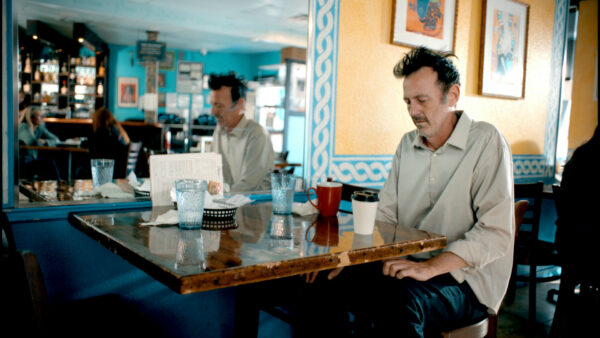
A scene from Bryan Poyser’s To-Go. Photo: IFFBoston
To-Go — Premise: a father who’s pretty sure his urine sample will flunk an impending check-in with his parole officer asks his college freshman daughter for a cup of hers. In writer-director Bryan Poyser’s pithy short, it’s the details that count. The cheerful décor of the Mexican café in which the two are having breakfast is incongruous with the indecent proposal. Mostly, it’s the sharp performances by Eva De Guelle and Brian McGuire — the daughter pondering the ethical dilemma while also nursing hurt feelings that he probably hasn’t been listening to her stories of dorm life; the father trying to charm and guilt-trip his daughter into complying, while pivoting to euphemisms with the server. McGuire is hilarious as a dirtbag, but a redeemable one.
Yard Sale — Karmen Dann directed, and the two stars scripted, this frank and lively story about estranged sisters forced to deal with the financial fallout from their mother’s death before they can absorb the emotional fallout. Selling their mom’s stuff in her yard will go toward the cost of cremation. Older sister Opal (Katie Ryan) is the diligent one who took care of their mother during her illness. Ruby (Dana Fares) is the feckless wanderer who breezes back for the funeral. The yard sale, on a chilly October day, is played for quirks as bargain hunters stalk the property. But their mother is not forgotten (the girls’ gemstone names suggest something about her). Irritation ratchets up to the danger zone. The question is, what will happen the next day, and in the years beyond, between these two?
Betsy Sherman has written about movies, old and new, for The Boston Globe, The Boston Phoenix, and The Improper Bostonian, among others. She holds a degree in archives management from Simmons Graduate School of Library and Information Science. When she grows up, she wants to be Barbara Stanwyck.