
Book Review: The Stillness Before Silence — Robert Seethaler’s “The Last Movement”
By Joan Frank
A brief, haunting meditation homing in on the final weeks—and thoughts—of the ailing Gustav Mahler during his voyage back to Europe.
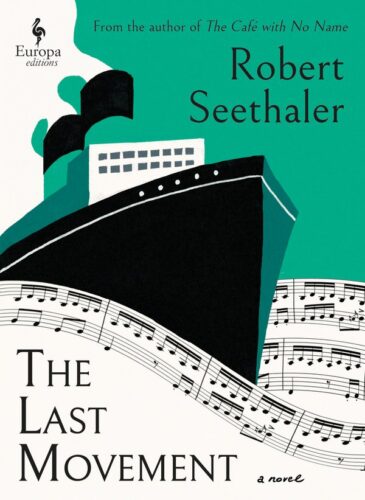
The Last Movement by Robert Seethaler. Translated from the German by Charlotte Collins. Europa Editions, 112 pages, $22.
 Every reader remembers some seminal encounter with an unfamiliar book. Mine involved the slender novel A Whole Life by Robert Seethaler, a Vienna-born writer who lives in Berlin. A simple yet mind-slicing story of one man’s life in a remote mountain village during the onset of the 20th century—stunning for its extreme, harsh beauty—A Whole Life may fairly be compared, in its treatment and trajectory, with Denis Johnson’s Train Dreams. I later learned that the novel was shortlisted for the 2016 Man Booker Prize and the 2017 International Dublin Literary Award.
Yet most Americans still seem unaware of Seethaler’s oeuvre, and I hope that will change. After the pleasant shock of A Whole Life I rushed to acquire The Tobacconist, The Field, and The Café with No Name. If none quite effected the impact of A Whole Life, they felt like close kin.
Now we have The Last Movement, a brief, haunting meditation homing in on the final weeks—and thoughts—of the ailing Gustav Mahler during his ship voyage to Europe.
Huddling, blanketed, in an ocean liner’s deck chair, monitored by an anxious cabin boy, Mahler, weak and gravely ill, ponders his memories, which play out like small, cinematic excerpts. Alma Mahler waits unseen below, with their little daughter Anna. (Tragically, their first daughter, Maria, died at age 5, of diphtheria.) Readers are simply invited to listen to Mahler’s mind rummage in remembered time: his courtship and marriage with the ravishing, tempestuous Alma “who could pick her men like currants from the cake of society;” the making of his music: its massive acclaim. Agonies entail Maria’s death (“Mahler ran into the forest and wept and screamed…”) and later, to his horror, Alma’s falling in love with architect Walter Gropius—never named here—though she’s postponed their affair to care for her mortally ill husband. (Mahler died at age 50, in 1911.)
Seethaler’s dreamlike forays into the great composer’s thinking are so poignant, one longs to quote them all. The smallish Mahler sits down at a massive desk in Vienna as director of the Court Opera: “…and for a brief moment he was overcome by the definitive, irrefutable certainty of his impending failure. Then he set to work.” Or: “You play a note, and it continues to vibrate in the room. Yet it already contains its own end.”
He is enraged by having to sit for a bust sculpted by Auguste Rodin. “I have no idea why I agreed to this idiotic business. That Rodin…a peasant. Coarse, dirty and loud.” On watching Alma sleep: “The bluish radiance of night lay on her face. There is no one else…She is my happiness…I don’t know whether I’ve earned her…There are no dreams, only this face.” In his conducting he “had the reputation of being something of a demon on the podium…Perhaps it was the energy born of resistance, a sort of stubborn fury, that drove the orchestra to its limits and beyond.”
When the awed cabin boy who calls him “Mr. Director” asks, “What kind of music do you make?” Mahler retorts: “You can’t talk about music; there’s no language for it. As soon as music can be described, it’s bad.” Yet Seethaler hints at how some of the music came about — birdsong — and at how Mahler overcame his diminutive size, terrible health, and unloved Jewishness to succeed wildly at his musical career. Still, melancholia seeps through: “Sitting on the sundeck, Mahler contemplated the meaninglessness of life…yet he loved [life] so much that his sadness at the futility of this love almost broke his heart.”
Intriguingly, no visceral sense of Mahler’s music itself is felt here. Rather, Seethaler aims at dwelling awhile in the artist’s mind and heart. To that end he mounts a quiet tribute, conveying human yearning in its unadorned complexity.
Joan Frank‘s latest books are Late Work: A Literary Autobiography of Love, Loss, and What I Was Reading and Juniper Street. Her new novella, Troldhaugen, appears in the online literary zine Failbetter.
1 Comment
Leave a Comment

I picked up A Whole Life a few years ago and it’s still stuck in my head. Interesting that Seethaler chose Mahler’s final voyage for this one—makes me wonder if the ocean crossing becomes its own kind of character. 112 pages feels right for a dying composer’s last thoughts, not a page too long.