Concert Review: Rare Boston Revival — Steve Reich’s Minimalist Epic Thrives with 20 Musicians
By Paul Robicheau
Steve Reich’s 1976 minimalist masterpiece, performed by Ensemble Signal, was a special event to see and hear live.
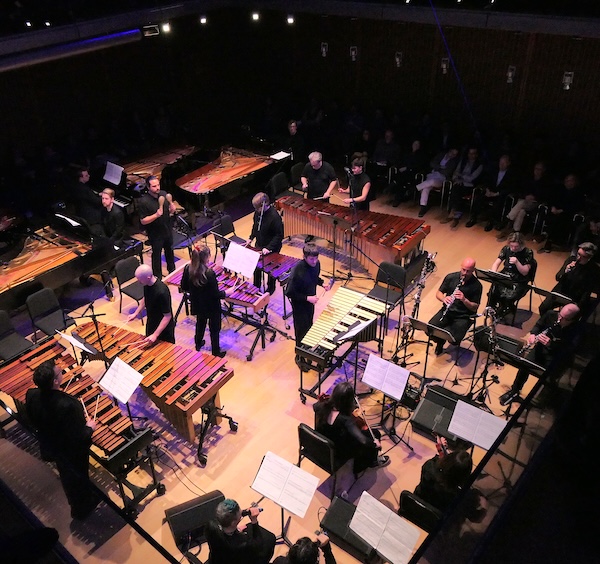
Ensemble Signal plays Steve Reich’s “Music for 18 Musicians” at the Gardner’s Calderwood Hall. Photo: Paul Robicheau
The Isabella Stewart Gardner Museum’s new Thursday Night Music series kicked off this week with a rare, hypnotic Boston performance of composer Steve Reich’s 1976 minimalist masterpiece “Music for 18 Musicians.” But let’s get one curious point out of the way. Ensemble Signal, which recorded the piece in 2015, utilized 20 musicians rather than 18 to bring it to life in Calderwood Hall.
Given the New York–based ensemble’s brisk pacing and seamless precision, maybe one shouldn’t fault the group for executing the piece with two extra sets of hands, if just to divvy up mallet parts on the three marimbas and two xylophones. Reich’s composition requires tightly integrated repetitions (carpal tunnel, anyone?) that slowly phase into layers, and the alternating musicians likely didn’t mind chances to rest within the aural sea.
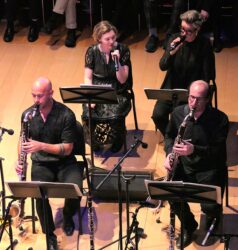
Ensemble Signal plays Steve Reich’s “Music for 18 Musicians” at the Gardner’s Calderwood Hall. Photo: Paul Robicheau
For an audience lining the four levels that surrounded the group in Calderwood’s sleek, cube-shaped coliseum, it proved a visual as well as an audio experience, particularly for those looking down from along the rails of the three balconies. The layout alone was intriguing. The central mallet instruments, rounded out by a vibraphone, were flanked by four interlocked Steinway pianos on one side and seats for four vocalists, two clarinetists, one violinist, and one cellist on the other. And midway through the hour-long piece, a pair of maracas injected the final icing.
Influenced by Balinese gamelan, West African drumming, jazz, and plainchant (Reich’s 1978 recording was one of David Bowie’s favorites), “Music for 18 Musicians” is based on a cycle of 11 chords that starts and ends the composition. The piece began Thursday night with a first note from a marimba player (fitting for a piece dominated by mallet instruments), expanded as he was joined by a second marimba, and their pulsing notes expanded into chords with three joining pianists.
But for an all-acoustic orchestration, the other element that makes Reich’s piece stand out arrived when two bass clarinetists subtly overlapped parts with the four female singers, gently nodding their heads as they breathed into and out of their notes to forge a sonic blanket that suggested the electronic tones of a synthesizer. Their rising and falling volume over sawed strokes of violin and cello added to the dynamics.
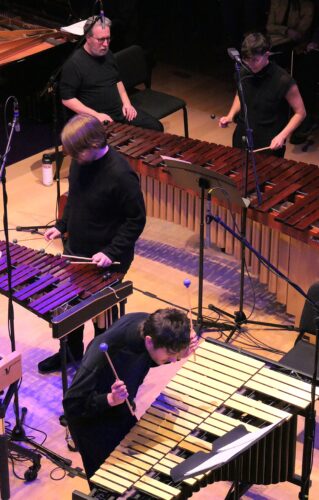
Ensemble Signal plays Steve Reich’s “Music for 18 Musicians” at Gardner’s Calderwood Hall. Photo: Paul Robicheau
Layered textures continued to build through the piece’s opening sections with the melodic patterns of wooden xylophones and finally the sparse, chiming punctuation of vibraphone cues, while singers cycled through ghostly voicings. Xylophonists deftly evoked a sense of accelerating and slowing pace anchored by the marimbas. Then three players teamed up to split one large marimba while the clarinetists and strings merged into a passage of reedy, neo-Eastern tonalities. The ensemble continued to forge a rhythmic, melodic, and harmonic ebb-and-flow in careful balance, often to shimmering effect when most hands were on deck.
The four pianists surged forward in the fifth section of the piece, two digging in with double-handed repetition while the other two bounced from a three-note pattern to a build of their own, contrasted only by the high pulse of xylophones. And soon the final piece in the puzzle emerged in a steady shaking of maracas, while the vocalists wove a wordless melody along with strings over the vibes.
Granted, the surprise of phased parts and sonic blends introduced through the first half, along with the shuffle of mallet players to and from the bars, began to lose its freshness by later sections — until the pulse eventually resolved into a final note, effectively signaling the turn of the hour. Still, the evening’s discovery as a whole of the influential Reich composition’s structure and sounds in the hands of Ensemble Signal confirmed what a special event this was to see and hear live.
Paul Robicheau served more than 20 years as contributing editor for music at the Improper Bostonian in addition to writing and photography for The Boston Globe, Rolling Stone, and many other publications. He was also the founding arts editor of Boston Metro.
Tagged: "Music for 18 Musicians", Ensemble Signal