Album Review: Django Festival Allstars Keep Gypsy Swing Vibrant on “Evolution”
By Allen Michie
Evolution is a major statement from master musicians building on a strong tradition and taking it forward into our own generation with passion and elegance.
Evolution – Django Festival Allstars (Motéma)
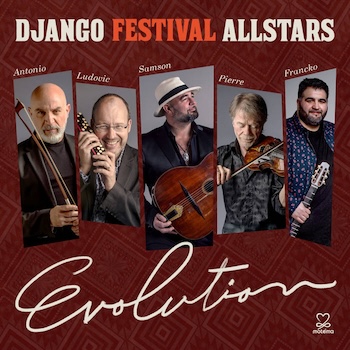
Maybe you’ve never heard, or never taken seriously, so-called Gypsy Swing (a.k.a. Sinti Jazz or Jazz Manouche). Perhaps your dad had an old Django Reinhardt album, and you heard it in the background now and then. Or maybe you heard some Stéphane Grappelli playing quietly in your favorite romantic French restaurant. But trust me—a lot has been going on in recent years, and Gypsy Swing is as vital, authentic, exciting, and challenging as any subgenre of jazz today. The title of the latest from the Django Festival Allstars clues you in: Evolution. It was called “hot jazz” back then, and it still very much is.
It’s gratifying that Django Reinhardt has inspired gifted players, from Biréli Lagrène to Willie Nelson, to find their own identities and not just sound like copycats. There is a long tradition of dedicated guitarists, violinists, and accordion players who have built a mansion from Reinhardt’s foundation ever since the heyday of the Quintette du Hot Club de France in the mid-1930s. In much the same way several traditional New Orleans Jazz bands have been branching out into new territories to keep the genre alive and healthy (including, surprisingly, the formerly most conservative of them all, the Preservation Hall Jazz Band), Gypsy Swing musicians have pushed this music forward — it is far more than a nostalgic museum piece. All of the tracks on Evolution are originals.
There’s a certain tone to an acoustic guitar that links it to the Django tradition. It’s hard to describe. It’s a twangy attack, a tight and controlled vibrato, a hollow-bodied tone, swooping lines, and a propulsive rhythm. It’s not easy to play (and imagine—Reinhardt created it with just two operational fingers on his left hand), and it’s harder still to stay within Reinhardt’s style and still maintain your own voice. Harder yet again to do all of this with a sense of so much freedom and joy. There’s something instantly French about it, and you know it when you hear it.
It’s a good idea to start in the present day and work backwards to get hooked. Five of the top musicians in the craft have come together via the Django Reinhardt Festival in New York City that has been going on since 2000, and they have coalesced into what must surely be the best Gypsy Swing band in New York, Paris, or anywhere else. Every composition, every solo, and every ensemble passage on Evolution sings with joie de vivre.
Solos are short and to the point. There are no drums, because they’re not needed (hint: the rhythm guitarist, Francko Mehrstein, has the nickname “Locomotive”). There’s often a kind of fast boom-chuck rhythm instead of the admittedly somewhat tedious ching-ching-a-ching and walking bass you’re used to hearing from straight-ahead jazz rhythm sections. The rhythm guitar can sound just like brushes on a snare, with the same kind of swing rhythm. It’s not camp, corny, or old-fashioned in the slightest.
If I haven’t convinced you so far, let me try this angle: You simply have to hear this accordion player, Ludovic Beier. He’s of course an established maestro in the genre, but he’s new to me, and perhaps to you as well. The guy is a monster. His ballad playing tugs at the heartstrings, and his fast numbers are on fire. You have to do three different things with two hands on the bulky accordion — Beier handles these acrobatics with ease, like Oscar Peterson handles a piano. In addition, he’s also a key player in the recent rediscovery of the accordina, a kind of huge harmonica with an accordion’s set of buttons, which accordion players used to travel with to practice on trains. It has a beautiful sound, like an especially resonant and cleanly articulated harmonica. On his tribute to the legacy of Toots Thielemans, “Around Toots,” Beier somehow captures the distinct details of Thieleman’s vibrato at the ends of phrases, his quick chromatic runs in the middle of phrases, his slurs, and his spirit.
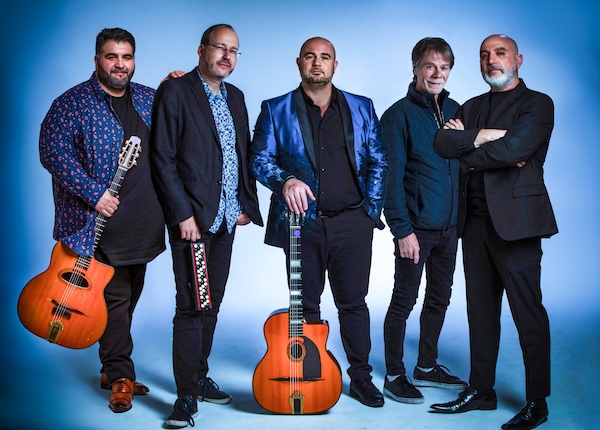
The Django Reinhardt Allstars with Francko Mehrstein. Photo: courtesy of the artist
Beier is a fine composer as well (although all the compositions on Evolution are excellent). “El Destino” has a sly and sinuous melody that tangos its way around the chord changes. “Swing and Ready” is like a soundtrack for a chase scene in Paris. Everyone gets to shred while Mehrstein and bassist Antonio Licusati lay it down hard in the rhythm section. Beier plays with flawless command and confidence, as if every improvised solo was written out beforehand. He enters strong, stays strong, and finishes strong. Beier starts riffing with the bass and rhythm guitar, and the whole thing just lifts ten feet into the air.
“Casse Noisette,” by lead guitarist (and likely Reinhardt reincarnation) Samson Schmitt, is another uptempo swinger. The bass plays in 2/4, and when he shifts to a walking 4/4, the swing kicks into overdrive. The guitar, violin, and accordion chase each other around the melody like squirrels corkscrewing around a tree trunk. “Balkanic Dance,” by violinist Pierre Blanchard, has a Balkan flavor in the opening melody, showcasing the tight unison playing between violin, guitar, and accordion. They just sound great together, and it’s a classic French sound given an international and contemporary twist. All the solos are fantastic, but Beier is once again just jaw-dropping. With its dizzy, twirling conclusion, “Balkanic Dance” is a standout track among the standout tracks.
Blanchard’s “Dorado’s Smile” is uptempo and playful, and the violin solo soars straight in with the melody, like Stéphane Grappelli used to do. Blanchard’s ballad playing draws from the Grappelli tradition without being confined to it. “Lovely Wife” has a beautiful solo that doesn’t go quite where you would expect. Blanchard plays with a human, imperfect, delicate sound, somewhere between the folksy fiddle and the Baroque European violin. The accordion, with a little imagination, sounds like an entire orchestra in the background. With gorgeous playing from everyone in the band, “Lovely Wife” is a track to hear how versatile and moving Gypsy Swing can still be today.
“Piazza Italia” is a ballad with an international flair, like some Italian wine with your French dinner. There’s finally a solo for bassist Licusati, who solos expertly like all the others—to the point, effective, and with a well-constructed melody. “Sunshine in My Heart” is a pleasure, bright and cheerful, and I hope it gets some airplay (or — sigh — to be more contemporary about it, gets used on TikTok behind some cute animal videos). Beware, however, the undercurrent of melancholy hiding in the phrasing of the violin solo and the sighs of the accordina—how quintessentially Parisian.
Evolution is a major statement from master musicians building on a strong tradition and taking it forward into our generation with passion and elegance. It’s what’s supposed to happen, and you should support it—and enjoy it!—when it does.
Allen Michie works in higher education administration in Austin, Texas. He cannot decide if he likes strawberry, almond, pistachio, or lemon macarons best.
Tagged: Antonio Licusati, Django Festival Allstars, Django Reinhardt, Francko Mehrstein, Ludovic Beier, Motéma, Pierre Blanchard