
Album Review: “Love Life” — Lerner and Weill’s Pioneering 1948 Concept Musical Finally Gets Its First Recording
By Ralph P. Locke
Lauded in histories of Broadway but rarely performed, Love Life proves to be an insightful and effective work of social criticism, nearly eight decades after its premiere.
Love Life, musical by Kurt Weill (music) and Alan Jay Lerner (lyrics and book).
Quirijn de Lang (Sam Cooper), Stephanie Corley (Susan Cooper), Louie Stow (Johnny, their son), Tilly Baker (Elizabeth, their daughter), Themba Mvula (Magician & Interlocutor), Justin Hopkins (Hobo).
Orchestra and Chorus of Opera North, cond. James Holmes.
Capriccio C5550 [2 CDs]—136 minutes. (To try a track or purchase, click here.)
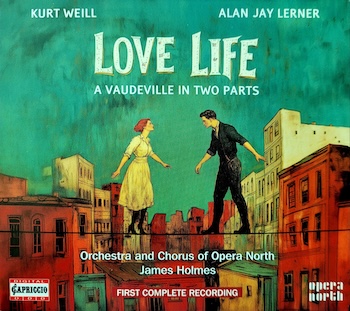 One of the smartest and tartest Broadway shows you probably never heard of has finally been recorded. It’s Love Life: A Vaudeville in Two Parts (1948), and it was devised in large part by composer Kurt Weill in conjunction with the lyricist Alan Jay Lerner, who was fresh off a success with Brigadoon and would go on to do My Fair Lady and Camelot. Weill himself, best known to us today for The Threepenny Opera (1928) and The Rise and Fall of the City of Mahagonny (1930), had more recently brought important and imaginative works to Broadway, including Lady in the Dark, One Touch of Venus, and Street Scene.
Weill, though born and trained in Germany, became an essential figure in American musical life after fleeing here from the Nazi regime. In Love Life, Weill and Lerner together crafted an immensely engaging, playful, and often satirical look at American social history across two centuries.
The basic device is that a woman and her husband, Susan and Samuel Cooper, are placed in a series of settings and situations that move gradually from Colonial days to 1948 (the year the show opened on Broadway) without ever aging, though their marriage experiences tensions and frays over time, as the result of forces laid out in vaudeville-like numbers that comment on social pressures (bearing such titles as “Progress” and “Economics”). These commentary numbers are sung by unnamed characters—e.g., a Hobo and a male quartet—who do not directly interact with the named characters until the Illusion Minstrel Show finale, which leaves the couple, divorced but now realizing what they have lost along the way, walking a tightrope toward each other but, as the curtain falls, possibly not meeting in the middle.
Love Life has been justly called the first “concept musical,” and thus the direct precursor of such shows as Stephen Sondheim’s Follies and Company and Kander and Ebb’s Chicago. Lerner himself would collaborate on a work plainly inspired by Love Life: Leonard Bernstein’s epic failure, 1600 Pennsylvania Avenue (revised after the composer’s death into the fascinating A White House Cantata).
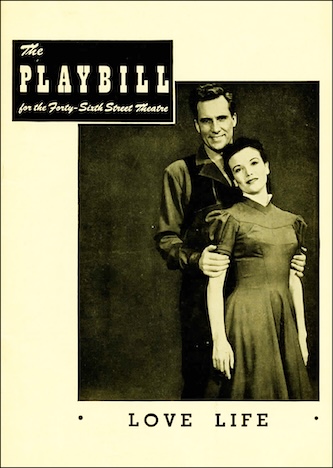
Playbill for the 1948 Broadway production of Love Life.
Love Life contains show-stopping solo numbers that are among the best that Weill ever wrote, including “Here I’ll Stay [with You]” (near the beginning of the show, dramatizing 1791 Sam’s and Susan’s determination to build a family and serve as model citizens) and “This Is the Life” (for 1948 Sam, in a hotel room, trying to convince himself that he was right to leave his wife and “the kids”).
Love Life had a short run (252 performances, closing after 7 months), starring Nanette Fabray and Ray Middleton. It was heartily praised and just as heartily dismissed, and went largely unheard thereafter, until Opera North made this recording during a new and imaginative (yet appropriate) production in Leeds in January 2025. The recording was captured live from the three performances, one of which was broadcast on the BBC.
The cast boasts firm, youthful voices (no wobbling or shouting). The principal characters are Quirijn de Lang (Samuel Cooper), Stephanie Corley (Susan Cooper), Themba Mvula (Magician & Interlocutor), and Justin Hopkins (Hobo). The smallish orchestra is whip-smart, with conductor James Holmes elegantly shaping phrases and keeping the momentum going. Weill did all his own orchestrations and arrangements — his fluency and tact are evident at every turn. The booklet includes the full libretto, a marvelously informative essay by Joel Galand, and numerous photos of the original (1948) and Opera North productions.
In short, we can now hear Love Life for ourselves, to feel the joy and pain generated by the show’s sharply observed human relationships and social trends, all brilliantly conveyed in a wide range of styles, including boogie-woogie, a parodic a cappella madrigal, and the jazzy, sardonic “Mr. Right” (for wised-up modern-day Susan), plus a Divorce Ballet commenting engagingly on various songs heard earlier in the show. It’s a wild ride, and more daring than many things on our commercial stages today.
I should add that the second CD ends with two fascinating scenes that were cut from the original production and from the Opera North one as well, but recorded for the listeners’ benefit. They would probably confuse more than clarify, but they show, yet further, how richly Lerner’s and Weill’s imaginations were bubbling as they concocted this remarkable theater work.
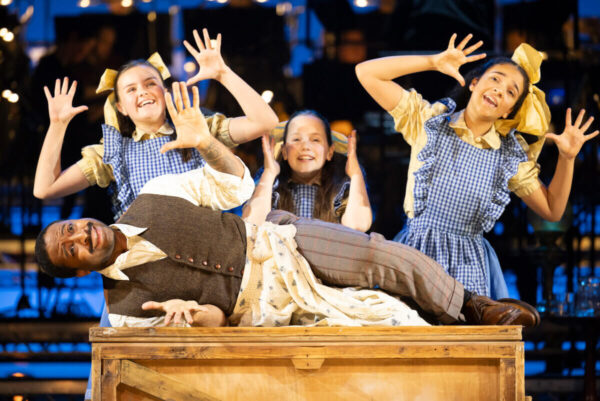
A scene from the Opera North production of Love Life, Jan. 2025. Photo: courtesy of the artist
An entirely independent production of Love Life took place in May 2025 in New York City’s acclaimed Encores! series (see review here). A single-CD release of major excerpts is imminent, and, with performances by renowned Broadway stars Kate Baldwin and Brian Stokes Mitchell, will surely add yet more luster to this amazing and influential stagework that, for so long, audiences (and even many Broadway aficionados) have had no way of knowing.
For further insight into Weill’s underappreciated impact on American musical theater, I recommend books by Stephen Hinton and Rebecca Schmid (though the latter, for reasons of space, focuses on other Weill stage works, such as Lady in the Dark).
Ralph P. Locke is emeritus professor of musicology at the University of Rochester’s Eastman School of Music. Six of his articles have won the ASCAP-Deems Taylor Award for excellence in writing about music. His most recent two books are Musical Exoticism: Images and Reflections and Music and the Exotic from the Renaissance to Mozart (both Cambridge University Press). Both are now available in paperback; the second, also as an e-book. Ralph Locke also contributes to American Record Guide and to the online arts-magazines New York Arts, Opera Today, and The Boston Musical Intelligencer. His articles have appeared in major scholarly journals, in Oxford Music Online (Grove Dictionary), and in the program books of major opera houses, e.g., Santa Fe (New Mexico), Wexford (Ireland), Glyndebourne, Covent Garden, and the Bavarian State Opera (Munich). He is part of the editorial team behind the wide-ranging open-access periodical Music & Musical Performance: An International Journal. The book series that he founded in the 1990s and still edits, Eastman Studies in Music (University of Rochester Press), has recently published its 200th title, on songs by Robert Schumann.
Tagged: "Love Life", Alan Jay Lerner, James Holmes, Kurt-Weill, Orchestra and Chorus of Opera North