
Film Review: “A Poet” — The Agony and Ecstasy of Mediocrity
By Peter Keough
He’s not a poet and he doesn’t know it.
A Poet. Directed by Simón Mesa Soto. Opens at the Boston Common on February 6.
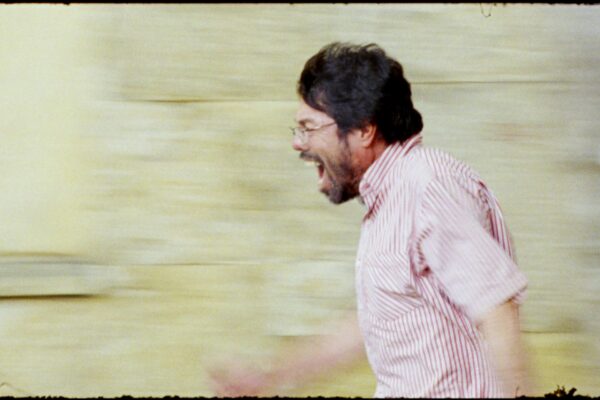
Ubeimar Rios in a scene from A Poet.
The screen has offered more than its share of dysfunctional, feckless, and destructive men over the past year. Among the Best Picture Oscar favorites alone you’ll find assholes featured in Bugonia, Frankenstein, Hamnet, Marty Supreme, One Battle After Another, Sentimental Value, and Sinners.
It’s a world-wide trend, this fascination with toxic masculinity. And you wonder why we have the leadership we do.
As is their wont, the Academy overlooked perhaps the year’s best film featuring a benighted male protagonist – Simón Mesa Soto’s A Poet, Colombia’s official entry in the International Film category. In it Oscar Restrepo – a hirsute, gnomelike, wannabe genius well past his prime played with exquisite, horrifying, and hilarious nuance by Ubeimar Rios – pursues his ideal of artistic purity despite the blunt rejections of the world.
He showed promise once, winning prizes and a modicum of acclaim for a couple of books of verse back when he was in his twenties. But that was long ago and now he lives with his ailing, disapproving mother and refuses to work, insisting on his privileged status. “Suffering is the raw material of poems,” he says during a gaseous introduction at a reading of a poem we never hear because an abrupt cut is made to him outside lecturing his raffish drinking buddies on the street about the privileged misery of the artist. Then Soto cuts again to Oscar the next morning waking up on the sidewalk where he has passed out – and not for the first or last time.
This elliptical editing mirrors Oscar’s poetic – or soused – consciousness. The effect is sardonic, satiric, and endearing, but it also emphasizes the fact that for all his blustering Oscar is never seen actually writing poetry nor, until much later, are any of his poems shared (they are about as good as you might expect). As his sister points out, he seems to value – or at least enjoy – the suffering more than the poetry. He certainly gets off on bragging about it.
Unfortunately, he’s not the only one who’s suffering. His estranged teenage daughter Daniela (Allison Correa) cringes in embarrassment and resentment at his approach. When he suggests to his mother that they commit suicide together, his brother-in-law orders him to move out. Not until he agrees with his sister to accept a high school teaching job is he allowed to stay.
Fortified by a thermos full of booze, Oscar at first regales his captive audience with his standard rhapsodic bullshit about the woes of poetic genius. They are amused, and point out that one of the students, Yurlady (Rebeca Andrade), writes poetry too. After class, he looks at her notebook: he is shocked that the poems are actually good and accompanied by drawings of exceptional skill. Yurlady becomes his next great cause; he is determined to help her achieve the recognition that was denied him. He no doubt also sees her as a surrogate for his own daughter. As for Yurlady, she acquiesces, passively. She seems more interested in nail polish and makeup, not to mention the needs of her impoverished family back home in the barrio.
To further his ambitions for Yurlady, Oscar takes her to the local poetry club, where the seedy directors immediately recognize her value in promoting the organization. They’ll give her a prize and have her do a reading and maybe the Danish envoy will become a sponsor for the club! Of course, she’ll have to write more about social issues, fulfilling her role as a voice of the oppressed. In short, they all are using Yurlady for their own ends. Still, for a while, everyone benefits, especially Oscar, who stops drinking and makes progress towards reconciling with his daughter.
It doesn’t last. And maybe Oscar wouldn’t have it any other way. As narcissistic, self-loathing, and blundering as he is, the scraggy protagonist has more integrity than the other trolls and mediocrities around him, predators who have made themselves comfortable through complicity — exploiting weakness, hypocritically extolling virtue, and accommodating a fallen system. Oscar might not be much of a poet, but his life has the makings of a poem.
Peter Keough writes about film and other topics and has contributed to numerous publications. He had been the film editor of the Boston Phoenix from 1989 to its demise in 2013 and has edited three books on film, including Kathryn Bigelow: Interviews (University Press of Mississippi, 2013) and For Kids of All Ages: The National Society of Film Critics on Children’s Movies (Rowman & Littlefield, 2019).
Good stuff, Peter.
thanks Peg!
Agreed – pathetic yet oddly empathetic! Brilliant acting.