
Jazz Album Reviews: A Big Band Bonanza from Canada’s Cellar Music Group
By Allen Michie
Two debut big band albums, one traditional and one progressive, are blowing in hot in the dead of winter.
Vancouver Jazz Orchestra Meets Brian Charette – Vancouver Jazz Orchestra (Cellar)
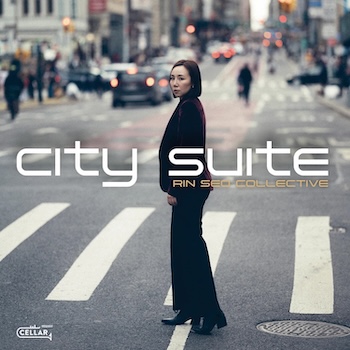
City Suite – Rin Seo Collective (Cellar)
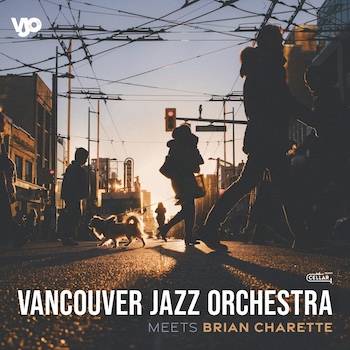
Each album, from Canada’s Cellar Music Group, celebrates its home city. The Vancouver Jazz Orchestra is a passion project of local saxophonist James Danderfer, a big dreamer with big chops who wanted to “create an ensemble that would help shine a light on the musicians of this city, provide performance and composition opportunities, and invest in the future generations through mentorship programs,” as he writes in the liner notes. The VJO is more than just a big band—it’s a full-blown organization with a Board of Directors that sponsors a youth orchestra, community outreach, a concert series, commissioned recording opportunities, and a scholarship program. How hip is that?
Their first CD is full of Vancouver musicians, along with guests Andy Hunter from Germany’s VDR big band (who was in Vancouver for the year) and organist Brian Charette (who plays great, but why pick a New Yorker to feature on this Vancouver-centric project?). All the compositions or arrangements are by the locals, and they all do the city proud.
It’s more of a Latin band than you’d expect, even for multicultural Vancouver. Most tracks have a samba or bossa nova feel (at least in part), although in that highly arranged, smoothed-out traditional big band way. The arrangements are in the late-Basie, Thad Jones/Mel Lewis style prevalent in the many excellent college big bands around the world. There’s nothing strikingly original going on the compositions, arrangements, or solos, but a polished and kickin’ big band is always reward enough.
The album starts with an up-tempo swinger, as one would expect. “Equestrian Interlude” introduces Charette, who doesn’t supply the stereotypical Hammond B-3 sound; he swings hard while avoiding the soul-jazz B-3 clichés. It’s always a treat to hear a great big band drummer, and Jesse Cahill is here for it, right on top with every accent in the right place on the chart.
“Don’t Call Before 10” has a kind of New Orleans 16-bar blues feel. Charette adds a hint of electric guitar to his sound, and he can build a solo and goose the drama like all the great jazz organists know how to do. “Lado a Lado” begins with a more complex Latin rhythm and unfolds into a fast Latin swing, alternating between the two tempos. Trumpeter Julian Borkowski emerges from the tight trumpet section to glide through the changes and tempos in his fine solo.
We hear a fuller example of what the horns can do in “As Luck Would Have It,” a mid-tempo shuffle with attractive voicings that maintain a light and colorful tone. The organ lays down sustained chords, freeing the horns (especially the saxes and low brass, who usually do most of the harmonic cushion work) to do more and in different combinations. This one could swing a little harder in the rhythm section, but it’s still a highlight. To hear the rhythm section hit its stride, check out the fast waltz “Shimmy!”.
The lone standard is Herbie Hancock’s “The Sorcerer,” arranged by trumpet soloist Brad Turner. It’s done here as an unexpected bossa nova. It’s a little too slick for its own good, and the melody gets a bit lost in the busy arrangement. The better bossa is “Colour Contrast,” featuring Danderfer on alto sax. He’s got a great tone, and I wish he could have curbed his instinct to showcase his fellow musicians so he could be featured more often. Danderfer’s composition “The Same Old You with the Same Old Blues” is similarly modest—this blues shuffle gives the organist some room to play, but it’s the second-shortest track on the album. I wish it had been longer to give more people a chance to solo.
Finally, Charette’s “Honeymoon Phase” stands out from the others with a slow rock feel and a distinctive arrangement. It’s loaded with drama, soaring brass, and a catchy melody. Assuming Charette did the arrangement, he builds and stacks the harmonies like a great jazz organist builds a powerful solo.
Cory Weeds, the executive producer at Cellar, is also the executive director of the VJO, so hopefully more albums from this worthy and accomplished band will be crossing our border soon.
It’s no small thing to make your first record a big band session with 14 New York session pros, plus two A-list guest soloists.
Korean-born and Berklee-educated Rin Seo makes an impressive debut with City Suite, a series of tone poems. According to the promotional notes, “The work features a range of emotions including ambition, struggle, isolation, nostalgia, and solidarity provoked by urban life,” particularly in New York City where Seo has settled.
Seo is the composer, arranger, and conductor—she doesn’t play on the disk. All are her compositions, except for Wayne Shorter’s “Blues a la Carte,” which is significantly transformed. She uses a wide palette of colors in the Gil Evans tradition, combining instruments across sections and prioritizing rhythmic expressiveness over swing per se. Most notably and effectively, she combines the traditional big band with a string quartet.
The first three tracks form the “City Suite.” Part one, “The Big Apple,” is an appropriately fast-paced and ambitious swinger. It’s a brave move to stop the full-speed-ahead train and have everyone drop out for a cello solo. But why not? — this is New York! Then guest Steve Wilson comes in for an alto sax solo in a completely different musical language. This track has some winding and crowded streets, but it gets you from uptown to downtown.
Seo writes in the notes that part two, “Cityscape,” conveys “the dazzling beauty of the city’s night skyline, while evoking feelings of isolation and nostalgia stirred by the rhythms of urban life.” There’s a rock feel, with shifting textures between the brass and the flutes with strings. Interesting voices emerge, such as a muted trumpet in unison with alto sax, with a flute on top. Seo will follow the string quartet with a rock electric guitar solo over funky drums. It’s an enterprising track that hangs together and works.
Part three, “Alone, But Not Alone,” is a bossa nova ballad with nice work from soprano sax master Wilson. Among the many highlights, there’s a well-recorded acoustic bass solo from Matt Clohesy, paired up with contrasting flutes.
The remaining tracks take a variety of approaches with different sounds and structures. There are two lovely ballads, “Lullaby” and “Desert Flower.” The first begins with a singable melody and rewards close listening with further delicate touches—there’s a short little run from a low baritone sax up through a high soprano. At one point, everything drops out for a rippling piano, the bass introduces a riff that is picked up by a trumpet, and the harmonies fold into place. The textures shift behind the soloists, depending on the sonorities of which instrument is soloing, as they should. “Desert Flower,” in honor of Somali women’s rights activist Waris Dirie, features the beautiful trumpet of guest Ingrid Jensen. She brings some Maria Schneider Orchestra credibility to Rin Seo’s Collective, where Schneider is a clear and respected influence. The song is a waltz, whose gentle undulating voicings are set not to compete with Jensen’s rich, emotional, and vocal-like tone. It’s a beautiful, unsentimental track.
Other such pleasures await on this sophisticated and ambitious album, voted one of the top ten debut recordings of 2025 in the recent Francis Davis Jazz Poll. One of those votes was mine.
Allen Michie works in higher education administration in Austin, Texas. For one glorious but obscure year he was the conductor of the Oxford University Big Band.
Tagged: "City Suite", Brian Charette, James Danderfer, Rin Seo, Rin Seo Collective