
Film Review: “H is for Hawk” — Stumbling and Soaring
By Peg Aloi
Despite an occasional narrative misstep, H is for Hawk soars with enormous power and beauty when it revels in the mysterious, graceful ways of nature.
H is for Hawk, directed by Philippa Lowthorpe. Screening at AMC Theatres in Boston area, Kendall Square Cinema, and Dedham Community Theatre through January 28, then at the Dedham Community Theatre and Maynard Fine Arts Theatre through January 29.
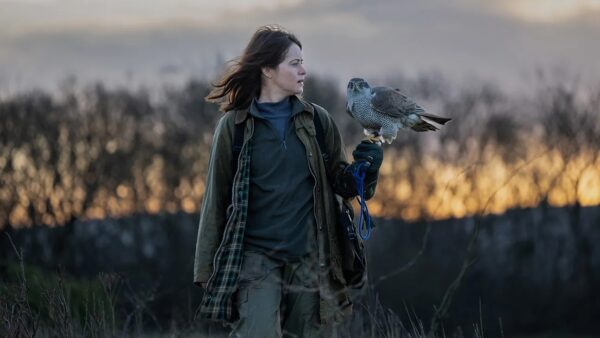
Claire Foy in H is for Hawk. Photo: Roadside
When I learned that H is for Hawk starred three of my favorite actors, Brendan Gleeson, Lindsay Duncan, and Claire Foy, I didn’t care what it was about, I knew I should see it. The plot, in a nutshell: a nature-loving academic becomes depressed and directionless after the sudden death of her father, and decides to devote her days to training a goshawk. Based on the best-selling memoir by Helen Macdonald, who co-wrote the screenplay with Emma Donahue and director Philippa Lowthorpe, the film also weaves in aspects of the book The Goshawk by T. H. White. The author of The Once and Future King also decided to train a goshawk at a challenging period in his life. The English literary tradition has always embraced nature in all its terrifying beauty, and that metaphor works well in this film.
The story opens with Helen, a Cambridge University history and literature professor, watching goshawks in a meadow, and calling her father about the sight. Alisdair (the always-excellent Gleeson), also referred to Ali Mac, is on his way to London, where he works as a photojournalist for the Daily Mirror. They chat for a moment; he teases Helen about returning his telescope and congratulates her on glimpsing the majestic birds. As played by Foy (The Crown, Unsane), Helen initially seems to be a cheerful young woman and passionate teacher. Her somewhat frumpy clothes and untrimmed hair suggest that this is an attractive woman who is unbothered by social convention. She greets her first class of the day by announcing they’re going to the pub (Cambridge’s legendary Eagle, which dates to the 17th century) — en route, she delivers a lively lecture about scholars who met there half a century ago.
That night, her friend Christina (Andor’s Denise Gough) comes to Helen’s apartment to pick her up for a planned dinner out. In a clumsy plot moment (there are a few of these), Christina picks up a piece of Helen’s mail and discovers an invitation to apply for a fellowship at the Max Planck Institute in Berlin. Helen’s mother (the great Lindsay Duncan, who shines in a small role) calls just as they’re leaving, with the awful news that Ali has died while on assignment in London. Obviously in shock, Helen, oddly, decides to keep her dinner plans. Later, Helen and her brother James (Josh Dylan) meet with their mum at a funeral director’s office, where the two siblings find themselves laughing uncontrollably at a catalog of themed caskets. Soon after, Helen hooks up with a handsome fellow who, after seeing books about grief on her nightstand, decides that he should keep his distance from her. Christina offers appropriate moral support, but Helen remains stoic. Impulsively, she visits a friend who trains falcons and then announces that she wants to purchase a goshawk to train it.
Helen’s training of the large bird of prey, who she names Mabel, is the center of the film, and it was the most appealing and engaging aspect of H is for Hawk for me. The fine cast of actors does a very fine job but, despite their best efforts, too many scenes of expository dialogue feel forced. It is Helen’s experience of getting to know this dangerous wild bird that supplies the suspense and exhilaration in this film. Some viewers may be disturbed by the idea of keeping a wild bird captive. I found it somewhat troubling at first. But when Helen is questioned about this issue at a public lecture, her answers are thoughtful and provocative. I have not read the memoir the film is based on, but I’m planning to seek it out as soon as possible.
It’s hard while watching this film not to be impressed by what it must have been like for the actors to be around these huge carnivorous birds. Foy is said to have trained with professional falconers and goshawk handlers for two weeks before filming. The scenes where Helen brings Mabel outdoors — shot on location in the fenlands of Cambridgeshire — manage to be both thrilling and bucolic. I also liked the music by Emilie Levienaise-Farrouch (who composed the scores for two of my favorite recent films, All of Us Strangers and Living). It has a traditional, orchestral feel, filled with alternatively plaintive and lively strings. The gorgeous cinematography by Charlotte Bruus Christensen (The Hunt, A Quiet Place) is paired with stunning wildlife photography by Mark Payne-Gill (a veteran of nature documentaries). The bond between Helen and Mabel deepens as she learns to train the bird how to properly hunt. Meanwhile, Helen’s connection to the world of humans begins to shift; her frequent recollections of conversations with her father tap into the depth of her unresolved grief.
Christina, obviously a devoted friend, begins to notice that various aspects of Helen’s life are unraveling. Her cheery, book-filled home has become a mess, she is forgetting to eat, she is beginning to feel uncomfortable in social situations, and her academic work is suffering. Her family and friends gently try to intervene, but Helen has become interested only in Mabel. But then the time comes closer for Mabel to be released and Helen has been asked to deliver her father’s eulogy. She slowly works to get her life back on track. Foy gives a fine, nuanced performance, revealing Helen’s complexity in scenes where barely a word is said. Despite an occasional narrative stumble, H is for Hawk soars with enormous power and beauty when it revels in the mysterious, graceful ways of nature.
Peg Aloi is a former film critic for the Boston Phoenix and member of the Boston Society of Film Critics, the Critics Choice Awards, and the Alliance for Women Film Journalists. She taught film studies in Boston for over a decade. She has written on film, TV, and culture for web publications like Time, Vice, Polygon, Bustle, Dread Central, Mic, Orlando Weekly, Refinery29, and Bloody Disgusting. Her blog “The Witching Hour” can be found on substack.
Tagged: "H is for Hawk", Brendan Gleeson, Claire Foy, Helen Macdonald
I also enjoyed this film and you’ve effectively captured its strengths. But I did read the memoir by Helen MacDonald and it was impossible not to compare book to movie. Written in the first person, the book shared MacDonald’s thoughts and emotions in her own voice, providing depth and feeling to her grief in ways that a film just cannot do. Given that, I thought the film still managed to illustrate this deep and overwhelming well of grief effectively enough to be worth seeing. Claire Foy and Brendan Gleeson are always worth seeing.
I was going to see this simply because of the cast, but now I’m very excited. I can overlook the narrative missteps (I’m not reviewing it), and what you did like sounds so compelling.
Such a well written review. This was a perfect and beautifully filmed movie for my United flight.