
Book Review: Who Commits Crime—and When? A Sociologist Reframes the Debate
By Bill Littlefield
Another informative, if unsurprising, contribution to the literature dedicated to understanding “criminal behavior,” especially among teenage boys and young men.
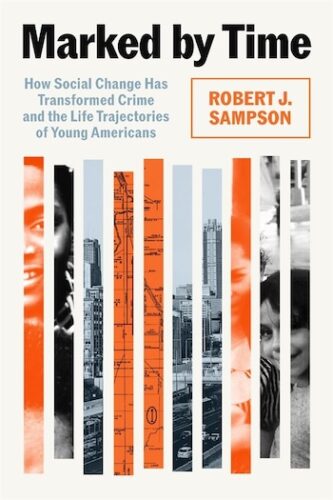
Marked By Time: How Social Change Has Transformed Crime and the Life Trajectories of Young Americans by Robert J. Sampson. The Belknap Press of Harvard University, 266 pages, $29.95.
Robert J. Sampson is the Woodford L. and Ann A. Flowers University Professor at Harvard University. His contribution to the literature dedicated to understanding “criminal behavior,” especially among teenage boys and young men, reflects his standing, meaning that the book is a challenging read for anyone not familiar with the academic language of the social sciences.
Sampson is aware of this. At several points he restates his thesis, emphasizing why it is important to hear this argument now:
The vast social changes in crime, punishment, and inequality of the last few decades, for good and ill, demand a fresh account of growing up in the late twentieth and early twenty-first centuries – and of the meaning of individual character, especially as it is defined by criminality.
I want to show, in short, how focusing on WHEN rather than WHO transforms our understanding of human development, crime, and justice.
Stated in its most general and strongest form, my thesis is that two groups of individuals whose only early-life difference is the year in which they are born will have immensely varied experiences over the courses of their lives, not because of who they are, but because of when they are.
Some of the “vast social changes” studied by Sampson are the shifts to and from (and perhaps “to” again?) a police policy that insists young offenders be arrested and prosecuted for relatively insignificant criminal acts, many of which might be more appropriately characterized as vandalism; changes in the political climate in which terms like “predator” are applied to children and young adults; efforts to clean up areas where lead poisoning has had a dramatically detrimental effect on the development of the brains and behavior of children; various other developments that have helped low-income families find ways to escape harmful physical, social, and psychological conditions; and the ebb and flow of gun violence.
In the chapter titled “Guns, Violence and Poisoned Development,” Sampson addresses the last of these factors, positing that “exposure to violence infiltrates the minds of children, disrupting cognitive functioning and academic performance, impulse control, and, more generally, long-term developmental trajectories.”
Sampson contends — often convincingly — that his work, much of which is based on decades-long studies of the experience of families and over a thousand children “across multiple cohorts” in Chicago, challenges some earlier theories of the development of criminal behavior that have failed to examine what he calls “the when.” That said, a lot of what he’s written here will strike readers as common sense. Youngsters who spend their childhoods in a place and time where gunfire is constant — and sometimes arbitrary — are bound to be more seriously damaged in the short and long terms than kids born ten years later, after the gunmen have moved on or the neighborhood has been reclaimed by peace-loving renters and homeowners. Kids who see their friends arrested and incarcerated for breaking windows or shot by police officers will end up with a different attitude toward authority than those who don’t have that experience because priorities in the police department and mayor’s office have changed. Kids treated as children will have a different perspective on life than those who were viewed as potential career criminals.
Sampson makes it clear from the outset that he’s concerned with examining and then understanding the behavior of young men growing up at different times in Chicago who do or don’t commit property crimes or, for example, murder, which leads to arrest and incarceration. He also points out that, though previous studies have examined many of the different kinds of harm done to individuals and families by incarceration, arrest can often have a dramatically bad and powerful impact on somebody’s life, whether or not the arrested person is ever convicted or incarcerated.
Still, at several points, I found myself wondering whether anyone would ever study the influences that have nurtured various other types of criminals. For example, what motivated executives at Exxon to hide their own industry studies that demonstrated, conclusively, the impact that burning fossil fuels has on climate change? That is a crime which will no doubt cause far more long-term damage than if someone stole a loaf of bread or if one gang member beat another. What childhood experiences shaped the men and women who flooded some of America’s poorest areas with addictive drugs, a poison that contributed to the ruin of countless lives? What explains the criminal behavior of men who continue to make cars that have been shown to be unsafe — even deadly? What drives a man who grows up in a wealthy family to seek more and more assets, even if that means taking actions that are in defiance of the law and morality? What has been done to the character of the inhabitants of the 1% to make them the way they are?
These are studies for another day, I suppose. For now, we’ve got Marked By Time. Sampson concludes with a powerful and necessary injunction: “If we truly want to elevate character,” he writes, “we should do so first at the social level, prioritizing justice in the here and now while preparing for whatever the future brings…making the design of a just society our shared imperative.” As the professor rightly contends, “While we can’t control individual futures, we can set collective priorities.”
Bill Littlefield volunteers with the Emerson Prison Initiative. He most recent book is Who Taught That Mouse To Write?