
Film Review: Troubled “Dreams”
By Peter Keough
This is a lyrical, visually arresting, if sometimes verbally prolix film version of Denis Johnson’s sublime 2011 novella.
Train Dreams. Directed by Clint Bentley adapted from the novella by Denis Johnson. Currently playing at the Kendall Square and West Newton Cinemas. Streams on Netflix beginning November 21.
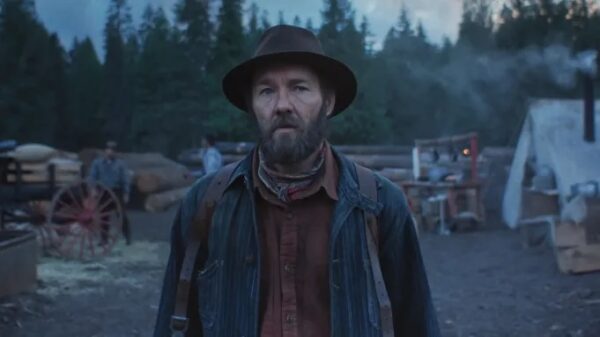
Joel Edgerton in Train Dreams.
At the beginning of Denis Johnson’s sublime 2011 novella Train Dreams the protagonist Robert Granier, working on the construction of a railroad bridge in Idaho in 1917, participates in the attempted lynching of a Chinese laborer. It is Granier’s original sin, the root cause of his woes to come, and it embodies the racism, violence, and exploitation of labor and natural resources that are among the original sins of this country.
That incident recurs in Clint Bentley’s lyrical, visually arresting (cinematography by Adolpho Veloso), if sometimes verbally prolix film version (not all of the voiceover narration, spoken by Will Patton who did the audiobook, seems taken from the text). But there is a major change: Granier is not complicit in the act, but merely an innocent, non-comprehending bystander. Dumbfounded as he watches, he does nothing to stop it and is forever haunted by the injustice he has witnessed.
Is it a big deal, this omission? I can see how the filmmakers might have been concerned that Granier would seem less sympathetic had they stuck to Johnson’s vision. But doesn’t denying the culpability and consciousness of the character reduce him from the status of tragic hero to that of melodramatic victim? It would certainly have made for a darker and more ambiguous movie. Still, Bentley makes the most of this simpler approach, and he has achieved an affecting, poetic, and unemphatic adaptation (notable for Bryce Dessner’s subdued but poignant score), and an eloquent evocation of loss, grief, and survival.
The narrative is marked by nuanced, heart-wrenching performances, notably by Joel Edgerton as Granier. An orphan, raised on the edge of the wilderness by strangers, Granier is a person who is stunned by life — he is anonymous even to himself. He drifts about in the midst of natural beauty and catastrophe, of human goodness and depravity. He makes his living mostly as a logger (no more working on the railroad for him). It’s a profession that despoils the landscape, but allows amusing montages of odd events and eccentric characters.
Notable among the latter is old-timer Arn Peeples (William H. Macy), who regales the lumberjacks with tall tales and his homespun, somewhat anachronistically tree-hugging philosophy. He points out how their labor is not just physically taxing but also spiritually debilitating because they are chopping down trees that are 500 years old or more. He notes that a tree is your friend until you try to cut it down — then it becomes your enemy. This observation turns out to be true when one topples the wrong way, killing three men. Arn has the victims’ boots nailed to trees next to their graves. “Now they won’t just pass out of this world with nothing to show they were here,” he says.
Granier’s life would have had no more significance than those marked by those eloquent relics had he not met Gladys (Felicity Jones) by chance at a church service. They fall in love and, via Edenic montages, they build a cabin by the side of the river, experience the joys of shared souls, and have a daughter. But Granier’s peripatetic profession proves to be the downfall of this paradise.
In his fallen state, Granier endures for years, working odd jobs, establishing a cartage business, remaining a loner, if not a hermit, though with a few poignant exceptions. Throughout it all, he strives to comprehend the meaning of it all as the film, like the book, probes the margins of the evanescent and the epiphanic. At times, Granier has encounters that seem beyond belief, miraculous visitations that, as the voiceover relates, “felt as real as anything in his life, even as he wondered if they really happened.” Repeatedly he sees the specter of the man he witnessed attacked at the bridge, and finally confronts him with the enormity of his subsequent ill fortune, “Don’t you think it’s too much?” he asks. “Why?”
His fate in the film might not have been too much had he been as guilty as he is in the novella. In that case, Granier would also have had the opportunity to achieve the elevated status of tragedy, able to achieve redemption by acknowledging responsibility for his misdeeds. But tragedy may be just another artifice made to render suffering meaningful when, in fact, it is pointless, which provides an easy answer to Granier’s question, “why?” Instead, here Johnson’s protagonist is like most of us, witnessing crimes and iniquities and either unwilling or unable to make a difference.
Peter Keough writes about film and other topics and has contributed to numerous publications. He had been the film editor of the Boston Phoenix from 1989 to its demise in 2013 and has edited three books on film, including Kathryn Bigelow: Interviews (University Press of Mississippi, 2013) and For Kids of All Ages: The National Society of Film Critics on Children’s Movies (Rowman & Littlefield, 2019).
Tagged: Adolpho Veloso, Clint Bentley, Denis Johnson, Felicity Jones, Joel Edgerton, Train Dreams