
Theater Review: “The Mountaintop” — A Room With a View of the Promised Land
By Bill Marx
The Front Porch Arts Collective’s engaging revival of Katori Hall’s drama comes at a critical time.
The Mountaintop by Katori Hall. Directed by Maurice Emmanuel Parent. Staged by the Front Porch Arts Collective at The Modern Theatre, 525 Washington Street, Boston, through October 12.
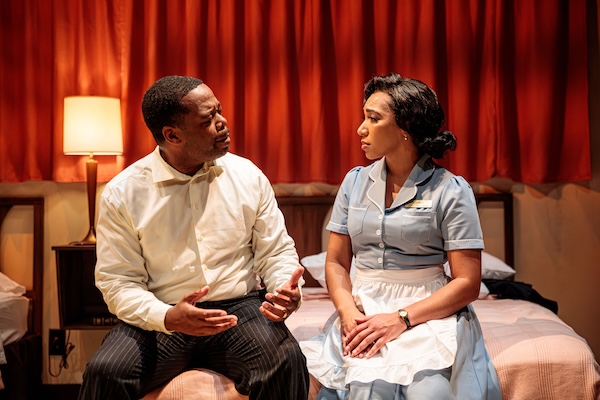
Dominic Carter as Dr. Martin Luther King, Jr and Kiera Prusmack as Camae in Front Porch Arts Collective’s production of The Mountaintop. Photo: Benjamin Rose Photography
The battle over the nature of American history and the meaning of progress is underway. The current push toward authoritarian revisionism is driven by an unholy alliance of the powerful among the Christian right, the corporate right, and Trump’s MAGA right. Their goal? To restore the privileges they believe belong primarily to the nation’s whites. What drives their animus? A virulent opposition to civil rights and social progress for minorities, women, and LGBTQ communities. It is also powered by a wholesale, at times gleeful, diminishment of the heroes who fought for the cause of racial justice and economic equality, particularly Martin Luther King Jr.
The late Charlie Kirk is quoted as saying MLK was a “mythological anti-racist creation.” “MLK was awful,” Kirk said in late 2023 at America Fest, a political gathering put together by his organization, Turning Point USA. “He’s not a good person. He said one good thing he actually didn’t believe.” For Kirk, passing the Civil Rights Act in the ’60s was a misstep; he claimed it led to what he called a “permanent DEI-type bureaucracy.”
Amid this backlash, the Front Porch Arts Collective’s engaging revival of Katori Hall’s drama (it premiered in London in 2009 and came to Broadway in 2011) arrives at a critical time. When it was initially produced, the script, which is set in Memphis’s Lorraine Motel on April 3, 1968 — the eve of the Rev. Martin Luther King Jr.‘s assassination — was generally welcomed as a recalibrated celebration of an icon. Today, the two-character drama serves as a rejoinder to emboldened efforts at political denigration. The play is a reminder of what King stood for — racial justice and economic equality — and what he stood against — xenophobia. The latter is being stoked by carefully nurtured resentments and reams of misinformation, and it has taken on a frighteningly virulent form. The ’60s were a time of enormous turmoil, violence, and chaos — I was there, protesting the Vietnam War — but due process and democracy itself were not in as much danger then as they are now.
The play’s Dr. King seems to have foreseen our current predicament. At the beginning of the evening, he has just delivered his “I’ve Been to the Mountaintop” address at the Mason Temple, and he is already at work on his next speech, a fiery one that will set out “why America is going to hell.” His exhaustion may exemplify the weariness felt by many in today’s liberal/progressive leadership: King is fatigued, embattled, rattled by death threats against him and his family, and beset by the paranoia that inevitably comes with F.B.I. surveillance. He also has intimations of mortality, reflected in his panic whenever he hears a blast of thunder.
Still, despite a bad cough and his smelly shoes, King is determined to finish his latest piece of oratory. A Pall Mall cigarette and a cup of coffee would help things along. These are brought to him by Camae, a new maid in the hotel, who turns out to be one of the most chameleonic servants in American drama since Sabina in Thornton Wilder’s The Skin of Our Teeth. This independent woman is alternately funny, quirky, challenging, seductive, and bullying. She both lampoons and praises King, brings up Malcolm X, faults the Reverend for not being aggressive enough (“walkin’ will only get us so far”), refers to the man’s infidelities, flirts with him (King is all too willing), takes him down a notch, and so on. Camae is not all she seems to be. At one point, King suspects that she might be a government plant — but Hall has other, more fantastical, ideas.
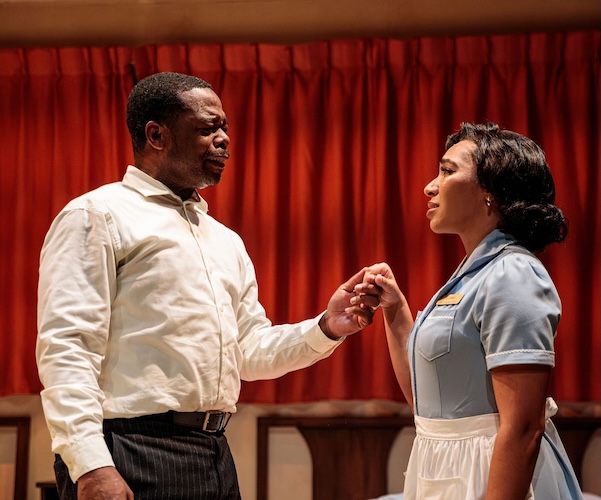
Dominic Carter as Dr. Martin Luther King, Jr and Kiera Prusmack as Camae in Front Porch Arts Collective’s production of The Mountaintop. Photo: Benjamin Rose Photography
Running 90 minutes with no intermission, the play takes its time to get going, and then has to pack in an enormous amount of material, helter-skeltering from humor and pathos to a glimpse of the Promised Land. Director Maurice Emmanuel Parent isn’t always in control of the dramatic tone — the discussion tumbles along without settling into a satisfying emotional shape. But he has the good fortune of a talented cast. Kiera Prusmack shifts through Camae’s various transformations with the panache of a championship race car driver. As impudent, pernickety, and flamboyantly self-admiring as the character can be, her sympathy for King, her sense that he “is and is not a saint,” never wavers. She is very much the Reverend’s equal. Dominic Carter doesn’t have King’s magnetism, but he does an admirable job of balancing the figure’s vulnerability and pride, seeing that his egotism, anchored in his silver tongue, is tempered by healthy doses of spiritual modesty. By accepting his limits as a sinner, King can confront his contradictory qualities, which leads to the drama’s final stretch, a telescopic look at politics and history.
“One of the many things that moves me about The Mountaintop is how it uses the metaphor of a relay race,” says Parent, “the baton gets passed; even when it’s dropped, we pick it up and keep running toward justice. If there was ever a time when that baton was dropped in America, it’s now.” The baton will be picked up, and The Mountaintop‘s rousing ending is reassuring — the struggle will end in triumph, not only by establishing racial justice, but economic equality, a redistribution of wealth that will eradicate world poverty, a dream rooted in King’s Christian socialist principles. But what America is confronting now is a reactionary attempt to change the rules of the game by stopping the contest. There will be no race to win. Hall’s Camae and King call for love over hate, good over evil, and that vision remains necessary and powerful. But it will take more than changing hearts to heal the causes of the pain and fear that have made the authoritarian temptation posed by Trump and company so inviting. It will take the kind of radical change that makes fighting unnecessary.
Bill Marx is the editor-in-chief of The Arts Fuse. For over four decades, he has written about arts and culture for print, broadcast, and online. He has regularly reviewed theater for National Public Radio Station WBUR and The Boston Globe. He created and edited WBUR Online Arts, a cultural webzine that in 2004 won an Online Journalism Award for Specialty Journalism. In 2007 he created The Arts Fuse, an online magazine dedicated to covering arts and culture in Boston and throughout New England.
Tagged: Dominic Carter, Katori Hall, Kiera Prusmack, Martin Luther King Jr., Maurice Emmanuel Parent