
Theater Commentary: Boston Fall Theater Preview — Rinse and Repeat and Repeat and Repeat …
By Robert Israel
My hunch is that not only theater critics but audiences will find the parade of tried and true tiresome.
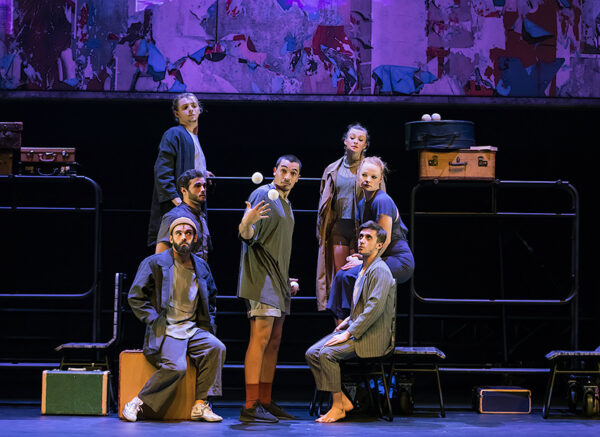
A scene from The 7 Fingers’ 2019 presentation of Passengers. Photo: Alexandre Galliez.
Scan the upcoming 2025-2026 seasons at Boston’s leading resident theaters — American Repertory Theater, Huntington Theater Company, Lyric Stage Co., SpeakEasy Stage, and Arts Emerson — and there is an inescapable trend: a parade of safe offerings. Several companies are taking this fear of provocation even further by playing the familiar game of Pete Repeat, i.e., mounting shows that have been previously staged by other Boston-area companies. In Boston, if you missed a show once, don’t fret — you can catch it later. It is as if Yogi Berra were the city’s theater programmer: it’s déjà vu all over again.
Take, for example, at A.R.T., which opens its new season with Passengers, by the Montreal-based troupe Les Doigts de la Main. According to artistic director Diane Paulus, the show exhibits “thrilling physicality and choreography.” My inquiring mind can’t help but wonder: Aren’t there other troupes – and shows – that could fit that description? I ask that question because, well, Passengers has been performed in Boston before — at Arts Emerson –in 2019 (Arts Fuse review).
Not to be outdone, Lyric Stage Co. is joining the Pete Repeat Club with yet another production of (please stifle your yawns) Our Town. In recent years, Thornton Wilder’s 1938 chestnut has been staged locally by Huntington Theater Co., Boston Playwrights Theater, Boston University College of Fine Arts, Cape Rep Theater, Eventide Theatre Co., and Calliope Theatre Company (not to mention at numerous high schools throughout New England.) If you somehow missed this omnipresent classic, now’s your chance to see it live and on stage!
The Huntington Theatre Company joins the been-there-seen-that-show-before game by reviving the multiple Tony award-winning musical Fun Home, last seen at SpeakEasy Stage in 2012. Why? Because Loretta Greco, HTC artistic director, says so: “this beloved Broadway anomaly is one of my all-time favorites.” OK, she’s the boss. But she doesn’t tell us why Boston audiences might be longing to see yet another play by American playwright Joshua Harmon: “We didn’t want to go another season without a play from our brilliant friend, the playwright Joshua Harmon,” she chirps. Last season, HTC presented Harmon’s Prayer for the French Republic (Arts Fuse review) and, before that, SpeakEasy Stage Co. gave us his Bad Jews (Arts Fuse review). Greco, who hails from San Francisco, evidently made warm promises to Harmon and to Carey Perloff (selected to be guest director for two plays at HTC) while she was employed as an artistic director on the West Coast. Harmon, for his part, is understandably thrilled: “This is the third play of mine she’s producing, in addition to many years of support and development opportunities.” Other playwrights — for example, two Pulitzer Prize winners Brandon Jacobs-Jenkins and Samuel D. Hunter (not to mention other local, national, and international writers and directors theater lovers could think of) — have had to wait in the lobby for 10 years or more before they were produced in Boston. Harmon is escorted, with regularity, onto HTC’s proscenium.
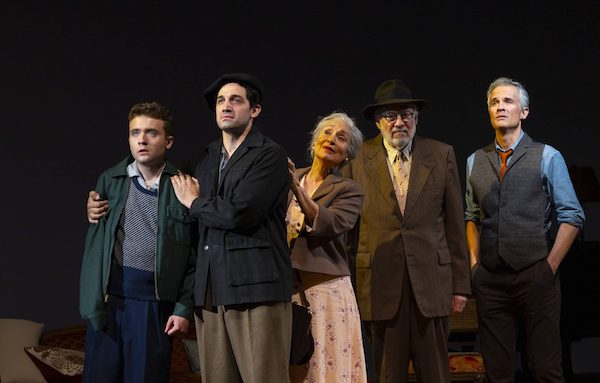
Left to right: Jesse Kodama, Jared Troilo, Phyllis Kay, Peter Van Wagner, and Tony Estrella in the Huntington Theatre Company production of Prayer for the French Republic. Photo: T Charles Erickson
To its credit, SpeakEasy Stage Co., breaks the Pete Repeat pattern, as does Arts Emerson. These theaters are offering new seasons of shows, scripts never before produced in the Boston area. And, in the Outer Cape, the Provincetown Tennessee Williams Theater Festival is celebrating two decades of daring productions. The fest is making good on a line from Williams’s Sweet Bird of Youth –“There’s no more valuable knowledge than knowing the right time to go”– by presenting its final full season with works by Williams and Samuel Beckett, No doubt the gathering will go with a bang: challenging audiences by mounting plays in unusual settings as well as staging challenging works.
One does not have to look far to see where our theater’s fear of the new is coming from. The Grim Reaper is hovering in the wings via cuts in federal funding of numerous arts organizations, courtesy of Donald Trump. Local and national organizations are understandably worried. The HTC has trimmed its staff, including laying off stalwart employee (Director of Public Affairs and Strategic Partnerships) Temple Gill after her two decades of service. More will face the chopping block as time marches on. Of course, this could be a time when performance troupes and arts groups rally together. They need to make loud, protesting noises as they look for new sources of funding. Or they can don the cheerful mask of submission and bow to the illiberal overlords, offering up mediocre seasons of familiar favorites and old chestnuts, and hope audiences will support them. No one knows how these ill winds will play out. But my hunch is that not only critics but audiences will find the tried and true tiresome. Live theater is a place to stir the spirit, not smother it with oh-so numbing wet blankets of familiarity.
In closing, and in the spirit of repetition, I once again share a quote from Sarah Benson, departing artistic director of the risk-taking SoHo Rep in NYC, who said it best in an exit interview in the New York Times:
Even in the mainstream commercial spaces, the old model of tourists and all of that, it’s gone, the subscription model is gone. There’s a lot of second-guessing that doesn’t put any trust in the audience — it’s really patronizing. But audiences want to see something new. They don’t want to see what they’ve seen over and over and over again.
Robert Israel, an Arts Fuse contributor since 2013, can be reached [email protected].
Tagged: American-Repertory-Theatre, Huntington-Theatre-Company, Lyric Stage Company, Provincetown Tennessee Williams Theater Festival
8 Comments
Leave a Comment
A note of agreement with some expansion. Boston area theaters are not acknowledging the world around us; in general, they are content to serve up scripts that, at least from what I can tell of the Fall Season, have little to say, directly and powerfully, about war, peace, genocide, economic concentration, a crisis for immigrants including kidnapping, huge cuts in Federal funding for the arts, and the possibility that democracy might be on the chopping block, etc. The impression is that the companies are serving theatergoers who want to escape into the safe and sound, even though the competitive choices for diversionary entertainment have never been greater, with online, cable, and AI offering endless opportunities to ignore political and moral demands. And you don’t have to leave your home.
I would agree with Bob that our stages are bending the knee (both knees in some cases) out of fear. There is also self-censorship going on, propelled by a lack of imagination, a refusal to use art to meet the moment with bracing truths rather than as a means to hide. Given what is happening around us, the choices of repertoire smack of complacency and fecklessness. Let us hope a younger generation of theater makers will look back and draw inspiration from theater’s past, when the Greeks, Shakespeare, Brecht, Soyinka, and Churchill etc embraced the freedom of the stage. “If liberty means anything at all, it means the right to tell people what they don’t want to hear.” — George Orwell.
As someone who spent some time as an arts administrator, I found that the recent ‘Rinse and Repeat’ commentary might benefit from some context.
Although capacity-building pledged to the Front Porch Arts Collective was cruelly clawed away, NEA funding has had minimal impact on most theatre companies cited in the commentary. Federal funding indeed kept us all afloat during the pandemic but it’s been some time since a regional theatre relied on that money.
Likewise, citing the programming decisions of SoHo Rep carries spotty resonance at best for the Boston-based theatre companies. As the quote correctly cites, tourist and subscription tickets are not reliable for Boston-based companies, but it overlooks how the sheer number of ticket-buyers in New York with high risk tolerance for new material dwarfs that of Boston.
Theatre is an interpretive artform and certainly nobody would call for Commonwealth Shakespeare or Actors Shakespeare Project to shutter or close their doors because they’re not presenting something new. One of the greatest challenges of presenting theatre is that unlike live music, which has Spotify as a backdrop, or a visual arts museum, where a hungry new visitor can augment their engagement with thousands of images on-line, theatre has to be experienced live to be fully appreciated; the pandemic taught us that lesson too.
With that in mind, I don’t like that we should find the Huntington’s decision to mount a Tony-award winning musical that was last produced 13 years ago to be such a dismaying turn of events. You should consider the number of people living in Boston who did not live here 13 years ago. (Not to mention, those that were teenagers or younger when SpeakEasy produced Fun/Home.)
I worked at the Huntington during its production of Our Town, one that I found so compelling, I didn’t wait 13 years; I saw it again ten days later. Full disclosure, Courtney O’Connor is a good friend of mine and one of the most valued colleagues I ever worked with, but even if that wasn’t the case, I look forward to her production, which I expect to carry a point of view very different from David Cromer’s and well worth time and attention. (I suspect it will be different from the high school production I appeared in back in 1987. I’m not sure that the existence of high school productions should be a disqualifier for programming a professional venue.)
None of which is to say that productions of new plays aren’t welcome, and the Huntington and Lyric Stage both have examples of that in their upcoming seasons. The best way to prove me wrong on this score is if audiences flood the gates. I wouldn’t argue though that the newness of a script should pre-determine if the production itself will be worthy or lacking. Certainly, it’s the role of The Arts Fuse and other critical journals to demand high standards of both, with a particular demand that the revivals are fresh and speak to the current moment. But to dismiss them out of hand simply because it’s been a decade or more since their last iteration seems short-sighted.
Great to have Matt’s perspective.
A few observations: Because few of Boston’s theaters depend on NEA funding doesn’t excuse that our stages have not publicly condemned the Trump administration’s actions, which are detrimental to the culture at large . And if our theaters do not depend on government funding, what explains their lack of gumption when it comes to programming?
Boston doesn’t have enough ticket-buyers with “high risk tolerance for new material.” Really? The city is at the top of those in the country with the highest concentration of students. They might come to the theater — if something “risky” was done that appealed to them. But our theaters are content to do the same old, same old rather than do the hard work of cultivating younger audiences with exciting work.
I am with Bob. There are so many contemporary works — new and fresh — that are not being done here that it is baffling to be served repeats. Yes, Commonwealth Shakespeare Company specializes in the Bard — but there are contemporary versions of Shakespeare that would offer a challenging alternative, such as Edward Bond’s Lear. It feels as if theaters are clinging to safety — when the times call for daring. Yes, to the classics, but there are so many of those that are not being done. The list is too exhaustive …
It’s wonderful to have friends, as Matt discloses, “Courtney O’Connor is a good friend of mine and one of the most valued colleagues I ever worked with.” It’s heartwarming to be supportive of a friend’s work. But given that Our Town has been produced so many times — the list of local productions is exhaustive — do we really need another production, at this time?
Loretta Greco has friends, too: Joshua Harmon is in that category when she states, “We didn’t want to go another season without a play from our brilliant friend, the playwright Joshua Harmon.” But should friendship be a criteria for programming? Would it hurt terribly if Ms. Greco staggered Mr. Harmon’s work to another season? Would Boston audiences cry out if she didn’t include him for this upcoming season?
There are many compelling reasons to think these decisions through with more clarity and more variety — and we’re just not getting that from many in the Boston theater community.
Hard not to agree with the sentiment of the original article and I wish more Artistic Directors would do the work of not only finding new local voices to bring into the circle but also throwing their weight behind helping them develop their careers. I have a hard time begrudging Joshua Harmon getting a production of a new play, (perhaps it says something that I’m just thrilled to see ANY living playwright gets a production of a new play at a major theater), but why exactly does Boston need the new Harmon work staged? So far as his bio reads, he wasn’t born here, grew up here, went to college here or lives here now. If the Huntington wants to say they’re part of Boston theatre, it would be great if they consistently produced a swath of local writers/artists rather than just every once in a while. Whether they mean it or not, it comes off as patronizing to those of us trying to create art in Boston. As though only one of us, once in a while, is doing something worth their attention.
Theatre is an industry that always likes to say that they’re speaking to the moment, but it’s always struck me as a bit odd that at season announcements, ADs will get on their soapboxes and proudly proclaim some version of “We feel it’s our duty to respond to [INSERT RECENT HISTORICAL EVENT] and we shall do so….by producing this play from fifty years ago…”.
Finally, all due respect, but can I say that it’s extremely lame/lazy/disheartening to hear someone who worked in arts admin in Boston say “the sheer number of ticket-buyers in New York with high risk tolerance for new material dwarfs that of Boston”? Cards on the table, I’m a local playwright/director/ex-critic/theatre-goer. I have skin in the game. But I can say without reservation that I’ve seen audience members come alive and respond to new and challenging plays. The thing is that it’s always happened at the fringe level. Since those companies don’t have the marketing budge (and because local media don’t give them the same share of the spotlight as they do for the larger theaters), those shows always inevitably play to smaller/negligible houses. The audience IS there and I think could be grown, it just takes commitment and dedication of resources. If a theatre company decides to do one strange/challenging/new play every three seasons and the rest of the time they’re rehashing classics, then obviously the new work will fail because the audience hasn’t been primed for it. Admittedly, it would take work and it might take some time to build that new audience, (it might mean a few lean seasons), but it could be done.
If we’re going to throw up our hands and say “Nevermind, it’s just going to be Shakespeare until the end of days,” then what are we even fighting to protect?
All to the point — and in line with Bob’s article. The only place I would disagree is with the notion that our theaters “proudly proclaim some version of “We feel it’s our duty to respond to [INSERT RECENT HISTORICAL EVENT] and we shall do so….” Maybe that was true in the past: our stages are boldly relevant — when they feel it is safe to do so.
Today, our theaters are asleep. They are NOT dealing with issues of threats to democracy, accusations that America is financing a genocide, growing evidence of climate disaster, economic inequality that’s generating anti-capitalist sentiment. Fear? Cowardice? Who knows? There is no interest in reflecting what is going on in the real world — meanwhile, those looking for escapism can stay at home and watch Netflix, Apple TV, etc. How about producing theater productions for the thousands and thousands who are going out to protest what is happening to our country? Don’t they deserve drama that speaks to the moment? Or are Boston theaters just content to be entertainment for the indifferent?
I hope you’re well. In reading your most recent commentary on The Arts Fuse regarding the upcoming fall theatre season in Boston, I was struck by how much your perspective resonated with me. As a theatre historian and a dramaturg, I’ve struggled with how lacking/non-existent the responses to our current moment have been from the major Boston theatre companies, especially those with large footprints and built-in audiences. I appreciate your perspective and thank you for sharing it.
Thank you Bob and Bill for starting and supporting a desperately needed discussion on what regional theater owes the region it serves. Key words here are regional, owes, and serves. Another key word is ‘live.’ The potential of live theater is that it can address the moment, and if there was ever a moment in American history that needs addressing, that moment is now. The entire structure of our lives (again the word ‘live’) from core values to the hundreds of interlocking infrastructures that shape our day-to-day existence is being destroyed, and a majority of the country (which, by the way, did NOT vote for the current inhabitant of the presidency) is still sleepwalking through each day, unaware of the growing efforts to resist this multifaceted destruction. Some seventy plus years ago, when the regional theater movement was born –– breaking away from the tried and true entertainment of commercial theater –– it was propelled by a bursting sense that theater could do more than entertain as part of a commercial transaction. There was a sure and certain knowledge that theater could tap deep wells of empathy, had the potential for transformation, and, indeed, had a responsibility to ‘serve’ and address the ‘regional’ needs and issues of our diverse nation. Regional meant the ability to address the differences, the nuances that commercial theater seemed to erase in its effort to appeal to the generic everybody.
Boston is not NY, but you’d never know that from the programing at most Boston theaters. The ART seems to pride itself on being pre-Broadway, and being able to offer a ‘Tony winning’ production seems to attracts ADs like a magnet. I agree with James –– where is the Boston, or greater New England focus? If the Boston theaters started offering theater that waded in to the thick of our issues, if it made theater part of our daily lives rather than a once-in-a-while event to escape reality, we would be on a path to not only finding but growing a larger audience. In a world of on-line, fragmented virtual surfing, with attention spans reduces to minutes, article after article speaks to peoples’ hunger for community –– for sitting together and experiencing together our shared struggles and aspirations for a better life for ourselves and our families.
By bringing people together in community, theater can play a major role in organizing the resistance to the destruction of our democracy, and of our planet. Theater can remind us, in vivid, dramatic ways, that we have agency, and that in a sense, it all started here! We were leaders! Why are we not leading now? Why are we not using our art and creativity to capture people’s attention, to bring together our diverse communities; to band together in solidarity, to build our power not only to resist the current destruction, but to create a vision of the kind of world we want for our children and our children’s children? We are in this mess because it has become clear that what was was no longer serving most of us. And with the region’s wealth of educational, medical and technical resources are we not poised to be part of the solution, of creating a new future?
And speaking of children –– why are we not using the performing arts to plant the values inherent in democracy in them; to instill a sense of social and civic responsibility in them so that when they enter the fray of life, they will be prepared to support and protect democracy. And oh, by the way, if we do that, we will also have created the next generations of audiences for the greater Boston regional theater –– a theater that serves all our needs –– including entertainment!