
Film Review: Dialectical “Materialists”
By Peter Keough
Director Celine Song beats the romantic comedy to death.
Materialists. Directed by Celine Song. At the Coolidge Corner Theatre and in the suburbs.
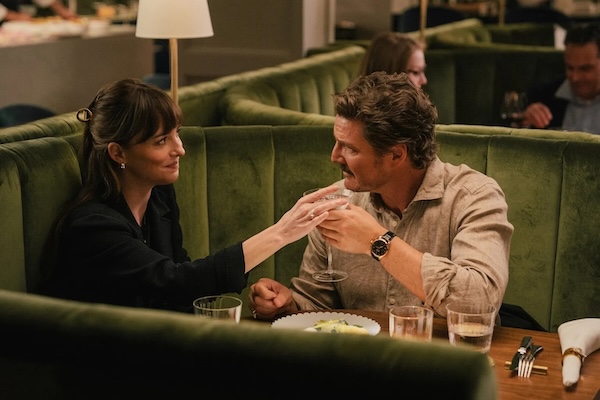
Dakota Johnson, left, and Pedro Pascal in Materialists. Photo: Atsushi Nishijima / A24
Like Stanley Kubrick’s 2001: A Space Odyssey (1968), Celine Song’s sophomore effort opens during The Dawn of Man. In an idyllic valley, a hunter-gatherer collects a bouquet of flowers and brings them to the cave of his beloved. He presents them to her along with a pouch full of primitive stone tools and, for a final winning touch, wraps a blossom around her finger. And just like that, the institution of marriage is born. Nor have we seen the last of this couple. They will return — via tedious unnecessary voiceover — because Song can’t leave an obvious metaphor, idea, or plot point alone until she belabors it into inanity.
Flash forward a few hundred millennia to present-day Manhattan, where Lucy (a doggedly insipid Dakota Johnson) is gazing into a mirror, applying make-up in her perfectly appointed boudoir. She struts out to the street where a passing stranger gives her a passing glad eye. She stops, turns back, and hands him a business card. Is she a latter day Julia Roberts from Pretty Woman (1990)? No. The card is for “Adore,” the matchmaking service she works for. She’s not a prostitute, but a panderer, or, as an embittered former client describes her, a pimp.
She’s good at her job and loves the work. When a dubious client questions Lucy, she offers this reassurance: “it doesn’t matter if you believe it, because I believe it.” Yet, on another occasion, she relates how some men spend hundreds of thousands of dollars on a painful surgery to increase their height by up to six inches, a procedure I had only previously heard of in Andrew Niccol’s 1997 dystopian sci-fi movie Gattaca (a quick trip to Mar-A-Lago suggests that the compulsion for such dysmorphic butchery is more symptomatic of female rather than male pathology). Is Lucy naïve or cynical? For Song, as with her other characters, such consistency or coherent psychological development doesn’t seem to matter – it’s sacrificed for immediate dramatic effect.
For now, though, she’s gung-ho. She’s produced nine glorious marriages and is attending the most recent, a match between two “unicorns,” candidates who “check all the boxes:” rich, good-looking, young, from a good (i.e., rich) family. But the bride is having second thoughts. I’m such a perfect woman, she whines, is my goal in life to become a perfect wife? Lucy assures her it is. Is Song doing so also?
At the reception, she bumps into another unicorn, the groom’s brother Harry (Pedro Pascal, no Cary Grant). He admires her skill at schmoozing, noting how skillfully she sets up marks among the wedding guests. And he likes her attitude, a mix of fanatical idealism and cold calculation (it is like working at a morgue or insurance company, she tells him). Harry takes a card too, but his interest is clearly more than professional.
But one of the caterers interrupts this blithe interlude. He sidles up unbidden to serve up Lucy’s favorite drink (coke and beer, for God’s sake, thus exposing her plebeian roots). It’s her old flame John (a rough around the edges Chris Evans), who, as a perfunctory flashback reveals, broke up with her in a petty argument about money. They were both aspiring actors at the time, dream-struck refugees in New York City fleeing poor and dysfunctional families. He, now pushing 40, is still trying. Clearly not a unicorn.
It’s the classic romantic comedy template, a genre going back to Shakespeare and Jane Austen and reaching its Hollywood peak in the ’30s and ’40s with masterpieces by Howard Hawks, Frank Capra, Preston Sturges, and others. It is a perennial crowd-pleaser in which endemic social conflicts (class, for example) are set in romantic situations that are usually resolved in contented marriage. Song, a playwright, is no doubt familiar with this template, but she’s not adept at fleshing it out with credible characters. Convincing dialogue is hard to find: the talk is more like a PowerPoint lecture for the director’s half-baked ideas. Like Lucy, it seems her strategy amounts to simply checking off all the boxes.
Compounding this artificiality, Song’s filmmaking has grown stagier and less cinematic since her promising debut, Past Lives (2023). As the camera dithers from one uninspired Manhattan setting to another, the mind wanders from the leads to the figures in the background, like the three out-of-focus chefs in white working in the chichi sushi restaurant – surely they have a more interesting story to tell? Or the troglodytes at the beginning – minus the vapid voiceover.
Peter Keough writes about film and other topics and has contributed to numerous publications. He was the film editor of the Boston Phoenix from 1989 to its demise in 2013 and has edited three books on film, most recently For Kids of All Ages: The National Society of Film Critics on Children’s Movies (Rowman & Littlefield, 2019).