Jazz Concert Review: Eliane Elias — One of a Kind
By Jon Garelick
The magic in Eliane Elias’s performances is in how easily she slips from one musical dialect into another.
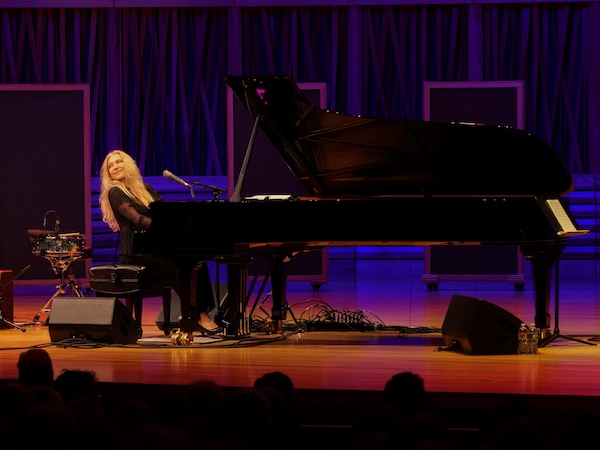
Eliane Elias at the Groton Hill Music Center. Photo: courtesy of Groton Hill Music Center
The singer, pianist, and composer Eliane Elias, now 65, has been a singular virtuoso for so long that it’s easy to take her for granted. But each performance is a vital reminder of who she is and where she comes from.
She began her concert on June 7 at Groton Hill Music Center describing how she was playing a jazz show at a club in São Paulo at the age of 17 and discovered that the great songwriting team of Antonio Carlos Jobim and Vinícius de Moraes, and another bossa legend, Toquinho, had been in the audience. After her set, they invited her to join a tour. “I accepted,” she said with a broad smile.
Thus the prodigy began her education in earnest, learning the bossa nova tradition from key figures in the genre’s invention. But there were still years of education ahead of her — hard work studying American jazz pianists like Art Tatum, Oscar Peterson, Bud Powell, and Bill Evans (see Glenn Rifkin’s Arts Fuse interview with Elias here), and time at Juilliard before joining the jazz-rock Steps Ahead, with a founding crew that included Michael Brecker.
Despite a wide range of music since then (and a whole bunch of Grammy nominations and wins), she has in recent years recommitted to her Brazilian roots, playing shows heavy on samba and bossa but with her own jazz-informed personality driving it all.
At Groton Hill she played with the same setup as last year at Scullers: acoustic piano with guitar, bass, and drums, blissfully short on the high gloss production that, to my ears, sometimes mars her recordings. There was a mix of late-career-spanning material, including the opening “To Each His Dulcinea,” from her 2018 Music from Man of La Mancha, and from Mirror Mirror (2021), her album of piano duets with Chick Corea and Chucho Valdéz, and from Time and Again (2024).
The magic in Elias’s performances is in how easily she slips from one musical dialect into another. A samba rhythm can shift into walking-bass swing or a hard-bop vamp, but always with clear intent, one section commenting on another or lifting the music into the next modulation in tempo or harmony. Sometimes, as in Saturday’s performance of her own “Falo do Amor,” you can hear the driving samba as the flip side of those hard-bop vamps, the bluesy backbeat rhythms that became explicit in the piano solo portion following the vocals.
My favorite portion of Elias’s recent shows has been the middle section, where, she said, she tries to recreate the intimacy of an early living-room gathering of bossa adepts — bringing drummer Mauricio Zottarelli from his trap kit to sit behind her with a single drum, next to guitarist Leandro Pellegrino, and bassist Marc Johnson also shifting from opposite the pianist to a spot just beyond her left hand.
When Pellegrino and Zottarelli launched into the bossa standard “Você e Eu” (“You and I”), by Carlos Lyra and de Moraes, it wasn’t difficult to imagine yourself in one of those living rooms overlooking the sea — Elias’s vocals floating over the elegant syncopations of guitar, brush, and stick, a fast swish and tock.
During these numbers, Elias would interject a few spare piano chords or single notes, mostly sketching the lyrics and rhythm by lightly waving her hands as she sang. After a verse or so, Johnson would join in, and the full group would take off, Elias’s piano leading the way.
There were other felicities. More standards, like “Esta Tardi Vi Llover” (by Mexican composer Armando Manzanero), Janet de Almeida’s “Eu Samba Mesmo,” the “Bahia medley” of “Saudade da Bahia” and “Você Já Foi à Bahia” by Dorival Caymmi, and originals like her own samba-inflected “At First Sight.” (The “acoustic” set is beautifully captured on Elias’s 2022 Quietude.)
As the show went on (and early audio balance problems were adjusted), Johnson’s role became more apparent — his ability to step in and out of tempo while maintaining the groove with Zottarelli and Elias and also augmenting harmonies, infused with his own melodic touches. Johnson was already a master when he joined Bill Evans’s trio nearly 50 years ago, and his 39-year partnership with Elias (to whom he is married) has been one of the most enduring and fruitful in jazz.
Saturday’s finale began as a ruminative piano solo, which gradually came into focus as Elias introduced a short phrase from “Desafinado,” with muted, slightly dissonant left-hand bass notes, so that this Jobim bossa chestnut emerged like a memory, and then, with more urgent crescendos, like an extended piano fantasy. Soon the piece took flight with the whole band — there were bravura solos from Johnson and Zottarelli (the latter of which brought down the house).
There were quibbles — despite its opulence, and the presence of multiple onstage sound baffles, Groton Hill’s big main Concert Hall (capacity 1,039) was as unfriendly to trap drums as most of the area’s big, “drier” concert halls, from Jordan Hall to Symphony Hall. And Pellegrino’s guitar was inaudible except for the quieter mid-show set and some electric guitar solos. Maybe moving shows like this from the Concert Hall to Groton Hill’s smaller Meadow Hall (capacity 307), would help. Groton Hill reported the audience for the Elias show at “about 700.”
But the musical impact of the show as a whole was undiminished. The standing ovations following “Desafinado” and a shorter encore were well earned. And Elias reasserted her uniqueness as singer/pianist, composer/arranger, and bandleader, fluent and authoritative in her own special dialect of jazz.
Jon Garelick can be reached at [email protected]. He is a former arts editor at The Boston Phoenix and member of the Boston Globe editorial board.
Tagged: Eliane Elias, Groton Hill Music Center