
Film Review: “The Phoenician Scheme” — Visions from a Mad Magician’s Toy Box
By Erica Abeel
Bottom line: for all of The Phoenician Scheme‘s visual glories, the whimsical portrait of a shady arms dealer who becomes a mensch in the bosom of family rings hollow — especially at the present moment.
The Phoenician Scheme, directed by Wes Anderson. Screening at cinemas around New England.
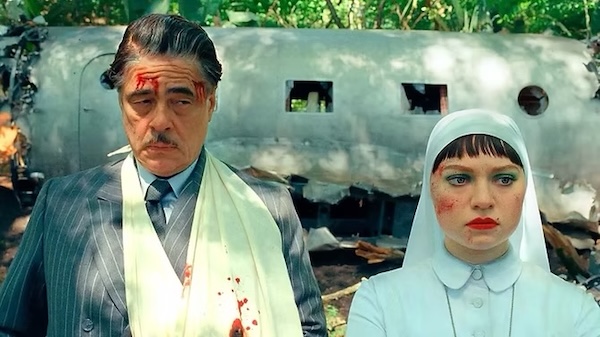
Benicio del Toro and Mia Threapleton in The Phoenician Scheme.
In fiction or film, a MacGuffin is an object, device, or event that is necessary to the plot and motivation of the characters, but insignificant or irrelevant in itself. It’s a fine strategy for structuring a narrative (an early example would be the search for the Holy Grail). But in the case of The Phoenician Scheme, the latest from Wes Anderson, the entire film feels like a MacGuffin.
This is not to say the film’s not gorgeous. The opening credits roll over a tableau shot from a God’s-eye-overhead of Benicio del Toro reclining in a tub in his ’50s-era bathroom. Having survived an assassination attempt, he’s being ministered to by a passel of servants: one dressing his wounds, another serving him comfort food. You could live in that tableau longer than it sits on the screen, so elegant is the spatial arrangement: del Toro in his tub hugging the left side of the frame, nurse fussing with surgical implements centered at the bottom, other objets placed just so. The thing could hang in a museum. And it’s only one of an onslaught of visual delights that comprise Phoenician.
That said, these images, adorning an overstuffed and confusing plot, are pretty much what you get. I left the theater feeling there’s no there there.
The plot, such as it is: Del Toro plays Zsa-zsa Korda, an oil tycoon and weapons dealer (read “ruthless business man”), who’s besieged by enemies, among them a government agent (Rupert Friend) and maybe the partners he’s screwed, all of whom want him dead. After improbably surviving the sixth or so airplane crash — and an encounter with Bill Murray’s God – Korda is moved to reassess his life. He decides to leave his grand construction project in the imaginary land of Phoenicia to his estranged daughter Liesl (Mia Threapleton), who’s become a novitiate nun.
On her side, Liesl hopes to persuade her father to take the moral high road in his business enterprises and, like, lose the slaves, and maybe stop saying, “help yourself to a grenade.” The pair hit the road to Phoenica, an amusingly hybrid world with only a passing resemblance to a real one, presumably to find funding for Zsa-zsa’s dream project. Traveling aboard a “private train” that chugs across the screen in a long tracking shot (an Anderson style fetish), they encounter a royal nabob (Riz Ahmed), two goofballs who like to shoot hoops (Tom Hanks, Bryan Cranston), a nightclub owner named Marseille Bob (Mathieu Amalric), and a Communist guerrilla (Richard Ayoade). Why Hanks and other name actors are along for one-minute cameos I’m not sure.
Perhaps they enjoy the feel of community. Apparently, Anderson likes to gather his cast for group dinners; in Cannes, they reportedly all hung together in the same digs. It harks back to the idea of repertory theater, where members share a common acting style (in short supply in the US, where you’re apt to get a gumbo of techniques in a play or film). In Anderson’s case, the group has mastered his signature deadpan delivery. Newcomers to the clique are Mia Threapleton, who charmingly nails the deadpan with dignified stillness, and Michael Cera, a scientist in Zsa-zsa’s employ, whose Norwegian accent serves mainly to annoy.
As in much of Anderson’s work, Phoenician is centered on the search for family connection. The bonding of Zaza and his daughter is the warmish heart of the film. Is it churlish — or beside the point — to say the director doesn’t go deep enough? Especially since Anderson’s aesthetic is to curate surfaces rather than plumb depths? I enjoyed the actors’ flattened affect in Asteroid City because it seemed to sit atop some genuine pain, but in Phoenician it just feels overused. God bless his fans if they can keep track of the film’s plethora of names, pop-up cameos, and stuff, among them the shoeboxes where Zsa-zsa stows his plans. A plot point involving the possible murder of Liesl’s mother by none other than Zsa-zsa himself is left dangling. (Spoiler: the perp may be one Uncle Nubar, or Benedict Cumberbatch, who seems about to crack up behind his fuzzed-up eyelashes and beard. Maybe not much of a spoiler because, trust me, it really doesn’t matter).
Of course, serious and earnest is anathema to Anderson — but perhaps his archness is ill-suited to Phoenician’s critique of capitalism. We’re given little idea of the crimes behind Zsa-zsa’s fortune, aside from the whoops! of using slaves. His motto, “if something gets in your way, flatten it,” would not meet the approval of Sister Liesl, never far from her rosary. And, as usual, Anderson has little interest in plausibility. But that Liesl has only to bestow papal-style blessings on dad to turn a bloodsucker into a mensch, happy to trade the luxe life for homespun happiness — well, tell it to the oligarchs.
Once again, this film confirms Wes Anderson as a creator of unique worlds — who else makes films like his? If you can ignore the plot, it almost merits a second viewing to absorb its rollout of tableaux, like visions from a mad magician’s toy box. Or a box by Joseph Cornell. At intervals, the film feels drawn from personal aspects of the auteur’s life and, though we don’t get how, exactly, it resonates all the same (the film is dedicated to his father-in-law). Into the bargain, Anderson serves up glimpses of bona fide masterpieces — a Renoir here, a Magritte there. Not fakes! The pictures required their own guards on set and are saluted in the final credits, which is of a piece with Anderson’s tweeness. Bottom line: For all its visual glories, the whimsical portrait of a shady arms dealer who becomes a mensch in the bosom of family rings hollow — especially at the present moment.
Erica Abeel is a novelist, critic, and former professor at CUNY. Among her novels are Wild Girls, named a Notable Book by Oprah Magazine and now available on Audible; and The Commune, a comic satire on the launch of Second Wave Feminism that Kirkus called “a joyous literary romp with hidden depth.” Her forthcoming novel reimagines characters from Ingmar Bergman’s Smiles of a Summer Night.
From that photo alone, I know I want to see this film. Thanks for the review–and the photo…