
Concert Review: A Rare Treat for King Crimson and Roches Diehards
By Paul Robicheau
Exposure is a septet assembled to perform Robert Fripp’s quirkily diverse, overlooked 1979 solo album Exposure for the first time ever, in sequence.
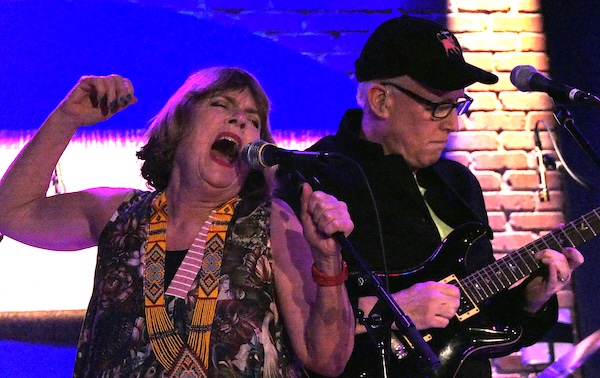
Terre Roche and Steve Ball of Exposure at City Winery. Photo: Paul Robicheau
Since guitar guru Robert Fripp again retired his evolving group King Crimson (perhaps for the last time) in 2021, there’s been no shortage of associated projects filling the void. Foremost among them has been Beat, an all-star vehicle for the band’s 1980s repertoire where longtime alumni Adrian Belew and Tony Levin plus Steve Vai and Tool’s Danny Carey packed large theaters. Arts Fuse review
At the other end of the spectrum is a septet assembled to perform Fripp’s quirkily diverse, overlooked 1979 solo album Exposure for the first time ever, in sequence. The Fripp-endorsed Exposure band includes Crimson drummer Pat Mastelotto and singer Terre Roche of the retired sisters act the Roches — and plays Roches and Crimson material in addition to Fripp’s album. But alas, on a Good Friday where a Paul Revere reenactor drew North End crowds ahead of Marathon Monday, Exposure brought merely about 60 people into City Winery.
The obscure Easter Weekend treat paid off for Crimson and Roches diehards, particularly as the musicians and fans alike appeared to adapt to the odd vibe of such sparse attendance. The album’s opening rock ‘n’ roll outlier “You Burn Me Up Like a Cigarette” — sung by Deb Mastelotto over her husband’s shuffle-based gait — came off as tempered and tentative in contrast to its woolly Daryl Hall-sung version on record. The group displayed more assurance around Mastelotto’s beefy fills in “Breathless,” a piece that the drummer played on rare occasions with Crimson’s final lineup. Two members of Exposure who hailed from the League of Crafty Guitarists (an ensemble born from Fripp’s Guitar Circle workshops) also dug in, with Steve Ball trilling the song’s eerie lead-in before Fernando Kabusacki lashed taut, dark chords.
But Exposure didn’t reach its stride until Terre Roche — one of the singers on Fripp’s original album — strolled out in a ball cap and sundress to screech “Disengage,” sung by the imposing prog-rocker Peter Hammill on record. Roche’s voice may not be as strong at 72 as it was at 26, but she conveyed authority, lending a slightly frayed quality that suited the clashing song. She shifted gears with a calm reading of the soothing Hall tune “North Star” (over slippery bass by Don Box, who orchestrated the album for the tour) and into the edgy control of the blues-steeped “Chicago” (another Hammill vehicle on record) before sitting cross-legged while the band locked into the rock churn of “NY3,” complete with sound bites of a couple in see-sawing argument. It had to seem schizophrenic to people in the audience unfamiliar with the album.
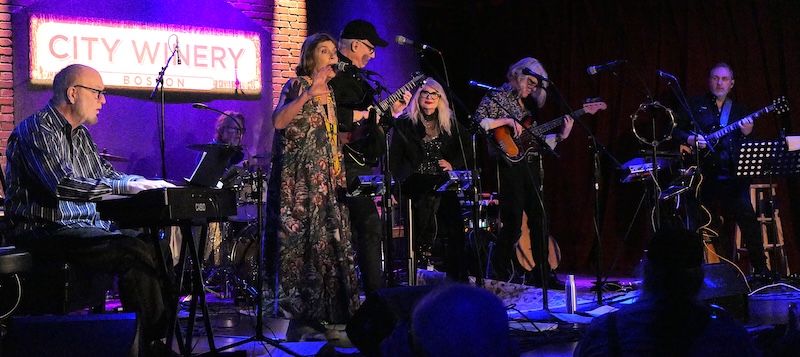
Exposure at City Winery. Photo: Paul Robicheau
Finally, Roche sang two of the three tracks she did on the record, finding tender and pained peaks within “Mary” (about one of lyricist Joanna Walton’s patients as a therapist), then unleashing the harsh refrain of the album’s title track over Ball’s volume-pedal hum. Ball was out of his league in attempting the Hammill part for a vocal face-off with Roche in “I May Not Have Had Enough of Me but I’ve Had Enough of You,” though their contradictory exchanges built a fun vibe.
The back end of Exposure mostly dips into Frippertronic soundscapes, largely handled by Box on a console and guitarist Kabusacki. Ball followed Roche’s lead in sitting cross-legged (plus removing his sneakers) for “Water Music I,” which faded into keyboardist Garry Dial’s light acoustic piano to cue the Peter Gabriel ballad “Here Comes the Flood.” Roche did her best in tackling the ex-Genesis front man’s low-key, emotive gem, finding a lingering resonance in its last line “Drink up, dreamers, you’re running dry.”
After a 50-minute run through the album, the group primarily rounded out its 100-minute set with Crimson and Roches material, a welcome bonus since Roche hadn’t even performed in Boston in the decade and a half since her sisters’ group was last active (well before eldest sister Maggie died in 2017). With Roche on one of four acoustic guitars and added harmonies from friends Lisa and Lori Brigantine, that section began with her own “Runs in the Family” and a sweet “Mr. Selleck” from the Roches’ Fripp-produced 1979 debut, while “My Sick Mind” showcased descending scales in the chorus over piano.
The four acoustic guitars remained for a loose, unusual Crimson jam through snippets of “Red,” “Breathless,” “Discipline,” and Fripp’s disco-fied offshoot the League of Gentlemen’s ping-pongy “Heptaparaparshinokh,” before the band indulged in a firm, on-point electric version of “Red.” A rich run through the Roches classic “Hammond Song” (a breakout for the Brigantino sisters) led to the final tune, Gabriel’s delicate “Mother of Violence,” Ball’s lead vocal helped by four-part female harmonies over acoustic guitar and piano.
“Mother of Violence” hails from Gabriel’s second solo album, which Fripp produced in addition to Daryl Hall’s solo debut Sacred Songs. Both of those albums shared tracks with Exposure, with Fripp viewing them as a trilogy of sorts. “Can I play you some of the new things I’ve been doing which I think could be commercial,” Fripp quips in a spoken-word prelude to Exposure. Alas, all three of those records paled in sales for those artists, although they found favor from an artistic standpoint. Likewise, ticket sales for Exposure’s Boston date were disappointing, yet the unique occasion proved intriguing.
Paul Robicheau served more than 20 years as contributing editor for music at the Improper Bostonian in addition to writing and photography for The Boston Globe, Rolling Stone, and many other publications. He was also the founding arts editor of Boston Metro.
Tagged: "Exposure", Exposure band, Pat Mastelotto, Steve Ball
1 Comment
Leave a Comment

I would have given my eye teeth to see this. Exposure is one of the most brilliant albums in Fripp’s canon.