
Theater Review: “The Odyssey” — From a Woman’s Point of View
By David Greenham
A lot goes on in an epic — three acts over three hours with two intermissions — and there’s boatloads for Kate Hamill to dramatize and for the audience to digest.
The Odyssey by Kate Hamill, based on the epic poem by Homer. Directed by Shana Cooper. Puppetry directions by and design by Kate Brehm. Movement direction by Stephanie Martinez. Fight direction by Ted Hewlett. Scenic design by Sibyl Wickersheimer. Costume design by An-Lin Dauber. Lighting design and projection design by Jeanette Oi-Suk Yew. Sound design and music composition by Paul James Prendergast. Staged by the American Repertory Theater at the Loeb Drama Center, Cambridge, through March 16.
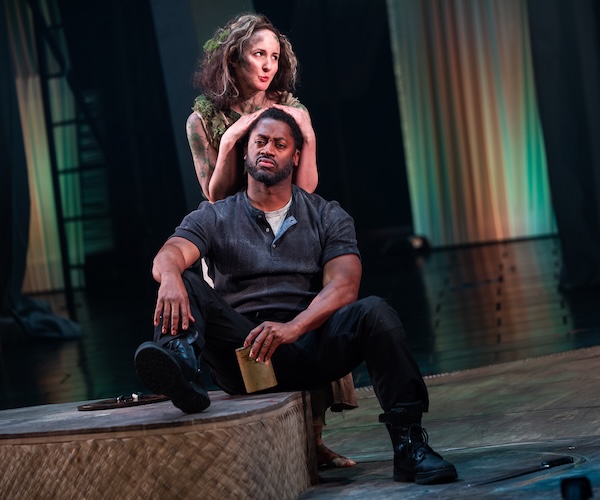
Kate Hamill and Wayne T. Carr in the American Repertory Theater production of The Odyssey. Photo: Nile Scott Studios and Maggie Hall
Actor and dramatist Kate Hamill rightly notes that Homer’s The Odyssey (and the vast majority of the adaptations of the epic that have appeared on stage and screen) focuses on the challenging choices that the war hero, Odysseus, must make in order to make it home alive. The subplot focuses on Telemachus, the son he’s never met, as he grows up in a world where the wolves, in the form of more than 100 disrespectful suitors, are at the gate. Each of these fortune hunters is vying for his mother, Penelope, who, once she declares Odysseus dead, will be free to remarry and turn her kingdom over to another man. There are several female characters in the Greek tale, but each is primarily seen through the eyes of men. Even Odysseus’s patron, Athena, must beg Zeus to allow her to intervene to ensure the man’s safe travels. Unsurprisingly, given the approach of her creative work, Hamill’s new adaptation puts a powerful feminist spin on the classic tale, to the point that it is turned topsy-turvy.
Instead of supernatural string-pulling from Mount Olympus, this story introduces the Fates (Hamill, Alejandra Escalante, and Kristian Espiritu), who represent the many women Odysseus (Wayne T. Carr) encounters as he journeys home in the decade after the bloody massacre at Troy. “Poor Odysseus,” they moan with a cynical sneer, “poor Odysseus.”
The three women serve as shadow judges in this version of the journey, constant reminders that — no matter how hard he tries — Odysseus can’t rid himself of war’s barbaric stigma, its violence and inhumanity. We also learn that his behavior during peacetime isn’t so great either.
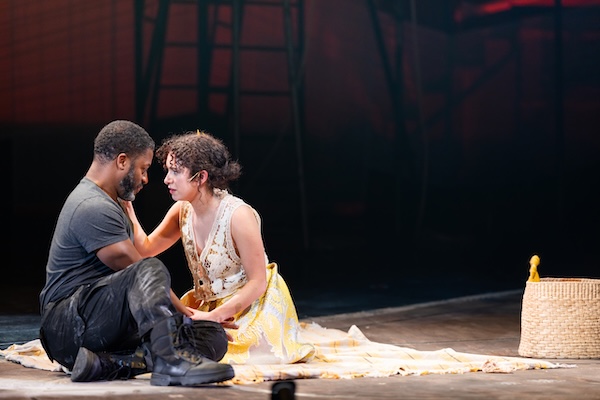
Wayne T. Carr and Alejandra Escalante in the American Repertory Theater production of The Odyssey. Photo: Nile Scott Studios and Maggie Hall
We meet a strong and assertive Penelope (Andrus Nichols) who is far from helpless in the face of her belligerent suitors (Benjamin Bonenfant, Jason O’Connell, Chris Thorn, and Keshav Moodliar). Her son Telemachus (Carlo Albán) is an awkward preteen as the story begins. Penelope is handling him, her silly servant Melantho (Espiritu), and the menacing gang of suitors with deft finesse.
One amusing scene focuses on the alluring mystique of Penelope’s cousin, Helen of Troy. Suitor Amphinomus (Moodliar) wants to know what qualities made the vaunted Helen worth fighting a war over. Helen was a normal woman, Penelope responds, with her own quirks. “They always ask about the beauty,” she says, “never about the truth.”
The travails of Odysseus and his crew are laid out episodically, and some liberties are taken. The staging of these adventures are striking, particularly a visually interesting pit stop with the Cyclops in the cave of Polyphemus (O’Connell).
But it’s the female characters who garner the most attention here. When Odysseus and crew arrive at the island of Aeaea, and have to deal with the crushing evil of Circe (Hamill), the narrative really begins to hit its stride. Hamill’s imagining of Circe is bold: harpy-like, she’s often slipping-and-sliding on the edge of sanity. She’s scary and unpredictable, but also cynical and quick-witted. When Odysseus implores the Gods to help him, she matter-of-factly responds, “the Gods are, um, assholes.” Odysseus and his men are helpless in the face of the feminine self-confidence of Circe and the ever-present Fates.
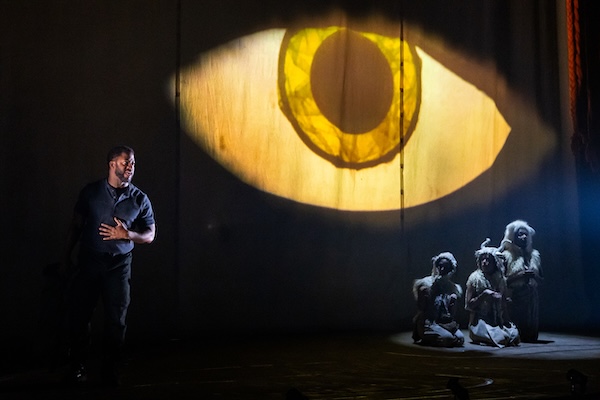
Wayne T. Carr, Kate Hamill, Alejandra Escalante, and Nike Imoru in the American Repertory Theater production of The Odyssey. Photo: Nile Scott Studios and Maggie Hall
In the meantime, Penelope has made a command decision; she’s waited long enough for her husband to return. She selects Amphinomus for her new mate and rumors fly. Even Telemachus questions her loyalty to her husband, but Mom doesn’t budge or apologize. Odysseus is simply a man and, based on his roving eye when he was home, he doesn’t deserve unquestioned commitment.
Later, even after they have been warned of the dangers of the Sirens’ song, Odysseus and his men can’t get out of their own way. They stuff wax in their ears and that kicks off a Keystone Cops comic scene before they fall victim to the lulling musical magic of the Sirens. Whether they’re turned to pigs in Aeaea, cows in Thrinacia, or sucked in by the Sirens’ song, Odysseus’s men — the “masterminds” of the Trojan horse — are downright dopey and fall for every trick.
Finally, alone, Odysseus washes up on the island of Scheria, where Nausicaa (Escalante) treats him with care and grace. It’s here that Odysseus tries to come to terms with the tragic ramifications of his past actions. “I’m not the man that I was then,” he insists. Nausicaa isn’t buying it. “You’re trying to escape; to pretend it didn’t happen. You can’t.” Despite their love, she sends him to Ithaca.
Odysseus arrives back home just before the wedding of Penelope and Amphinomus. As expected, men do what men do, and all hell breaks loose.
This Odyssey is a premiere, and it is very much a work in progress. A lot goes on in an epic — three acts over three hours with two intermissions — and there’s boatloads for Hamill to dramatize and for the audience to digest. There are many interesting scenes, especially in act three, the evening’s strongest. The encounter with the Cyclops is a stylistic tour de force, highlighted by a projection of a large and menacing eye. Lighting, sound, and set design combine to project compelling illusions of stormy seas and the precariousness of the ship. The Sirens’ costumes, sound, and lighting are lovely. But the standout episode is a moving shadow puppet show that depicts the horror of the battle of Troy, as Andromache (Espiritu) watches the murder of her child. It’s powerful stuff.

Members of the cast of the American Repertory Theater production of The Odyssey. Photo: Nile Scott Studios and Maggie Hall
But other scenes are spotty and less successful. The time spent in Ithaca is uninspired; more is needed to develop its dramatic potential. Also, it seems to me that at least Odysseus, or some of his men or the Fates, might contribute, in complicating ways, to the storytelling.
Still, Hamill’s most definitely on to something by sticking to a single perspective. Retelling our fundamental stories to show that men aren’t always heroic and women aren’t always at their best passively “standing by to wait” is important. She is making a valuable point about the invisibility of women at a time, after the November elections, that it is clear the patriarchy is striking back, part of its plan to hang onto power for as long as possible. Yes, this evening is rough around the edges, even a little clunky on occasion, but the time is right for plays that open minds to new ways of seeing. At this point, surveying the chaos Trump has already wrought, many Americans would agree that it won’t be white men who lead us “home” to a better place — it’ll be the women, nongendered, BIPOC, and people from marginalized communities.
David Greenham is an arts and culture consultant, adjunct lecturer on Drama at the University of Maine at Augusta, and is the former executive director of the Maine Arts Commission. He can be found at https://davidgreenham.com/
Tagged: Alejandra Escalant, American Repertory Theater, Andrus Nichols, Kate Hamill, Shana Cooper, The Odyssey
Found it too long, dull because of its lack of poetry and magic. Most of the time the stage felt too empty. Anachronistic jokes were just silly. Odysseus-as-war criminal slant felt tacked on, not a through-line. Interesting idea to foreground the women, but agree that Ithaca and the suitors plot drags; Penelope’s choice carries no weight.