
Musician Interview: Prog-Rock’s Senior Bass Master Tony Levin — Still Searching for the Ideal
By Paul Robicheau
Now, at least through mid-December, bassist Tony Levin — also a prolific photographer and blogger on tour — remains happy recasting King Crimson dreams each night with Beat.
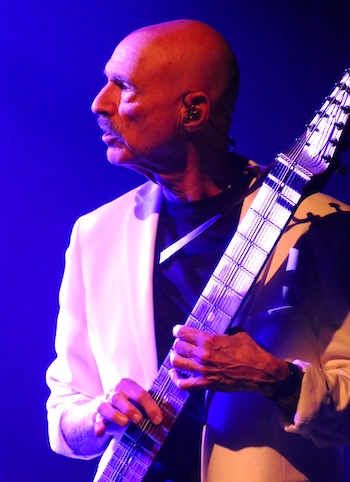
Tony Levin of Beat at Hampton Beach Casino Ballroom. Photo: Paul Robicheau
Tony Levin stands as prog-rock’s senior bass master for his longtime work with King Crimson and Peter Gabriel, as well as short stints with Yes and Pink Floyd. Yet during prog-rock’s early ’70s heyday, when the Brookline-bred bassist was working as a session player with Carly Simon, Buddy Rich, and Lou Reed, he didn’t even know the music of Yes, King Crimson, or Gabriel’s band Genesis.
Producer Bob Ezrin hired Levin for an Alice Cooper record and asked if he’d like to play on Gabriel’s 1977 solo debut, which included Crimson guitar guru Robert Fripp. “It certainly was my good luck that got me introduced to those two gentlemen who I’m still making music with after all those years,” Levin says. “If music had taken me in a different turn, I might never have done that.”
Levin played on hundreds of other sessions, from John Lennon and Yoko Ono to the Roches, Herbie Mann, Stevie Nicks, Joan Armatrading, and David Bowie. But he’s anchored each one of Gabriel’s solo albums and tours, and when Fripp formed a new 1980s quartet that became a reincarnated version of Crimson, Levin was on bass alongside previous Crimson/Yes drummer Bill Bruford and guitarist/singer Adrian Belew (Talking Heads’ Remain in Light, David Bowie, Frank Zappa). Levin continued his Crimson turns through the group’s final edition with seven to eight players that came to a halt after a 2021 tour.
Three-decade Crimson front man Belew, who wasn’t invited into that last lineup, kept a dream alive through the pandemic for a band to reinterpret material from the three albums of Crimson’s 1981-84 edition. He was finally able to make good on that plan this year. Fripp and Bruford passed on coming out of practical retirement to join in, but Fripp gave his blessing to the project and bestowed the name Beat. Belew and Levin, the ’80s quartet’s other half, drafted virtuoso ringers in guitarist Steve Vai and Tool drummer Danny Carey. (Arts Fuse review)
October concerts in Boston and Hampton Beach — part of a US tour that returns to Lynn Auditorium on December 6 — showed the new supergroup rising to the challenge of executing Crimson’s complex music not only with great chops but great joy, reflected in members’ swapped smiles onstage.
“We’ve really been tickled how it came out,” Levin, 78, says over Zoom from a Cleveland tour stop. “I wouldn’t say I enjoy this more [than King Crimson] but I would say that we’re having more fun onstage with this group, because there’s more latitude, more room to make mistakes and to change the parts radically.”
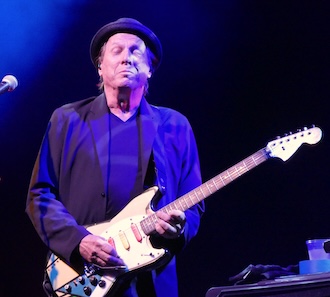
Adrian Belew of Beat at Hampton Beach Casino Ballroom. Photo: Paul Robicheau
That doesn’t mean that Carey doesn’t nod to Bruford in some ways, such as using Octoban tube toms like a ride cymbal within his acoustic and electronic hybrid kit. He opts for pads to imitate Bruford’s slit-drum pattern in the show’s ghostly centerpiece “The Sheltering Sky,” where Vai nails the processed sound of Fripp’s signature solo before sliding into his own flamboyant flurries. Belew juggles incisive chords, overhand slide (a buttery “Matte Kudasai”) and animal mimics. Vai and Belew ultimately prove more alike than different in style, both being ex-Zappa utility players who love their whammy bars and bent tonalities.
Perhaps it shouldn’t be a surprise that Levin more than holds his own as one of the four-piece outfit’s most dynamic standouts. For the bulk of Beat’s stage show, he’s tapping fingers all around his Chapman Stick (a rubbery-sounding touch guitar and bass in one fretboard), which became his trademark on songs like “Elephant Talk,” the lead track of 1981’s pioneering Discipline.
“I landed on the Stick as the main way I would react to the new music that would become King Crimson,” Levin says, recalling how he thought. “If I can live up to the challenge, the [Stick]’s gonna put me in the room with these guys, not literally but theoretically.”
On “Sleepless,” he also slaps a bass guitar with Funk Fingers, an invention Gabriel envisioned when Levin was adapting the hit “Big Time” to the stage. “I couldn’t play it live and was attempting night after night with one drumstick when Peter Gabriel — with his typical outside-the-box thinking that he takes for granted — suggested that I take two drumsticks and put them on my fingers.”
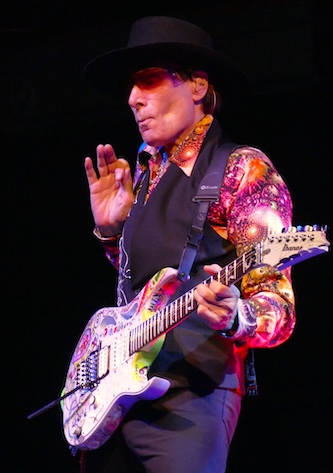
Steve Vai of Beat at Hampton Beach Casino Ballroom. Photo: Paul Robicheau
Levin further taps his collection of instruments and sounds on new solo album Bringing It Down to the Bass, which sports an astounding cast of musicians split into mix-and-match combos that span jazz fusion, thrashy rock, soundscapes, and barbershop vocals. “On most records, I would pick one rhythm section for the whole album, but on this one, I thought I’d indulge myself,” he says. “I thought, who will surprise me and really make me smile?”
Drummers include Sting/Zappa sideman Vinnie Colaiuta (for the aptly named duo workout “Uncle Funkster”), Crimson mates Pat Mastelotto and Jeremy Stacey, Gabriel associates Jerry Marotta and Manu Katché, Dream Theater’s Mike Portnoy, and old friend Steve Gadd. Levin was studying classical music at Eastman School of Music in Rochester, NY, when he met Gadd, who drew the bassist into jazz and shared gigs with Chuck Mangione and Paul Simon.
Levin sent bass and guitar-sketched files to his contacts, then would rerecord bass to drum tracks when he got them back. “I’ve learned it’s not a great idea to go over each bar with drum-machine parts because really good drummers are just going to get annoyed with you for wasting their time, ’cause they’re going to do what they want. And that’s what you want when you can get them.”
Guitarists on the album include Fripp, Alice Cooper session ace Steve Hunter, David Torn (who once joined Levin in a band with Bruford and trumpeter Chris Botti), Bowie slinger Earl Slick, and Sting wingman Dominic Miller. Add some keyboards from Larry Fast, Gary Husband, and brother Pete Levin, violin by onetime Shakti/Gabriel violinist L Shakar, and a dash of horns, and Bringing It Down to the Bass covers a lot of ground — even a frisky tune with the bassist on cello and vocals.
Levin also shows how he was “open to a sense of humor” when it came to his vocals in such lyrical conceits as “Boston Rocks” (which liberally quotes JFK in dropping regional terms), “Side B/Turn it Over” (his multitrack a cappella tribute to flipping a vinyl LP), and “On the Drums,” a polyphonic chorus that weaves together names of all the drummers he can recall playing with.
“In the lockdown year of 2020, we couldn’t tour,” Levin says. “Many people in many fields were walking around the house thinking, what in the world do I do with myself? Like everybody, I went a little crazy.”
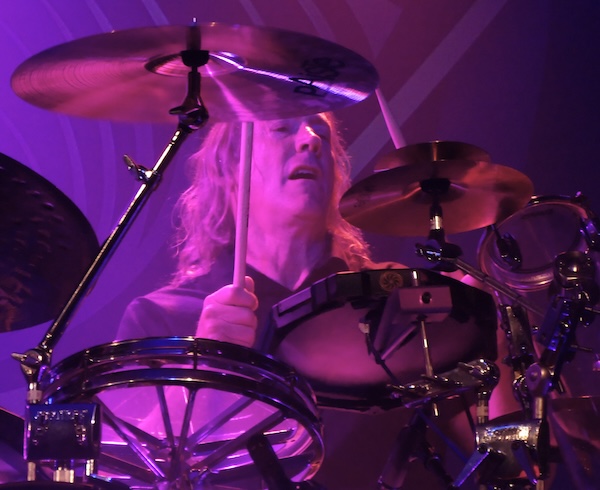
Danny Carey of Beat at Hampton Beach Casino Ballroom. Photo: Paul Robicheau
Now, at least through mid-December, the bassist — also a prolific photographer and blogger on tour — remains happy recasting Crimson dreams each night with Beat. “Sometimes the music has a special element that has a life of its own as you continue to play it,” he says, noting that even in pieces he’s played countless times, he’s “continuing the journey to find really ideal bass parts.”
Paul Robicheau served more than 20 years as contributing editor for music at the Improper Bostonian in addition to writing and photography for the Boston Globe, Rolling Stone, and many other publications. He was also the founding arts editor of Boston Metro.
Tagged: "Bringing It Down to the Bass", Adrian Belew, Danny Carey, King Crimson, Steve Val