Dance Review: After Five Decades, Pilobolus Still Moves Like No One Else
By Christopher Caggiano
Currently running at the Joyce Theater, “Trips” pairs classic Pilobolus works with new creations, reaffirming what has made the company one of dance’s most distinctive ensembles.
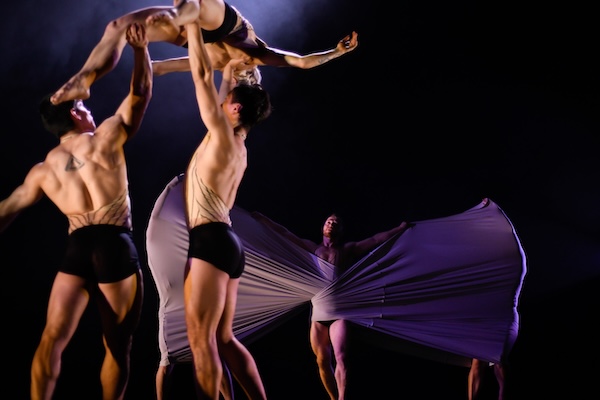
A scene from Pilobolus’s “Lamentation Variations.” Photo: Emily Denaro
More than half a century after its founding, Pilobolus still occupies a category almost entirely its own. Part modern dance, part theater, part acrobatics, the company continues to transform the human body into living sculpture, creating images that seem impossible until they dissolve into the next. While countless dance companies showcase extraordinary technical skill, Pilobolus remains distinguished by its ability to consistently turn physical virtuosity into poetry.
That quality is evident throughout Trips, the company’s current engagement at the Joyce Theater. The evening is presented in two rotating programs; the Program B performance I attended paired repertory favorites with newer works, demonstrating how Pilobolus has evolved without abandoning the collaborative aesthetic that has defined it since the early 1970s.
I’ve been following Pilobolus for more than 30 years, and what first drew me to the company still distinguishes it today: its exploration of human geometry. Long before I could articulate why the work felt so unlike anything else in dance, I was captivated by the way performers used one another’s bodies to create living studies in leverage, counterbalance, and support. Every image seemed to reveal a new possibility hidden within the mechanics of the human body.
It was only later that I learned Pilobolus had collaborated with Penn & Teller – including The Tempest at the American Repertory Theater, co-directed by Teller – and with dancer, juggler, and visual artist Michael Moschen, incorporating his geometric props into choreography that further blurred the line between dance, sculpture, and visual illusion. The interconnections made perfect sense. Like those artists, Pilobolus delights in reshaping the familiar until it feels almost impossible, inviting audiences to marvel not just at illusion but at what the human body can actually do.
In Trips, the company’s dancers, as always, possess astonishing strength and precision. But what’s most impressive isn’t individual prowess. Pilobolus has always placed an emphasis on mutual dependence rather than solo virtuosity. Performers become one another’s foundations, counterweights, and extensions, moving with such admirable trust that six separate bodies often appear to function as a single organism. Sculptural balances, gravity-defying lifts, and intricate weight-sharing create living architecture that seems to ignore the ordinary limitations of the human body.
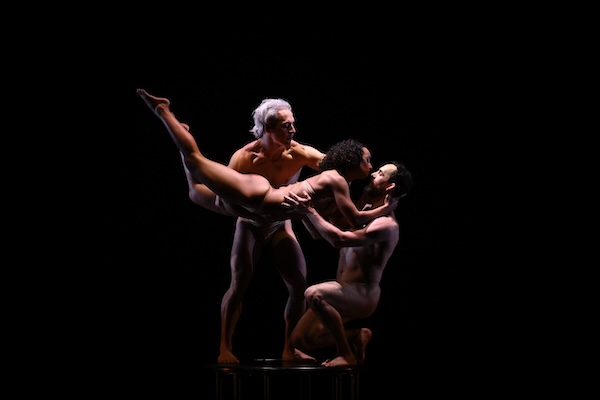
A scene from Pilobolus’s “On the Nature of Things” Photo: Ivan Martinez
That collaborative spirit gives the choreography an emotional dimension beyond its physical spectacle. The dancers frequently perform in minimal costumes and interact with remarkable intimacy, yet the work never feels prurient. Instead, bodies become instruments of communication, expressing humor, tenderness, vulnerability, and playfulness with equal ease. Even the company’s most astonishing feats avoid empty virtuosity. Every impossible balance or improbable lift serves a larger theatrical or emotional purpose.
Program B opens with “On the Nature of Things,” created in 2014 and beautifully restored here. Accompanied by the measured rhythms of Vivaldi, two men and one woman perform atop a table scarcely larger than themselves, discovering seemingly endless choreographic possibilities within an intentionally confined space. The restrictions often become the source of the dance’s beauty. Bodies intertwine in sculptural poses reminiscent of Giambologna’s The Abduction of the Sabine Women, while Thom Weaver’s elegant lighting enhances the work’s quiet, meditative atmosphere.
The program’s newest work, “Virtuous & Vicious,” shows how Pilobolus continues to find fresh ways to surprise. Emerging from an amoeba-like cluster in form-fitting green and yellow costumes, the dancers continually morph into shifting creatures and abstract forms. Luke Styles’ score, driven by deep bass lines and throbbing rhythms, propels choreography that alternates between ethereal beauty and sly humor. Bodies appear to surf invisible currents; isolated limbs twitch with mischievous independence before the performers melt back into the ensemble. The piece feels enchanting, playful, and unmistakably contemporary while remaining recognizably Pilobolus.
Perhaps the evening’s emotional centerpiece is “Lamentation Variations,” Pilobolus’ response to Martha Graham’s iconic solo. A ghostly figure draped in an illuminated sheath enters through the audience before archival footage of Graham’s 1940 performance projected onto the assembled company makes the homage explicit. Yet rather than imitate Graham’s deeply personal expression of grief, Pilobolus translates it into its own collaborative language. Individual shrouds are gradually replaced by larger shared versions, producing haunting geometric images. Sorrow becomes communal rather than solitary.
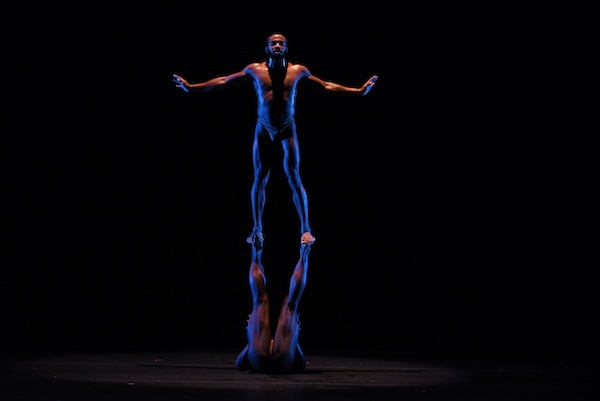
A scene from Pilobolus’s “Day Two.” Photo: Grant Havlerson
Following intermission, “Day Two” provides the program’s most extended and most primal experience. Jungle-like percussion begins before the curtain rises, establishing an atmosphere that grows increasingly elemental as selections by Brian Eno and David Byrne accompany a succession of striking visual tableaux. Four men and two women – again dressed only in dance belts – celebrate the human body with unapologetic confidence.
One sequence transforms four crouching men into pulsing creatures whose repetitive movements build from tightly controlled tension into explosive release. In another, groups of men support horizontal poles while women soar above them in arresting images of liberation and flight. Most mesmerizing of all is a sequence in which the entire cast disappears beneath a floor-sized tarp, their shifting forms suggesting animals, birth, and evolution all at once. Neil Peter Jampolis’ magnificent lighting deepens the dreamlike effect.
Among an exceptional ensemble, Connor Chaparro, Alexis Cruz-Castro, and Hannah Klinkman stand out, each combining expressive theatricality with the compact, muscular physicality that has long characterized Pilobolus dancers.
The evening’s only misstep comes between dances, during which a series of airline-style announcements intended to reinforce the Trips theme proves more cute than clever. These interludes briefly puncture the atmosphere created by the choreography without adding much comic payoff.
That minor quibble aside, Trips demonstrates why Pilobolus remains one of dance’s most distinctive companies. Few ensembles can match its breathtaking physical achievements, but fewer still can make those achievements feel so deeply human. More than fifty years after redefining what dance could look like, Pilobolus continues to remind audiences that the body’s greatest feats are rarely accomplished alone.
Christopher Caggiano is a freelance writer and editor living in Stamford, CT. He has written about theater for a variety of outlets, including TheaterMania, American Theatre, and Dramatics magazine. He taught musical theater history at the college level for 16 years and is an active member of the Outer Critics Circle.