Film Feature: “Marblehead Morning” Captures Folk Duo’s Enduring Harmony
By Brett Milano
Tim Jackson’s documentary takes a compelling look at Mason Daring & Jeanie Stahl’s drama-free half-century.
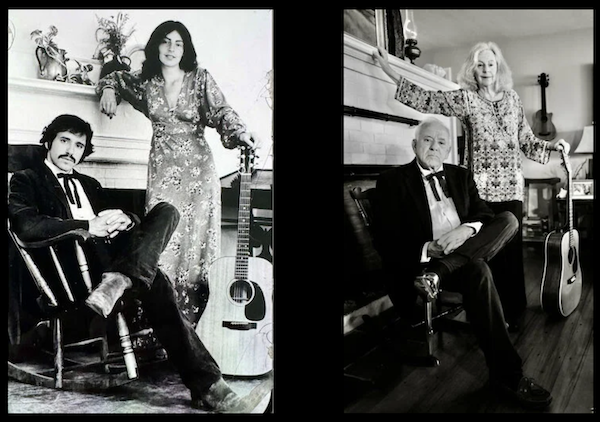
New England folk duo Mason Daring and Jeanie Stahl, then and now. Photo: courtesy of Tim Jackson
How do you make a compelling music biography about people who are essentially sweet and normal? Filmmaker and musician (and Arts Fuse contributor) Tim Jackson answers that question in Marblehead Morning: 50 Years in Harmony, about the beloved New England folk duo Mason Daring and Jeanie Stahl. Like a good folk ballad, the film tells its story with casual charm and an eye for the revealing details. And what it offers most of all is the considerable pleasure of spending time with these folks.
“I took a chance,” Jackson says, and compares this film to When Things Go Wrong, his earlier one about new-wave pioneers Robin Lane & the Chartbusters (which was Jackson’s own band in the late ’70s). “Unlike that movie there’s no rise and fall — a traditional film person might say, ‘Where’s the tension? Where’s the drama?’ But my question was exactly your question: Can’t we have something that’s just a nice piece, and has a lot of music? That’s also a movie, so why does it have to be this other formula? I hope that people get that and enjoy that.”
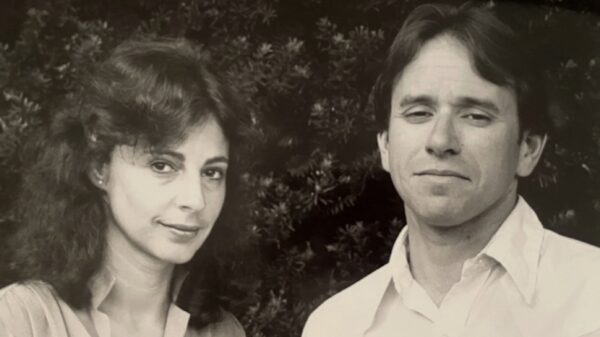
New England folk duo Mason Daring and Jeanie Stahl in the ’70s. Photo: courtesy of Tim Jackson
Jackson’s film wound up as a hybrid of biography and concert movie, though the concert wasn’t staged for an audience. It began with a live session at Q Division Studios in Cambridge, where Daring assembled a dream band to record some of the pair’s key songs. Most of the band also had connections going back decades: Jackson played drums, Richard Gates [Jackson’s 40-year partner in The Band That Time Forgot] played bass, Duke Levine (now with Bonnie Raitt and others) played guitar, Kenny White (Peter Wolf’s musical director) was on keys. Gus Sebring and Suzanne Boucher respectively guested on French horn and backup vocals. The sessions came out so well that Daring proposed building a film around them; he asked John Sayles, who was a fan of the Robin Lane movie and recommended Jackson.
It doesn’t hurt that the songs themselves are an autobiography of sorts. The title track has the timeless feel of a traditional New England song (which it practically is, having first been recorded in 1975). “Across the Great Divide” (a Kate Wolf song sung by Stahl) ponders life transitions; Stahl’s flirtatious “Bob the Waiter” represents the playful romantic side; Daring’s loss-informed “Funny” is as dark as things get. Toward the end there’s a recent live performance at the Me & Thee in Marblehead: Not a farewell show, not a career wrap-up, just another warm night between friends. Ten points to Jackson for not interrupting the performance, and 10 more for not clogging up the film with talking heads singing the duo’s praises. The music speaks for them just fine.
Their talent aside, it’s the very lack of drama that makes the pair’s story unique. They split up as a romantic couple at about the same chronological time that Lindsey Buckingham and Stevie Nicks of Fleetwood Mac did, but had considerably less trouble working together afterward — they not only stayed close to each other but befriended each other’s spouses (both are now widowed). Indeed, their mutual affection is so obvious onscreen that their platonic status is the film’s only real shocker.

Jeanie Stahl in a scene from Marblehead Morning: 50 Years in Harmony. Photo: courtesy of Tim Jackson
Likewise, they have no professional gripes to air, as both have maintained highly successful careers — Daring connected with filmmaker John Sayles early in his career, became his go-to soundtrack composer, and moved on to high-profile projects for Disney and elsewhere. Stahl is more a polymath, having had a career as a museum planner while still doing soundtrack vocals for Masterpiece Theater. So they’re on at least two very short lists: That of ex-couples who work together without tension, and of veteran performers who still play for the love of it.
For Jackson, the pair’s devotion to the music was a big part of the story. “They never had any doubts about doing music — for them it wasn’t fame, it wasn’t money, it was just what they did.” He also figured it would be a “dreadful cliché” to hang too much of the movie on their relationship. “I wanted to make it clear that they’re not a couple, yet they’re very supportive. Even in the interviews you can see that she gives him a lot of space, because he can talk a lot; but she just smiles and looks over. And I always thought she was a little bit passive in that way, but Jeanie is whip-smart. She just knows how to balance their relationship, from having been a couple and then musically. They don’t have to change who they are with each other.”

Mason Daring in a scene from Marblehead Morning: 50 Years in Harmony.
But surely there must be some dirty laundry in there somewhere? “No, and that’s surprising to me too. I knew them when they were a couple, and then suddenly they weren’t; it was so seamless that I never heard anything. So there was no conflict to pick apart there, and I’m not going to go into spousal death, because that’s not what the music is about. And both of their careers unfolded in a natural way: Mason meets John Sayles having done all the folk stuff successfully, and a career is born for him; he navigates it well. Jeanie meets her husband and because they’re both smart and talented, that fit was perfect too. So all their transitions just happened smoothly.”
Instead of aiming for a big summing-up statement, Jackson closes the movie with a lovely yet telling moment: Pondering their half-century partnership, Daring muses that “We may not be here in another 50 years.” “We won’t be here in 50 years,” Stahl corrects him. This again shows their chemistry: He’s the dreamer, she’s the voice of reason. But how many people would be optimistic enough to consider the possibility in the first place?
[Marblehead Morning: 50 Years in Harmony shows at the Brattle Theatre in Cambridge as part of the Boston Independent Film Festival on Sunday, April 26 at 12 p.m. There will be a panel discussion and a live Daring & Stahl performance afterward].
Brett Milano has covered music in Boston since the mid ’80s, when he appeared regularly in the Globe and the now legendary magazine Boston Rock. He had worked record label publicity in Los Angeles and edited the New Orleans music magazine OffBeat. His four books include Vinyl Junkies: Adventures in Record Collecting and Don’t All Thank Me at Once, a biography of pop cult hero Scott Miller. Currently he maintains a weekly music column in the Herald and in another realm entirely, writes for Harvard Law Today. His book on Boston rock history, The Sound of Our Town, was recently reissued.
Tagged: "Marblehead Morning: 50 Years in Harmony", Americana, Folk-Music, Jeanie Stahl, Mason Daring, documentary