
Theater Review: “The Comeuppance” — Reunions in the Age of Bad Choices
By Bill Marx
The proceedings are continually involving, each of the performers supplying sufficient dramatic weight and interacting as a credible ensemble of characters rather than caricatures.
The Comeuppance by Branden Jacobs-Jenkins. Directed by Don Mays. Staged by the Wilbury Theatre Group, 475 Valley Street, Providence, through April 12.
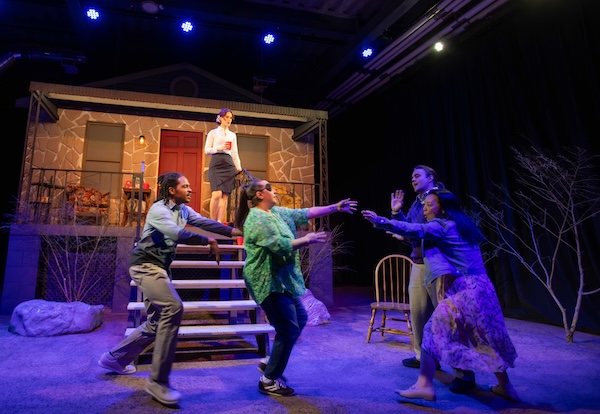
The cast of the Wilbury Theatre Group’s production of The Comeuppance. Photo: Erin X. Smithers
I am dating myself, but 1972’s That Championship Season stands for me as the cornerstone of the “reunion” play, a genre that centers on high school or college graduates returning home decades after graduation to catch up on each other’s lives. First come the nostalgic embraces, and then the inevitable psychological meltdowns: drunken and/or drug-fueled rants, confessions of envy, sexual jealousy, and grudges, intimations of mortality, examples of bad behavior, and, inevitably, someone confessing that life has been downhill since high school. Also, a must: a revelation of at least one long-buried secret tailor-made to shock the assemblage. Given how talented a playwright Branden Jacobs-Jenkins is — I am an admirer of An Octoroon and Appropriate — I wondered how, in The Comeupance, he was going to refresh, or at least mitigate, the form’s well-trod tropes.
I am happy to report that the dramatist comes up with a few new twists, partly by embracing uncertainty, perhaps as a homage to Trumpian pathology. What to believe and what to be suspicious of in his characters’ memories of high school is up for grabs: among this prevaricating company the truth is hard to discern. Even better, Jacobs-Jenkins has turned away from realism. Occasionally, one of the performers — cued by colored lights — comes forward and speaks to the audience as Death, a drily bemused spectator of the gathering’s goings-on who has a weakness for gossip and for making sardonic observations. Some critics objected to the otherworldly choice, but, given that that the script is set in our post-COVID, violence-filled America, why shouldn’t the Grim Reaper drop by? Jacobs-Jenkins has dealt with the figure of Thanatos onstage before — in his 2017 script Everybody, a version of the morality play, Everyman. If it was good enough for the late 15th century, it should be good enough for now, especially with the Iran war revving up and WWIII hovering in the wings. (Note: Europe in the 15th century was steeped in apocalyptic fears.)
Five former classmates reunite for their 20th high school reunion in a suburban neighborhood outside Washington, D.C., on the front porch of Ursula’s house (the play’s sole setting, which proves somewhat awkward in effect). The group—once a self‑proclaimed “Multi‑Ethnic Reject Group” (MERGE)—has gathered to pre‑party, drinking, smoking, and reminiscing. The get‑together is far from joyful; there’s a strong undercurrent of malaise, though Jacobs‑Jenkins is too savvy a dramatist not to inject dabs of dark humor. Now in their late 30s, the group has been roughed up by poor decisions, disillusionment, and the rise of regressive politics: 9/11, endless wars, MAGA, and the COVID‑19 pandemic. Ursula, the group’s convivial host, faces serious health issues—her failing eyesight, caused by diabetes, is pointedly symptomatic of generational blindness. Kristina, a burned‑out military doctor who has seen too much pain, self‑medicates with alcohol. Caitlin is trapped in an unhappy marriage to a Trump‑loving ex‑cop. Emilio, a successful avant‑garde artist who left America for Europe, is the group’s earnest, if defensive, truth‑seeker. And Francisco (“Paco”), a former classmate but not a member of MERGE, served in Iraq, suffers from PTSD, and has lived on the streets.
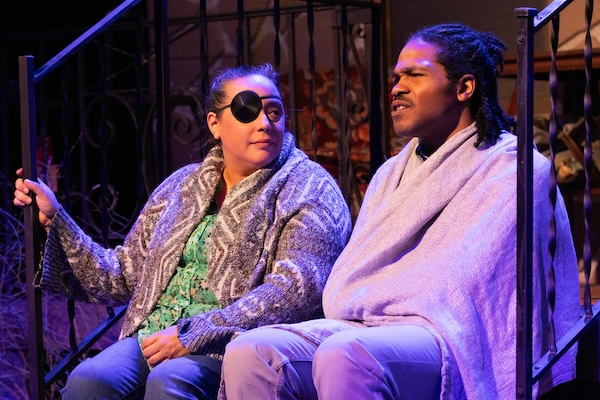
Christine Treglia and Rodney Witherspoon in the Wilbury Theatre Group’s production of The Comeuppance. Photo: Erin X. Smithers
The staging runs two hours without an intermission, which presents a challenge for director Don Mays and his cast: can they maintain a dramatic rhythm that doesn’t flag—one that invites us to stay curious about these characters as they undergo what Ursula calls “the dark ritual of the soul”? And can they ensure that Death’s cameo appearances are woven in to subtly sinister effect? They do. The proceedings are continually involving, each performer supplying sufficient dramatic weight and interacting as a credible ensemble of characters rather than caricatures. Against Scott Osbourne’s serviceable set, Christine Treglia evokes the soft steeliness of Ursula; Marcel Mascaró captures Paco’s creepy neediness; Jenna Lea Scott hints at the depression beneath Caitlin’s equanimity; and Francesca Hansen‑Dibello underlines Kristina’s self‑destructive rejection of what has become an unbearable reality. Rodney Witherspoon’s Emilio carries off the difficult task of being the perpetual questioner—the one determined to hold others to account when they only want to carry on in delusion.
The episodes here, heavy with COVID consciousness, circa 2022, weave together a number of concerns we have seen in other of Jacobs-Jenkins’s scripts: the wages of self-repression and the unreliability of memory (especially traumatic memories), the tragicomic fallibility of perception, characters who refuse to own up to past errors of judgment, and speculations about the construction and deconstruction of national identity. In this play, the dramatist is focusing, at least in part, on the polarization that followed the unity inspired by the onslaught of COVID (though there were 1,235,885 confirmed deaths, the most of any country). At the end of the evening, Death confesses to being puzzled at where Americans have ended up in the 21st century. It admired the togetherness people displayed in the face of the disease (for some reason, Death doesn’t take the horrific death toll into account), and wonders where all the mutual concern of those days went. “All night long,” Death says, “I’ve been trying to find the right moment to ask you: What happened?” Ursula may have supplied the answer earlier in the play: “The Age of Bad Choices Seeking Their Consequences. The Comeuppance…”
Bill Marx is the editor-in-chief of The Arts Fuse. For over four decades, he has written about arts and culture for print, broadcast, and online. He has regularly reviewed theater for National Public Radio Station WBUR and The Boston Globe. He created and edited WBUR Online Arts, a cultural webzine that in 2004 won an Online Journalism Award for Specialty Journalism. In 2007 he created The Arts Fuse, an online magazine dedicated to covering arts and culture in Boston and throughout New England.
Tagged: "The Comeuppance", Branden Jacobs-Jenkins, Christine Treglia, Don Mays, Rodney Witherspoon