
Opera Review: Odyssey Opera’s “The Last Savage” Finds Wit and Warmth in Menotti’s Madcap Satire
By Aaron Keebaugh
The Last Savage delivered good tunes, a delightfully twisted story, and all-around cheer.
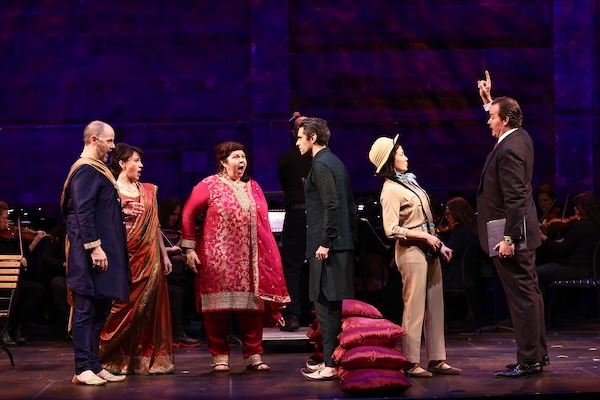
The ensemble of the BMOP collaboration with Odyssey Opera on its production of Gian Carlo Menotti’s The Last Savage at Huntington Avenue Theatre. Photo: Winslow Townson
As a librettist, Gian Carlo Menotti held a critical mirror up to society, often probing the psychological fault lines of his operatic targets. Yet, though he would often question what he saw around him, his works, no matter how pointed, never went over the ears of his targets.
This strategy was less contradictory than you might expect. Like Puccini, Kurt Weill, and even Hanns Eisler, Menotti made his incisive points through the most direct musical means. His melodies soared, his orchestration swept grandly. His scores embrace anxiety and laughter, at their best striking a healthy balance between skepticism and conventionality.
But, because of those populist qualities, Menotti ran afoul of critics and academics, who wrote off his operas as prosaic, even as they continued to attract a wide audience. The composer scored his most prodigious successes mid-century. Among them were The Medium (1946), The Consul (1950), and The Saint of Bleecker Street (1955). He won Pulitzer Prizes for the latter two, and mainstream accolades with 1951’s Amahl and the Night Visitors, the first opera specifically composed for television in the United States. He maintained his eclectic style even as his star gradually faded.
That Menotti’s work has been unfairly discounted becomes clear with revivals of even his lesser-known operas, nostalgic (for some of us) reminders of his rewarding fusion of warmth and sting. Sung with vitality, Odyssey Opera’s recent staging, in collaboration with the Boston Modern Orchestra Project, of Menotti’s The Last Savage at the Huntington Avenue Theatre was a reminder of why the composer struck such a popular chord during the 20th century.
The Last Savage is rarely produced, partly because it drew plenty of detractors when it premiered. Critics charged that the opera was banal, a musically underpowered bore, when it ran at the Metropolitan Opera in 1963. Audiences, too, were probably left bewildered by its pointed satire of high-society assumptions about what it means to be civilized. The incomprehension is understandable: opera fans didn’t get how the piece’s playful sensibility resonated with the upcoming social upheavals of the 1960s.
Today, the barbs in Menotti’s libretto provide the same amusement as an episode of Mad Men, only they are funnier. The story takes well-aimed swipes at just about everyone. Mr. Scattergood, an American businessman, meets with an Indian Maharaja to discuss the marriage of his daughter to the Prince. But Kitty Scattergood refuses to marry — until she completes her anthropological studies by capturing and then taming a mythical wild man. Anxious to get Kitty wed, her father and the Maharaja bribe an innocent stable hand named Abdul to play the part of a savage. Kitty, they assume, will capture him, send him to an American zoo, and then, free from her desire for independence, will marry Prince Kodanda as planned.
But, as Kitty teaches Abdul about what it means to be civilized, she is drawn into lust, then love. The narrative’s subplots only amplify the mating-game humor. Abdul’s girlfriend, Sardula, resists but then falls for the Prince’s advances. Scattergood and the Maharaja’s wife realize that the Prince, in reality, is their love child born from a prior union. The characters then all work overtime to reverse the original plan: Kitty hooks up with Abdul; Sardula ends up with the Prince; and the Maharaja is left wondering how everything worked out the way it did.
The music keeps the farce moving along smoothly, but Menotti challenges the ear by invoking the styles of various composers. There are Mozartean quintets, Rossinian orchestral flourishes, stinging harmonies that recall Prokofiev, and even a melodic sweep or two that brings Puccini to mind. The score wallows in cliché — but all in good fun. The melodies soar with ease and the dialogue is snappy and clear via George Mead’s English translation.
Odyssey Opera’s fine cast of singers delivered all the moments of lampoon with striking appeal. As Kitty, soprano Sharleen Joynt performed the called-for vocal fireworks with beaming tone and dexterity. Phillip Lopez sang the role of Abdul with basso profundo conviction. But, even with this bluster, his lines lifted gracefully. Lopez’s aria at the close of Act 1 dug nicely into the character’s predicament: he is torn between duty and hopes for a simple life.
Anya Matanovič’s voice glowed with buttery warmth in the role of Sardula. Omar Najmi’s nimble tenor conveyed the conventional sentimentality as well as the romantic desire of Prince Kodanda. Gabriel Preisser made for a witty and avuncular Scattergood, who retained his good humor even as his plot turned against him. Michelle Trainor brought just as much verve to the role of the Maharani, singing with transparent precision. Matthew Burns portrayed the Maharaja as the consummate straight man.
Rounding out the cast were members of the chorus. The standouts included Doan Drisdom, who played various roles as an Indian scientist, American tailor, and painter; Fausto Miro, who sang resplendently as an English tailor and poet; and Juan Suarez, who fit comfortably into the roles of the Catholic priest and a pretentious composer.
The small-boned staging used little more than tables and chairs to set the scenes. Costumes added a splash of color: dresses for the women, suits for the men, and a well-tailored safari outfit for Kitty.
Enterprising conductor Gil Rose looked for surprises on every page of the score and often found them. All told, The Last Savage delivered good tunes, a delightfully twisted story, and all-around cheer. Is this enjoyable opera high art or pop entertainment — who cares?
Aaron Keebaugh has been a classical music critic in Boston since 2012. His work has been featured in the Musical Times, Corymbus, Boston Classical Review, Early Music America, and BBC Radio 3. A musicologist, he teaches at North Shore Community College in both Danvers and Lynn.
Tagged: "The Last Savage", Anya Matanovič, Boston Modern Orchestra Project, Gabriel Preisser, Gian Carlo Menotti, Gil-Rose, Matthew Burns, Michelle Trainor, Odyssey Opera, Omar Najmi, Phillip Lopez