
Jazz Album Reviews: A Roundup of Recent Recordings
By Jon Garelick
New albums from Billy Hart, Phil Haynes & Free Country, Pat Thomas, Kalia Vandever, and the Webber/Morris Big Band.
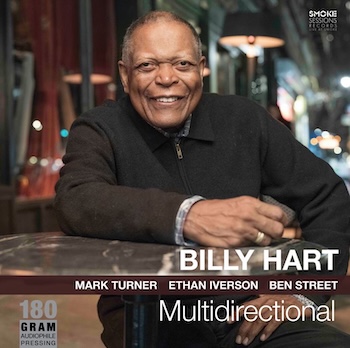
Billy Hart, Multidirectional (Smoke Sessions) There seems to be a relaxed finesse to everything the Billy Hart Quartet does — even its fastest tempos are unhurried. Take “Giant Steps” — John Coltrane’s up-tempo, chord-hurdling etude for aspiring saxophonists everywhere. This version starts with pianist Ethan Iverson’s widely spaced chords — unstable, moody, like something out of a Schubert sonata gone awry, before extending into longer single-note lines. After Iverson cues the band with the tune’s opening phrase (at about the two-minute mark), he drops out, and they come in fast over Hart’s crisp brush work, but tenor saxophonist Mark Turner leaves lots of space, too, in his outline of the tune, all the better to hear the ongoing counterpoint from bassist Ben Street. There are frequent rests, Hart dropping out and coming back in, Street moving from counterpoint to hard walk and back. Even when Turner picks up speed and Iverson returns, this is not Coltrane’s note-stuffed 1959 workout. But it’s fleet and daring and everything propels forward.
Hart, who just celebrated his 85th birthday (Nov. 29), has been leading this band for more than 20 years. He’s been an acknowledged master for more than twice as long. This disc, recorded live at Smoke Jazz Club, in New York, in December 2023, follows the release earlier this year of Just (their third studio recording for ECM). Aside from audience reaction, you also get to hear the band stretch out more than on their studio discs — which allows for the inventive arrangement of “Giant Steps” as well as a surprisingly brooding take on Hart’s “Song for Balkis” (for Hart’s daughter), an even more free-wheeling “Amethyst” (from his 1993 album of that name), a medium-tempo stroll from Turner (“Sonnet for Stevie”), and a touching Iverson ballad (“Showdown,” from Just) with an especially eloquent Turner solo. These four players are all busy with multiple projects; it’s good to see them reuniting regularly with Hart. He brings out the best in everyone.
Phil Haynes & Free Country, Liberty Now! (Corner Store Jazz) As with a lot of jazz releases these days, the first couple of tracks don’t tell the whole story (see Ambrose Akinmusire’s honey from a winter stone, Fieldwork’s Thereupon, or the recently reviewed Away, by singer Kris Adams and drummer Peter Perfido). Liberty Now! opens with two tracks of folk-country-jazz shuffles (the second a lovely downtempo beauty by guitarist Jim Yanda, “Past Time”) and then quickly goes any which way: broken rhythms, extended techniques, fragmented melodies, wayward harmonies, abrupt silences, artless vocals. But you can also hear clear deliberation of intent in all these pieces — a dozen new tracks and a second disc of 14 more from previous releases. (This is what poets call “New and Selected.”) The band is drummer Haynes, Yanda, cellist Hank Roberts, and bassist Drew Gress — a string band, after all — everyone contributing compositions and occasional vocals. Despite the title and exclamation point, the album is refreshingly soft-spoken, with pliant grooves and songful coherence, everyone revealing impressive chops in service to the greater good. Maybe that’s the message in the exclamatory title. The second disc favors more pointed covers (“Respect,” “What’s Going On,” the Beatles’ “Revolution,” Copland’s “Fanfare for the Common Man”) but is no less appealing in its unassuming warmth and generosity.
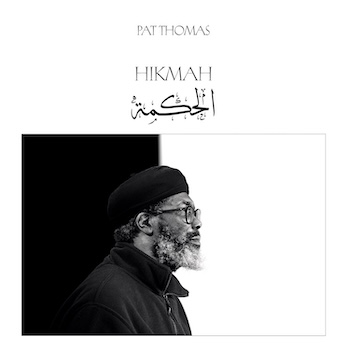 Pat Thomas, Hikmah (Tao Forms) The 65-year-old Oxford, England-born pianist Pat Thomas never lets you forget that he’s playing a percussion instrument. In the press notes to “Hikmah” (Arabic for “wisdom”), he’s quoted as saying, “The piano is basically a zither with strings.” Here he carves big blocks of sound with two-handed chords, or rumbles in the bass register, or strums and scrapes the strings. This solo piano outing is not the relentless incandescent assault of his work with the collective quartet أحمد [Ahmed], which made a splash at its debut US performances earlier this year in Brooklyn and at Big Ears in Knoxville and placed 10th in last year’s Francis Davis Jazz Critics Poll with Giant Beauty. That band is known for “immersive” sets of continuous music where staccato incantations of fortissimo short phrases can get repeated for minutes on end. This ain’t that, but let’s just say that the delicacy of the legato line is not Thomas’s thing.
Which isn’t to say there is no dynamic or textural variety here, and there’s a constant exploration of timbre. Sonorous percussive chords are offset by dexterous treble filigree. The opening, title tune begins with a sharply stabbed single note at the tippity top of the piano’s treble end before settling into soft chords and ascending figures that flirt with tonality and French impressionism, and then skitter off into some fast, sharply articulated lines before fading. And the ghost of Thelonious Monk flits through at least a couple of pieces (especially in “The Shehu,” where a Monkish progression is accompanied by a stolid marching left-hand). “For Joe Gallivan” is very percussive, its opening ruminations of staggered chords and dissonant clusters eventually finding its way to a staccato repeated eight-chord pattern and a hard stop. “For Caroline L. Karcher” turns into a fast-running conversation between independent single-note lines in each hand. “Luqman the Wise” is all inside the piano, hands on strings — plucking, strumming, rubbing, and what sounds like the aspirations of Thomas’s own breath.
 Kalia Vandever, Another View (Northern Spy) At this point, to a list of pathbreaking avant-garde trombonist-composers that includes Grachan Moncur III, Julian Priester, and Roswell Rudd you’d have to add Kalia Vandever. Her big warm tone, technical facility, and conceptual boldness mark her as an heir to these earlier innovators.
Another View is Vandever’s fourth album under her own name on indie labels. Earlier releases found her in standard jazz rhythm sections with guitar, piano, bass, and drums (Regrowth, from 20202, added Immanuel Wilkins on alto). We Fell in Turn (2023) was just Vandever on trombone, effects, and (some) vocals, and it was flat-out gorgeous — a suite of layered, overdubbed horn, each piece with its own long-toned shape and color.
Another View returns Vandever to the rhythm-section set-up, but with a more limited palette of her trombone with just guitar, bass, and drums. A more minimalist approach also applies to the writing. Per usual, Vandever loves making those beautiful long tones, but often against short repetitive rhythmic figures. Guitarist Mary Halvorson is the perfect foil here — she has the patience to dig into an accompanying riff and just hold it, for as long as it takes, while Vandever unfurls gradually longer and longer skeins of sound from those generative kernels. (Drummer Kayvon Gordon and bassist Kanoa Mendenhall also deserve credit for maintaining that restrained rhythmic tension.) On “Staring at the Cracked Window,” Halvorson lays down what sound like slightly dissonant bossa nova chords. On “Withholding” (apt title) it’s Vandever who sets up the vamp, with a querying downward two-note interval answered by a repeated pattern from Halvorson. Here and on “Unearth What You Know,” the suspense is almost unbearably delicious. After these, “In My Dream House” plays like a ballad standard. There’s an air of melancholy throughout the album (the saudade of those bossa chords, the unison of bowed bass and trombone on “Cycle in Mourning”). Album notes cite writer Carmen Maria Machado’s In the Dream House as an inspiration, but this is sorrow without sentimentality, and a great deal of joy in music-making. (And yes, Halvorson also gets to shred.)
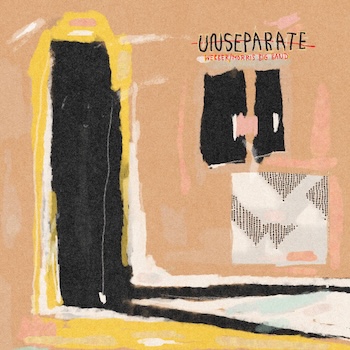 Webber/Morris Big Band, Unseparate (Out of Your Head) As jazz changes, so does the big band. On the second recording of their 10-year-old big band, Anna Webber and Angela Morris (composer/saxophonist/flautists both) continue to explore their complementary takes, deploying traditional jazz instrumentation with the composers’ “respective pieces . . . equally rooted in minimalism, pop, noise, and other music of the past century or so.”
In the quick, gross generalization, Webber is the academic modernist, and Morris is the progressive jazz head in the Bob Brookmeyer/Maria Schneider mold.
But those generalizations quickly collapse. Yes, Webber’s four-part “Just Intonation Etudes for Big Band” adapts a centuries-old procedure (just intonation) and features the kind of modular structure familiar from the minimalists — short phrases built on pulsing rhythms, repeated ad infinitum. And Morris likes more explicitly “jazzy jazz” (to borrow a phrase from Fred Hersch) — she even provides a passage for pianist Marta Sánchez (with bassist Adam Hopkins and drummer Jeff Davis) that at times conjures the loose-time feel of the Bill Evans trio. But there the dichotomy ends. They each take turns writing the four pieces called “Unseparate.” Both composers like tricky odd-meter strategies and free-form dialogues for soloists, they solo on each other’s pieces, and they both like the suspense of unfolding orchestral narrative.
What’s consistent in all of this is the startling beauty and excitement throughout, from the curtain-raising drama of the mysterious deep, dark opening chords of the first track (Webber’s “Unseparate 1,” of the “Just Intonation Etudes”) to the easy lope and antic free-brass passage of Morris’s “Microchimera.” And how did the band produce those soft rhythmic susurrations for Webber’s “Timbre”? And why hadn’t I heard of Lisa Parrott, she of the ardent baritone solo on Morris’s “Habitual”? And wait, couldn’t the playful hocketing rhythms on that tune be from Webber’s pen?
As their pieces alternate throughout the album — each with distinctive solo voices popping up through the beautifully designed matrices of sound — it’s like Webber and Morris are two halves of the same jazz brain. Unseparate?
Jon Garelick can be reached at garelickjon@gmail.com.
Tagged: "Another View", "Hikmah", "Liberty Now!", "Multidirectional", "Unseparate", Billy Hart, Corner Store Jazz, Kalia Vandever, Northern Spy, Pat Thomas, Phil Haynes & Free Country, Smoke Sessions, Tao Forms