
Theater Review: “Fun Home” — The Fragility of Memory
By Hannah Brueske
Fun Home’s relevance not only lies in how it flawlessly interweaves three storylines that revolve around the same character, but in how it dramatizes, with grace, humor, and pathos, a familiar human struggle — looking at our parents through adult eyes.
Fun Home Music by Jeanine Tesori, Book & Lyrics by Lisa Kron. Based on the graphic novel by Alison Bechdel. Directed by Logan Ellis. Staged by the Huntington Theatre Company at the Huntington Theatre (264 Huntington Ave), Boston, through December 14.
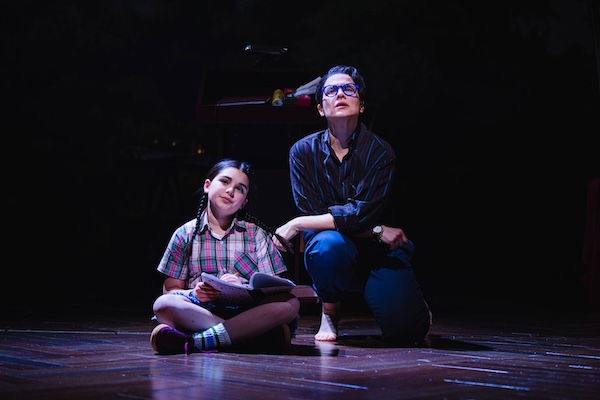
Lyla Randall and Sarah Bockel in the Huntington Theatre production of Fun Home. Photo: Marc J Franklin
When Fun Home, a musical based on the acclaimed graphic memoir by lesbian cartoonist Alison Bechdel, opened on Broadway in 2015, it made history as one of the first shows to center around a lesbian protagonist. It received 12 Tony nominations, winning five (including Best Book, Score, and Musical). In this revival of the show at the Huntington Theatre Company, director Logan Ellis proves why the story — with its heartfelt book and lyrics by Lisa Kron and emotionally captivating score by Jeanine Tesori — needs to continue to be told now. The material’s relevance not only lies in how it flawlessly interweaves three storylines that revolve around the same character. Fun Home also dramatizes, with grace, humor, and pathos, a familiar human struggle — looking at our parents through adult eyes.
The show opens with a middle-aged Alison, played with consistently stern conviction by Sarah Bockel, at her drawing board, frustrated at her inability to paint (or rather draw) images that accurately chronicle her complicated relationship with her father, Bruce. As she recalls key memories, the story splits into three phases of Alison’s life. Maya Jacobson supplies an endearing embodiment of adolescent discovery as she plays Alison when she experiences her sexual awakening in college. Lyla Randall plays Alison as a nine-year-old in a fiercely confident performance whose emotional depth equals that of her two adult counterparts.
In many of Alison’s memories of childhood, the Bechdels appear to be a picture-perfect 1970s family living in a beautifully furnished home. As Alison watches the past play out from the point of view of the present, she begins to search for the details she missed. The domestic reality, underneath the placid surface, is grim. After all, this is also the space in which her father is a closeted gay man who struggles with severe OCD, has reckless affairs with younger men, and eventually, just as Alison blossoms into her own sexuality in college, commits suicide.
Playing Bruce, the ghost that haunts the present, actor Nick Duckart has the challenge of fleshing out a man who is only seen through his daughter’s increasingly critical eyes. Duckart injects the cheating husband — and often a self-absorbed father — with a sympathetic insecurity that is at its most effective at moments of strain, such as the shake in his voice when arguing with his wife, or the intimations of projection when he tries to make young Alison dress more feminine.

Sarah Bockel and Nick Duckart in the Huntington Theater Company production of Fun Home. Photo: Marc J Franklin
Director Logan Ellis is convinced that the theater can serve as a distinctive platform where the living and the dead can converse. And that works especially well at the HTC, he said in an interview with New England Theater Mirror. “When I sit in that theater, I feel a ghostly presence,” Ellis said. “And I feel such a history in the air between the audience and that fantastic big stage.”
Ellis makes good use of the large proscenium theater space. Alison is often positioned at the periphery of the stage, reevaluating her memories as they play out before her at the center. This invites the audience to sympathize with Alison’s perspective, interpreting, along with her, what is going on. It also makes for affecting theater; as the middle-aged Alison pieces together the details of her memory, the characters of her past literally push the furniture and set pieces into place.
Scenic designer Tanya Orlando has shaped the emotional atmosphere of the “memory” spaces across time with exceptional detail. Emphasizing Alison’s initial writer’s block and isolation, the set is plain and dreary — a dark room, save for the drawing desk under the spotlight. The space that Alison as a child inhabits stands in stark contrast. The Bechdel home, arguably the show’s most fundamental location, showcases Bruce’s neurotic obsession with bourgeois convention: it is ornately put together, bright and crammed with valuable antiques.
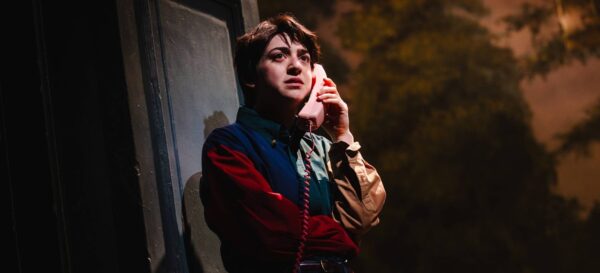
Maya Jacobson in the Huntington Theatre Company production of Fun Home. Photo:Marc J Franklin
The set design also aids the piercing effect of the last memory Alison recalls — the final moment between her and her father, just weeks before he would step in front of a moving truck. It took place only a little after Alison came out to him and her mother Helen at college. Alison only grapples with her father’s queerness after Helen, in a fit of desperation, throws it at her daughter like a dagger. The quality that Alison thought made her unique, her sexual identity, is what generated the repressed pain in the family’s life. Fun Home‘s final moment puts Bruce and Alison sitting together in a car, with no elaborate furniture or decorations to hide behind. Maybe now, Alison thinks, the veil between the two can be lifted, and they can see that, at least in one way, they are the same.
Reflecting back on this memory, Alison desperately searches for a glimpse that Bruce would acknowledge the truth about himself. But, after combing over every word, Alison must face the sad fact that he died without ever acknowledging their similarity.
This scene encapsulates why Fun Home retains its impact: the show celebrates our power to remember momentary joys and kindnesses when they first occurred, no matter how fleeting, to free them from being despoiled by whatever knowledge comes after. Memory may be fragile, ripe for revision, but it can also be sustaining. At the show’s conclusion, the stage goes dark, a split moment after Alison, as a child, jumps into her father’s waiting arms.
Hannah Brueske is a senior journalism student at Emerson College, with a special interest in feature stories, arts reporting, and documentary filmmaking. She is active in campus publications as a projects editor for The Berkeley Beacon, Emerson’s only independent student newspaper, and the editor-in-chief of The Independent, an arts magazine that covers independent art. She just finished directing her first documentary short about the experience of transfer students and hopes to work on more documentary films soon. After graduating next December she plans to move to New York City to continue chasing and contributing to the worlds of art and culture.
Tagged: "Fun Home", Alison Bechdel, Huntington-Theatre-Company, Jeanine Tesori, Lisa Kron, Logan Ellis, Lyla Randall, Maya Jacobson, Nick Duckart