
Concert Review: Club d’Elf — Where Trance Meets Revelation
By Scott McLennan
If any out-there band deserves the opportunity to be in-here, Club d’Elf is it.
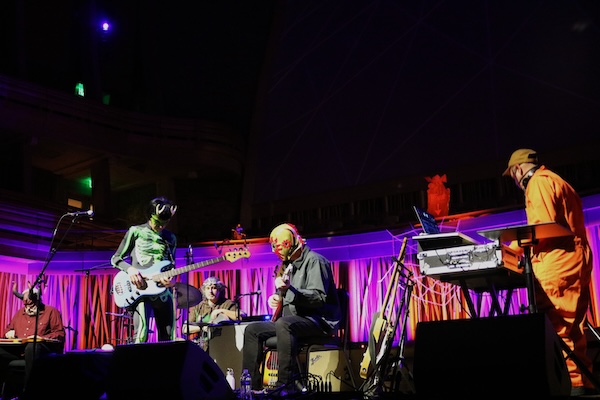
Club d’Elf at the Groton Hill Music Center. Photo: Scott McLennan
Club d’Elf is as much a state of mind as it is a band that blends unshakeable rhythmic groove with improvisational experimentation, leading listeners to that spot where trance meets revelation.
And what better mindset could there be to celebrate Halloween? Club d’Elf brought its annual Fright Night show to Groton Hill Music Center, a dramatic change of scenery from the band’s usual holiday haunt at The Lizard Lounge in Cambridge. Chief Elf Mike Rivard took advantage of the stately concert hall, bringing in an expanded band lineup that included guitarists Duke Levine and Kevin Barry, DJ/turntablist Mister Rourke, drummer Fabio Pirozzolo, keyboard player Paul Schultheis, sax player Tom Hall, trumpet player Jerry Sabatini, and trombone player David Harris.
Rivard, the one constant in Club d’Elf, played electric bass and a three-stringed sinter, an acoustic instrument used in traditional Gnawa music from Morocco. He served as the show’s emcee (Club d’Elf regulars in the audience made certain to shout out Rivard’s birthday).
The challenge for Club d’Elf was obvious: moving experimental, underground music from the cozy confines of a nightclub to the acoustically and visually majestic likes of Groton Hill is a dicey proposition. Listeners are inclined to stay seated; there is more physical distance between players and audience, and the musicians can spread themselves across the stage. More expanse, but less intimacy.
But if any out-there band deserves the opportunity to be in-here, Club d’Elf is it. First off, Rivard and the musicians he works with are highly accomplished, world-class players. In the Club d’Elf setting they strip away norms, but their eclectic tastes and sensibilities are nothing if not exhilaratingly various. The end result is inevitably beguiling without being beholden to any one tradition.
Club d’Elf opened its show with an instrumental version of the Grateful Dead’s “Bird Song.” Band members decked out in masks and costumes, Club d’Elf patiently journeyed through the jammy ballad, with Mister Rourke applying spiky textures atop the mellower grooves with Barry and Levine paying homage to Jerry Garcia with their own spin on cosmic roots music.
Tenor sax player Tom Hall is a Club d’Elf regular, but his “Horns of Horror” companions on trumpet and trombone were making their debuts with the group. Sabatini and Harris are longtime contributors to the region’s jazz scene and are teammates with Hall in the Revolutionary Snake Ensemble. The pair fit right in with Club d’Elf. The three-piece horn section made its presence known a few songs into the show’s first set; it punched up the already dizzying “Lalla Aisha in Jhaptal,” a fusion of African and Indian musical styles from Club d’Elf’s most recent album You Never Know. The Horns of Horror remained in the mix for most of the rest of the performance, adding ensemble blasts of brass as well as passage-punctuating solos.
Club d’Elf included material that’s set for its next album, starting with the buoyant horn-driven “Second Line.” Another new number, markedly lighter in tone and airier in feel, prompted Rivard to joke that the band was becoming too happy.
But Rivard went on to note that the iteration of horror-movie scary woven into Club d’Elf’s show, via “The Tingler” and other supernatural-inspired jams, is the kind of scary he prefers. It is preferable to the scary of today’s real-world headlines. To that end, Rivard’s music, as performed by Club d’Elf, has been crafted to be an ever-changing invitation to create community. No two shows feature identical lineups of players replicating a set-list of songs or, naturally, identical audiences. Every night is a chance to create a unique collective experience.
Eventually, the towering jams during the show’s second set, anchored by a sprawling take on Rivard’s “Boney Oscar Stomp” and a deconstructed rendition of the Grateful Dead’s “New Speedway Boogie,” wound down to quieter, more introspective pieces. The solos from each member of the ensemble were concise and poignant, the mastery of each player dissolving into the splendor of the whole.
Scott McLennan covered music for the Worcester Telegram & Gazette from 1993 to 2008. He then contributed music reviews and features to The Boston Globe, Providence Journal, Portland Press Herald, and WGBH, as well as to The Arts Fuse. He also operated the NE Metal blog to provide in-depth coverage of the region’s heavy metal scene.
Tagged: Club d’elf, Duke Levine, Groton Hill Music Center, Kevin Barry, Mike Rivard, Mister Rourke
An excellent review of an unforgettable performance!
Thanks for another fabulously written review.