
Latin Jazz Album Reviews: “Masters of Our Roots” and “Portal”
By Brooks Geiken
Two very influential and brilliant Cuban musicians, Albita Rodríguez and Chucho Valdés join together to make a fine album; Chilean guitarist/vocalist/composer Camila Meza serves up a potent mixture of jazz and lyrics concerned with social justice.
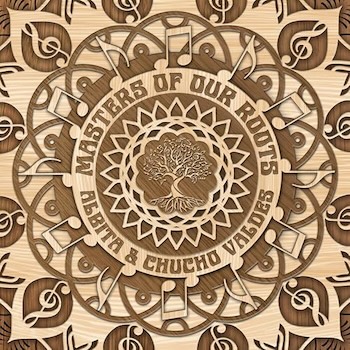
The pairing of singer Albita Rodríguez and pianist Chucho Valdés seems to me to be a logical, even slightly overdue, artistic collaboration. Albita has been a regular performer on the Miami scene for many years, meanwhile, Valdés is a fairly recent Miami resident, so that may account for the time lag. In any case, the recording of these two giants of Cuban music on Masters of Our Roots is an exciting musical proposition.
Since arriving in this country several years ago, Valdés has been very busy touring with Irakere on their 50th anniversary and making albums with Paquito D’Rivera and his Royal Quartet. A phone call from Valdés to Albita, a very well-known singer last seen in the 1998 movie Dance With Me, set the ball rolling, leading to the current recording. For their repertoire, they chose a lineup of admired Cuban standards, with some contemporary arrangements.
“Carnaval” starts the record out with Albita’s powerful, declamatory vocals and the band, horns included, swinging mightily behind. The complex percussion and exquisite piano of Valdés surge behind Albita’s intense vocals. For the next track, they wisely shift tempo, serving up a gorgeous lullaby, “Drume Negrita.” Accompanied by the great Dianne Reeves, Albita softly intones the familiar lyrics. The vocal combination — two voices switching back and forth — provides just the right dream-like quality. Especially entrancing is the wordless vocal section, an impressive skill that Reeves has mastered over the years.
One of the only tunes on the album that is not a classic, “Piano Bien Toaó” (Piano Well Played), begins with voice and piano alone. Later on, there’s the bolero, “Hola Soledad” (Hello Solitude) which reminds me of Billie Holiday’s rendition of “Good Morning Heartache.” Albita’s voice is filled with the same kind of melancholy and hurt.
The bata drums open “Tabú,” adding a very appropriate bow to the Santería (Afro Cuban spiritual belief) Gods mentioned in the lyrics. It turns out the “taboo” is a Black man daring to look at a white woman — behavior proscribed in a racist society.
To round out the record, the horns and uptempo percussion return in a smashing finale with “Mi Rumba Echando Candela”(My Rumba Is On Fire). Albita is in especially fine form as she improvises a chorus that harkens back to an Irakere tune, “Bacalao Con Pan”(Codfish With Bread).
 In June of 2019, the Chilean guitarist/vocalist/composer Camila Meza appeared with Fabian Almazan and Linda May Han Oh at the SF Jazz Center. Meza’s performance was quite compelling, so I was excited to listen to her new album, Portal.
Chile has a long standing tradition of admired singer/songwriters. Meza is a member of this special group, which includes Violeta Parra, Patricio Manns, and Victor Jara. In addition to songwriting, these artists were also activists, very involved in Chile’s social justice movements. Meza’s songs on Portal have political resonance.
Three musicians are present for most of the tracks. Meza supplies vocals and plays acoustic and electric guitars. Shai Maestro is on keyboards, synthesizers, and programming. Opri Nehemya is on drums and percussion for four tracks.
The tracks are multi-layered, vocals included, and the soundscape is wide and varied. The enterprise exudes an extremely improvised feel: there are no rhyming lines, either in Spanish or English. High notes suit Meza’s voice perfectly and she hews to a higher register throughout the album. Her note choices are unusual, to the point that they take some getting used to.
The Spanish pieces, “Utopía”, “Transmutación”, “Remecer” and “Persistir” are not translated into English in the booklet. Mapuche poet Faumelisa Manquepillán recites the haunting “Nieno La” which is translated into Spanish, forcing the listener to the dictionary. As a result, you have to do a little work to fully understand Meza’s songs, and itis well worth it.
One of the highlights of the album is the artist’s unrelentingly positive attitude. The songs are meant to uplift and inspire us to be our better selves. There’s so much negativity in the world today — and with our government behaving abominably. Meza has decided that the best opposition lies in singing of an existence filled with peace and harmony. The “Utopía,” “The Nurturer,” “Harvesting Under The Moon,” and “Uncovered Ground” are committed to optimism.
With the aid of superb vocalists Grechen Parlato and Becca Stevens, “Uncovered Ground” goes to the heart of the album’s visions. Its lyrics state that “If you’re falling down, I’ll fight for you. Even when it all goes down, I’ll stay here to find the light.” The idea of not giving up, even though things are really bad, is one many need to hear, especially right now.
Not all of Portal is as successful, however. There is an irritating tendency among contemporary guitarists and keyboardists to overplay their instruments. “The Nurturer” is a really nice song — until Meza goes overboard during her electric guitar solo, noodling away, supposedly dazzling the listener with her virtuosity. Maestro is guilty of the same ego trip on “Utopía,” where there is no need to go into overdrive on the synthesizer.
Poignant lyrics are in ample supply on “Remecer” (To Shake) and “Persistir” (To Persist). In “Remecer” Meza wants to shake things up, choosing her fond embrace over past fears. As for “Persistir,” the singer finds no easy answers — we must persist, even though times are tough.
A potent mixture of jazz, provocative lyrics, and an upbeat message, Portal serves up a sumptuous sonic landscape, full of thoughtful twists and turns.
Brooks Geiken is a retired Spanish teacher with a lifelong interest in music, specifically Afro-Cuban, Brazilian, and Black American music. His wife thinks he should write a book titled “The White Dude’s Guide to Afro-Cuban and Jazz Music.” Brooks lives in the San Francisco Bay Area.
Tagged: "Masters of Our Roots", "Portal", Albita Rodríguez, Camila Meza, Chucho Valdés