
Opera Review: Boston Modern Orchestra Project Sheds New Light on “Frederick Douglass”
By Aaron Keebaugh
Played and sung with verve in its New England premiere, Frederick Douglass stands as the most significant revival BMOP has undertaken in recent years.
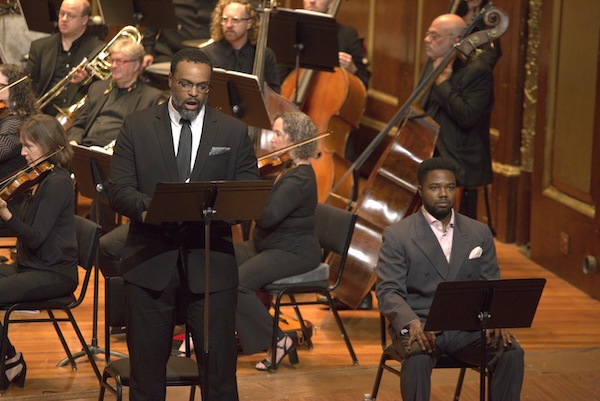
Kenneth Kellogg (l) and Leroy Davis in the BMOP production of Frederick Douglass. Photo: Jason J Lachapelle
“Think of this as an opera, not a movie,” composer Ulysses Kay told a reporter ahead of the 1991 premiere of his three-act spectacle. The topic of the opera concerned the final years of Civil-War-era abolitionist Frederick Douglass, not his escape via ship from a Maryland slave owner nor his rise to prominence. It’s fair to assume the interviewer was looking for something a little glitzier.
But for Kay, the political tragedy that all but derailed Douglass’s public career was the very stuff of flesh-and-blood drama. And he didn’t limit his imagination in telling it. Running three hours, the opera brims with Verdian flourishes, emotionally powerful choruses, a sizable cast, and a score that ties it all together beautifully. Frederick Douglass remains Kay’s most realized artistic statement.
But, because of mixed reviews, the opera fell into immediate oblivion, with little hope of ever being revived. Fortunately, Gil Rose and the Boston Modern Orchestra Project make unfairly neglected works like this their mainstay. Played and sung with verve in its New England premiere (at Boston’s Jordan Hall on June 20), Frederick Douglass stands as the most significant revival BMOP has undertaken in recent years.
That’s not to say the opera is without its flaws. Most of the problematic issues can be pinpointed to Donald Dorr’s libretto, which, quizzically, sidelines Douglass, making him a secondary character. The action ends up revolving around him — though it contains plenty of engaging political intrigue. The semi-fictional story is propelled by a white senator, Norton, and his cohorts, who plot to toss Douglass from his exalted position as a major leader of the newly freed Blacks. Their scheme is to place him in a government role — minister to Haiti — where they hope his efforts to lead Haitians to freedom will fail. That, in turn, will destroy his Freedman’s Bank, which will land him in political hot water. They believe that the public, by losing faith in Douglass, will take care of the rest. People already fear Douglass’s persuasive power as a Black leader; with evidence of financial corruption, they will believe he is only crusading for the cause to enrich himself.
Amid this trap and all its hubbub, Dorr paints Douglass as a passive do-gooder. But he redeems himself, somewhat, by throwing in an intriguing side story. Douglass is married to Helen, a white woman. A young officer named Aubrey vows to separate the couple and claim Helen as his own. The plot further thickens when Douglass’s son, Howard, tries to persuade Helen to leave his father. According to him, it will achieve better race relations. But when Douglass, despite his failure in Haiti, is exonerated, the plot threatens to backfire on Senator Hooker and his co-conspirators. They pin the whole scheme on Aubrey, who is left betrayed and despondent.
Despite this encouraging turn in fortune, the opera still ends tragically. Douglass, weary of struggle and scandal, dies just as Howard invites Helen to remain part of the family.
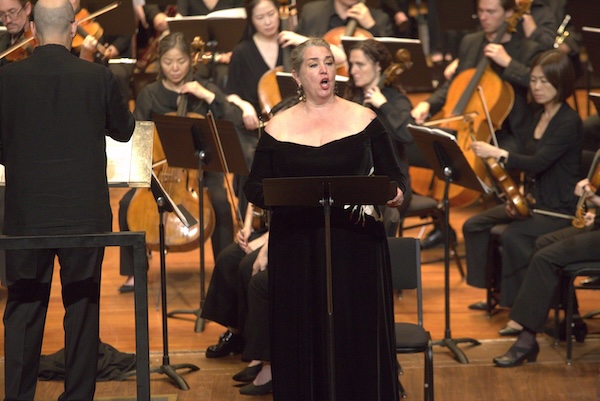
Melody Moore in the BMOP production of Frederick Douglass. Photo: Jason J Lachapelle
This story has plenty of compelling machinations, but it makes for wordy singing. The music and lyrics often explain emotional states, forgoing subtleties. There is more telling than showing here. For example, Frederick Douglass’s arias tend to be overly declamatory. They may reflect the historical figure’s formidable skills as an orator, but “Love at Autumn,” a love duet with Helen, needs to be more than an oracular exchange of information. In that scene the couple comes off sounding like sentient to-do lists. Kay did his best to make the lines soar, and they do in some spectacular moments. The chorus plays a key role, see-sawing between folksy whimsy and hymnic grace. The music achieves its grandest flair in Aubrey’s love song in Act 3 to Helen.
The opera’s greatest strength lies in its expansive orchestral canvas. At once sensuous, yet crowned with dissonant thorns, the music underscores the turbulent emotional drama with skillful elan. The sound is never thin, even when solo violin, cello, and trumpet are pushed to the fore. Harmonies resolve in unexpected ways that draw the listener in while also keeping the emotional tensions spinning forward.
The singing ranged from excellent to outright stellar. Kenneth Kellogg brought burnished tone and stoic assurance to the role of Frederick Douglass; his diction dovetailed the crisp and the percussive. Kellogg had a fine companion in Melody Moore, as Helen, a soprano who made the character’s vocal lines ring. Kellogg served up a forceful presence; Moore balanced him by supplying emotional conviction. Helen’s concern for her husband’s health and position came across with raw heartbreak — this was a partner panicked that she would lose everything.
Neal Ferreira sang the role of Aubrey with agile fervency, conveying the officer’s bitter jealousy along with his deep affection for Helen. Ferreira and Moore’s Pucciniesque love duet wafted like perfume above the accompanying orchestra and chorus, with Kay’s music providing sweet, Neo-Romantic splendor.
Omar Najmi made for a suitably opportunistic Demler, a journalist who was constantly searching for ways to catch Douglass in what would be a headline-grabbing scandal. Najmi’s clear and resonant baritone complemented the ensemble of John Allen Nelson, Matthew Arnold, and Devon Russo, who respectively portrayed Senator Norton, the merchant Busby, and Secretary Welles with stentorian presence.
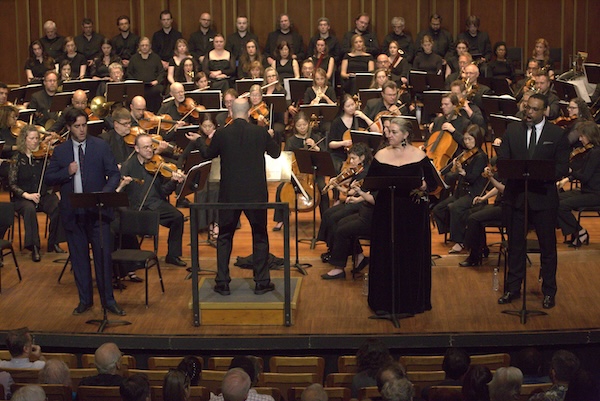
Gil Rose conducting the cast, chorus, and orchestra in the BMOP production of Frederick Douglass. Photo: Jason J Lachapelle
As Howard, Leroy Davis was given the challenge of walking the vocal and dramatic wire between Kellogg’s assertive pose and Moore’s sonic furor. His smooth-toned baritone conveyed familial warmth in his featured moments with Moore. Dani Zhang, in the brief role of the servant Agnes, topped the cast off by contributing some glittery vocal finesse.
The chorus, prepared by Edward Jones, was sometimes buried beneath the orchestral waves. But, when it rose above the din, the singers could be admired for their uniform blend and limpid vitality.
The stars of this staging were the members of the orchestra, who, under Gil Rose’s crisp and alert direction, infused vibrancy into every page of the score. These adroit musicians teased out every nuance, grand build-up, and soulful sweep. Some might have called it cinematic. But it was really as operatic as it can get.
Aaron Keebaugh has been a classical music critic in Boston since 2012. His work has been featured in the Musical Times, Corymbus, Boston Classical Review, Early Music America, and BBC Radio 3. A musicologist, he teaches at North Shore Community College in both Danvers and Lynn.
Tagged: BMOP, Boston Modern Orchestra Project, Donald Dorr, Frederick Douglass, Gil-Rose