
Concert Review: Sam Grisman Project and Peter Rowan — Seizing the Moment
By Scott McLennan
There were unscripted song selections whose daring and heart made this concert so much more than a night of old beloved tunes.
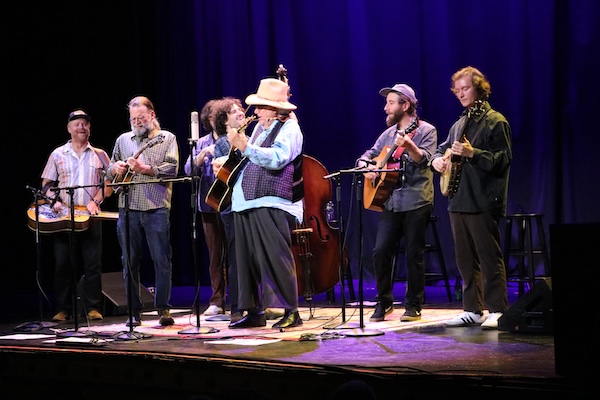
Peter Rowan and Sam Grisman Project in action at The Cabot in Beverly. Photo: Scott McLennan
Peter Rowan and Sam Grisman Project certainly met the moment in concert Saturday at The Cabot in Beverly, performing songs that captured the mood and spirit of a day filled with political protests across the country as the Trump administration flexed authoritarian muscle in Washington D.C.
These bluegrass devotees not only belied the notion that string music should be relegated to “old-timey” status, but they also reminded us that resistance and protest should not be devoid of joy.
Bass player Grisman has formed an ever-changing traveling bluegrass ensemble, ostensibly to celebrate the legacy of acoustic music produced by his father, mandolin great David Grisman, and a moonlighting Jerry Garcia, when he wasn’t busy playing with the Grateful Dead. Over time, Sam Grisman Project has widened its scope while staying focused on both the legacy of this repertoire and continuing the history of the progressive musicians who have kept the music fresh and inspiring.
Grisman told the Cabot crowd that good songs are a religion unto themselves, and he and his band – augmented by the legendary Rowan, who also worked with the elder Grisman to bring bluegrass into uncharted destinations musically and physically in the ’60s and ’70s — took us to church for two sets that stretched over roughly three hours.
When Sam Grisman Project and Rowan arrange an occasion to team up, they typically bill the shows as a celebration of the band Old & In the Way, a beloved but short-lived ensemble formed by Rowan, the elder Grisman, Garcia, bassist John Kahn, and fiddle player Vassar Clements.
However, at The Cabot, the ensemble leaned less into OAITW material. Instead, the band delivered a freewheeling and pointed concert fueled by a desire to grasp the moment as well as pay homage to the past. It was a smart strategy: to celebrate that history without making it feel like a trip to the museum.
The concert started with the soon-to-be-83-year-old Rowan ambling out to the stage for a solo number about how glad he felt being back in New England. Rowan was born in Wayland and performed in the fertile Boston folk music scene of the late ’50s and early ’60s.
Rowan departed to make way for Sam Grisman Project, which on this leg of concerts in the Northeast features mandolin player Matt Flinner, guitarist Max Flansburg, fiddle player John Mailander, and banjo player Victor Furtado joining the bassist, with dobro player Tod Livingston also joining the group throughout the night.
SGP opened with “How Can You Keep Moving,” an Agnes Cunningham song done by Ry Cooder that shines a light on the way authorities force poor people toward the fringes of society — it was a sign of things to come.
Before Rowan rejoined SGP, each of the band members was given an opportunity to display his respective dazzling chops. Flinner and Flansburg, in particular, seemed to be the most comfortable in their roles, especially when anchoring a long, exploratory version of “Shady Grove,” a number that was a staple in a ’90s musical reunion of the elder Grisman and Garcia
Furtado, a newer recruit to SGP, added grit to the sound with his percussive claw hammer style of playing. Mailander is another virtuoso who did not take long to look for ways he could push the boundaries of the group. That was most evident when Mailander led on a version of George Harrison’s “Isn’t it a Pity.” Furtado took advantage of the same opportunity when his spotlight turn came on Bobby Charles’s “Homemade Songs.”
When Rowan returned in the first set, he did so in grand fashion with a full-throated version of Woody Guthrie’s “This Land Is Your Land.” The moment was not lost on the crowd, which responded with singalongs, clap-alongs, and general revelry.
Rowan went from ragged patriot to wry rascal with his weed-smuggling gem “The Free Mexican Airforce” and then delivered a blistering “Sweet Melinda” that had the band members in a frenzy of funky picking, with Grisman and Rowan locked in vocal harmonies around a single microphone.
SGP closed the first set with “Went to See the Gypsy,” a Bob Dylan deep cut the group was inspired to find a bluegrass arrangement for, inspired by Grisman’s fascination with Tim O’Brien’s Dylan homage album Red on Blonde. Grisman loves to connect the dots for his listeners — he is a most welcoming tour guide.
Rowan opened the second set with a solo reading of “The American Eagle Tragedy,” a rarity from Earth Opera, the first group he formed with David Grisman. This tale of a corrupt leader, written during the Vietnam War era, resonated on Saturday. Rowan next sang “Oh Liberty,” a song he released in May that hails America as a beacon of hope and freedom for migrants – it was an obvious counternarrative to Trump’s mass deportation actions.
Rowan and Grisman then did a mesmerizing duo take on Blind Lemon Jefferson’s “See that my Grave is Kept Clean.” The affection the two had for each other and for the music was palpable.
The show finally took a turn into the original Old & in the Way era, first with Rowan orchestrating a big hootenanny on “High Lonesome Sound,” a song he said was inspired by the news he received in 1973 that Clements would be touring with his hippie bluegrass band.
Mailander then played a rousing version of Clements’ “Kissimmee Kid,” another OAITW signature.
Before going back to music featured by OAITW, Sam Grisman Project played a deeply moving rendition of Jody Stecher’s “Leela.”
The second set ended on a magnificent run, beginning with Carter Stanley’s “White Dove,” an OAITW staple given a brilliant working over by SGP and Rowan, followed by “Walls of Time,” which Rowan co-wrote with bluegrass godfather Bill Monroe. Next came the band’s namesake, “Old and in the Way,” written by the elder Grisman and sung now by his son. Rowan’s anthemic “Midnight Moonlight” closed out the set.
During the encores, SGP and Rowan offered more surprises after a celebratory take of “Rosalee McFall.” First, SGP returned to the Woody Guthrie songbook for a scathing rendition of “All You Fascists” — they dedicated the takedown to Trump’s top adviser, Stephen Miller. Rowan then returned and, noting the recent deaths of Sly Stone and Brian Wilson, delivered a tender version of Wilson’s “Love and Mercy.”
These were unscripted moments — not on the written setlists sitting on stage. It was just that sort of daring and heart that made this concert so much more than a night of old beloved songs.
Scott McLennan covered music for the Worcester Telegram & Gazette from 1993 to 2008. He then contributed music reviews and features to The Boston Globe, Providence Journal, Portland Press Herald, and WGBH, as well as to The Arts Fuse. He also operated the NE Metal blog to provide in-depth coverage of the region’s heavy metal scene.
Tagged: John Mailander, Matt Flinner, Max Flansburg, Peter Rowan, Sam Grisman Project, The Cabot, Tod Livingston
I’m not sure why you felt the need to inject your personal politics into your concert review.
The concert held many overtly political moments staged by the musicians, not interpreted by me. When was the last time you heard Peter Rowan perform American Eagle Tragedy? Or SGP do All You Fascists? Those were not subtle song choices. How Can You Keep Moving, Isn’t it a Pity, This Land is Your Land, Oh Liberty, and Love and Mercy were perhaps more subtle but formed an easily discernable theme . Your comment would make more sense of I had chastised the band for not making political commentary if none were given.
Right on! Telling it like it was is not “injecting” anything. it’s what journalists do. Not doing that would be the crime.