
Theater Reviews: Berkshires Roundup — In Touch With Reality
By Bill Marx
A trio of companies — Barrington Stage Company, Great Barrington Public Theater, and, to a lesser extent, Berkshire Theatre Festival — draw on the stage’s power to address our current political emergencies.
It isn’t often that I leave the theater feeling encouraged these days, but I did after sitting through a trio of shows in Western Mass. It is not that the dramas were optimistic — they weren’t. But at least they touched on America’s soul-killing dilemmas, among them the tightening grip of oligarchy, autocracy, and xenophobia. A trio of companies — Barrington Stage Company, Great Barrington Public Theater, and, to a lesser extent, Berkshire Theater Festival — drew on the stage’s power to address political emergencies, to diagnose our political malaise, and to confront fantasies of violence spawned by destructive divisions. After all, if democracy goes down, creative freedom will go with it.
Thousands and thousands of protesters around the country insist that there’s a national crisis. But Boston’s stages don’t see it. They choose to bask in a never-never land of see-no-evil neutrality, summed up by American Repertory Theater artistic director Diane Paulus’s credo for the company’s next season. Upcoming productions for this major (and very wealthy) regional theater are slated to explore “themes of ambition, empathy, transformation and discovery, these shows all grapple with what it means to be human.” The future of dissent? The rise of government censorship? The looming specter of dictatorship? The garroting of America’s top-flight universities? The slashing of art and culture funding? None of these issues are confronted head-on. The fact is, shows that meditate on “what it means to be human” are useful, but we also need plays that engage with how we can protect human beings. But that would mean dealing with the scary real world, which is undergoing a sinister “transformation” that does not make for Broadway-friendly fodder, at least without big-name stars.
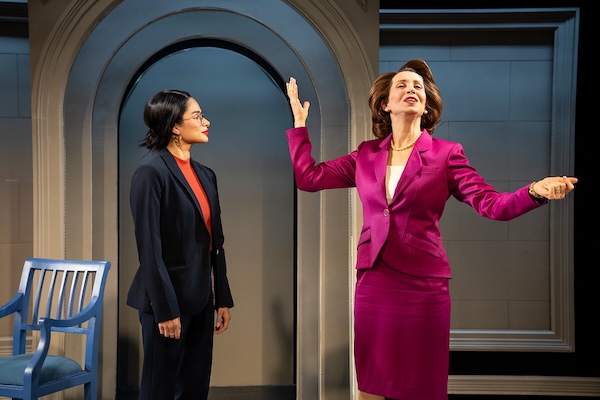
(L-R) Diane Guerrero and Kelly Lester in the Barrington Stage production of N/A. Photo: Daniel Rader
At Barrington Stage, Mario Correa’s enjoyable two-hander N/A (through June 22 at the St. Germain Stage) pits Nancy Pelosi, an icon of moderate liberalism, against Alexandria Ocasio-Cortez, an iconoclastic outsider, in a seesaw battle over what the Democratic Party is and will become. Is there a way forward for a party that is scraping bottom, at least in public popularity? Should they continue the customary compromise with lobbyists and fat-cat donors, so Democrats can generate the numbers needed to win the House of Representatives? Or fight for progressive causes — and working-class issues — that may hand the Republicans the ammo they need to take the field?
The pair agree on goals — such as protecting immigrants at the southern border — but are at loggerheads over strategy. (Divisive issues such as Israel/Palestine are not brought up.) In five scenes, starting with the 2018 midterms (when the Democrats win control of the House), and ending with the 2022 midterms (when they lose it), the two women play ideological ping-pong, each landing amusing zingers as they posture, pout, zig, and zag. As for ideas and retorts, there is nothing said that a dedicated watcher of MSNBC wouldn’t be familiar with. But Correa brings wit and vigor to the ideological showdown and he has plenty of fun sending up stereotypical personality traits. The sleek Barrington Stage production is directed with efficient snap by Katie Birenboim and performed with showy panache by Kelly Lester as Pelosi and Diane Guerrero as an alternately winsome and waspish AOC. Kudos to costume designer Ásta Bennie-Hostetter for supplying such deliciously recognizable outfits.
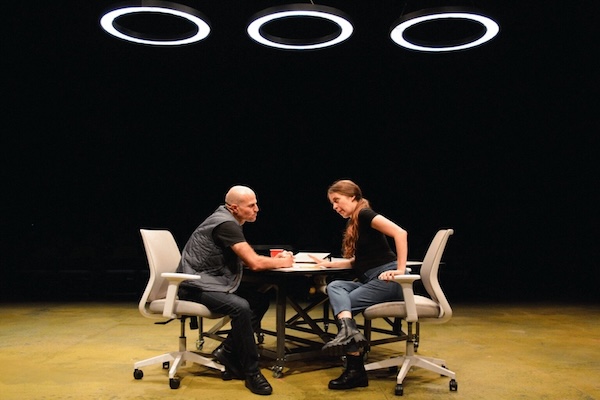
Noah Ilya Alexis Tuleja and Eliza Fichter in the Great Barrington Public Theater production of How to NOT Save the World with Mr. Bezos. Photo: Lauren Jacobbe
N/A supplies a recognizable map of left-wing frustrations, but it is too well-groomed and conventional to tap into what many Americans feel about the current state of the union: panic, anxiety, fear, helplessness, despair, and more. At the end of the play, AOC announces she has “a plan” for delivering genuine change. But we don’t hear what it is: A third party? A mass movement? A dose of democratic socialism? Correa won’t posit how — from the progressive point of view — the Democratic Party might stop its decline and try to reinvigorate itself. On the other hand, How to NOT Save the World with Mr. Bezos is a provocative (if dramaturgically messy) fantasia about what might lie ahead. The setup of this Great Barrington Public Theater production (running through June 22) is as follows: Congress has passed a bill honoring the memory of Bernie Sanders. 900+ billionaires have been ordered by the US government to hand over every dollar they have accumulated over a billion. Predictably, many of the plutocrats are hiding their excess wealth, and the have-nots, excitedly anticipating what the redistribution of so much cash will bring, are angry. A journalist arrives to interview Amazon mogul Jeff Bezos about a federal investigation into whether he is withholding any of his many, many zillions.
No spoilers here regarding the twists and turns this wild ride of a play takes. Let’s just say there are lots, and Boston-based playwright Maggie Kearnan steps harder on the gas after each head-shaking curve. A lot of what goes on here is too erratic to mesh theatrically: the tone veers from satiric to deadly, cute to confessional; personal and political vendettas don’t quite jibe (motivations are as murky as Elon Musk’s tax return), and there are parallels drawn between the bloodlust of mob violence and the lethal sadism of our sociopathic/libertarian overlords. The message appears to be “a plague on both of their houses,” which leads me to believe the play shares the nihilism it is ostensibly condemning. Or is this a warning of what might happen if political solutions are not arrived at? As in N/A, none are offered.
That said, the script and production pulse with visceral pizzazz. This indictment of growing inequality, engineered by the domination of an oligarchic few, is delivered with plenty of mischievous verve and several well-earned kicks to the economic groin. Eliza Fichter’s galvanic performance as the journalist goes over the top way too soon, though Noah Ilya Alexis Tuleja manages to keep his Bezos from nosediving into hysteria.The addition of a Fact Checker character is a brilliant conceit. The kibitzer promptly tells us who is fibbing and who is not, sets the record straight, etc. And Shai Vaknine, as the fact-giver, gives us the straight and often depressing dope — via micro explanations and sing-alongs — with deadpan panache. (Full disclosure: I appeared with Fichter in this season’s staging of Climate Crisis Cabaret: The Warm-up at Cambridge’s Arrow Street Arts.)
To its credit, How to NOT Save the World with Mr. Bezos ventures where few contemporary scripts have dared: it is propelled by the dark suspicion, shared by a growing number of citizens, that the world is hurtling “out of joint,” soon to reach the point of madness. The transactional indifference of the power-plundering über-rich to humanity and the public good — embodied by their race to reach Mars — is taking a cancerous stranglehold. Kearnan and company’s primal scream at today’s chaos is well worth hearing, though Bertolt Brecht had a point: silent yelps should be mixed in from time to time.
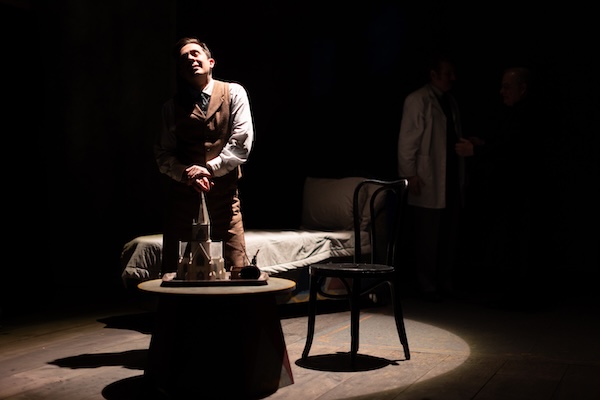
Michael Wartella in the Berkshire Theatre Festival production of The Elephant Man. Photo: Tucker Blair
The Elephant Man at Berkshire Theatre Festival’s Unicorn Stage (through June 15) might seem to be the odd production out, given that it is set in late 19th-century London. But director Eric Hill’s program note supplies an apt link to the present. “The true passage to healing lies not in scientific advancement but in the compassion and understanding we extend to those who suffer,” he writes. “Despite the passing of centuries, we have not moved much from our Victorian forebears in this regard.”
The plight of the “other,” in this case John Merrick, the grotesquely misshapen inspiration for Bernard Pomerance’s 1977 drama, remains deeply moving, and this production does right by the script, particularly in Michael Wartella’s tenderly nuanced performance as Merrick. He evokes the tenacious spiritual and artistic strength at the core of this radically vulnerable figure, who is protected from public ridicule and injury by the well-intentioned doctor, Sir Frederick Treves. But the physician grows to realize that he is imprisoning another human being: saving Merrick has meant denying him his full humanity. Harry Smith is fine, if a bit shouty, as Treves, but the actor falls short in conveying the character’s turnabout in the second half of the play. At first, Merrick needs help — by the end, it is Treves who does, once he sees through the hypocrisy of a society that saves the “Elephant Man” in order to market its good deed for funds.
I would quibble with Hill on one point: it is not only science that fails “those who suffer” in The Elephant Man, but also the two-faced altruism of a fading empire, aided and abetted by the voyeuristic, performative generosity of an upper crust conniving to enjoy its privileges guilt-free. In other words, Pomerance is critiquing the limits of “ambition, empathy, transformation, and discovery” when they don’t lead to a demand that a corrupt system be changed. And that is what gives the script political resonance today.
Bill Marx is the editor-in-chief of The Arts Fuse. For over four decades, he has written about arts and culture for print, broadcast, and online. He has regularly reviewed theater for National Public Radio Station WBUR and The Boston Globe. He created and edited WBUR Online Arts, a cultural webzine that in 2004 won an Online Journalism Award for Specialty Journalism. In 2007 he created The Arts Fuse, an online magazine dedicated to covering arts and culture in Boston and throughout New England.
Tagged: "How to NOT Save the World with Mr. Bezos", "N/A", Barrington Stage, Berkshire Theater Festival, Clay Hopper, Diane Guerrerom Kelly Lester, Eric Hill, Jeff Bezos, Maggie Kearnan, Michael Wartella
There is no entity called “Berkshire Theater Festival”. Do you mean Berkshire Theatre group?
It is a bit confusing: this is on the Berkshire Theatre Group website: The Colonial Theatre in Pittsfield, The Unicorn Theatre and The Fitzpatrick Main Stage in Stockbridge are part of the Berkshire Theatre Festival. The show was performed in the Unicorn Theatre, and that is part of the Berkshire Theatre Festival.
I’ve been subscribing at A.R.T. since I moved here from NYC in 2007, but I’m dropping my subscription after seeing their plans for next season. Not one of the announced shows sounds interesting, much less compelling.