
Jazz Album Review: “Chick Corea, Piano Improvisations Vol 1” — Flights of Lyrical Logic
By Michael Ullman
Throughout these bold solo performances, pianist Chick Corea exudes confidence.
Chick Corea, Piano Improvisations Vol. 1 (ECM, LP)
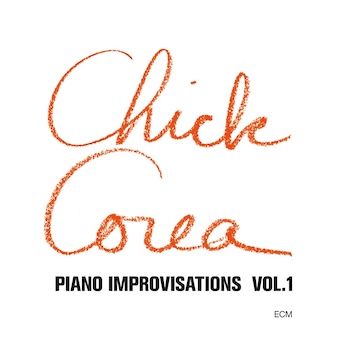 “This music,” wrote Chick Corea for the original back cover of Piano Improvisations Vol. 1, “was created out of the desire to communicate and share the dream of a better life with people everywhere.” It seems like an innocent enough statement, but those words had special significance at this exact moment in Corea’s career. He had been performing with his group Circle, which featured Dave Holland, Barry Altschul, and Anthony Braxton. Braxton was already well known as a figure in the avant-garde, and he brought that vibe to Corea’s band. For instance, on their “Nefertiti” from Circle: Paris Concert (recorded on February 21, 1971), Braxton leaves the chord changes behind in a long solo that has him shrieking as well as playing jagged phrases in a series of choruses I find exciting as well as daring. Soon afterwards, Corea broke up the band, explicitly because he wanted to play music that was more accessible. (I asked Braxton about it and he said he was okay with Corea’s decision, but wished the breakup hadn’t happened when the band was in California. He had to find his own way home.) Circle’s last recording was on May 17, 1971.
A month earlier, on April 21 and 22, Corea entered a studio in Oslo to improvise the pieces that were issued on two LPs, titled Piano Improvisations Vol. 1 and Vol. 2. The sessions weren’t exactly Corea’s idea: producer Manfred Eicher offered a solo recording possibility to Corea, Keith Jarrett, and Paul Bley. Corea bit first. Regrettably, the recent reissue of Volume One omits Corea’s statement that I quoted above, but it offers, via sparkling sound, the original music along with an essay on the music by Corea himself. He writes: “This was an intense period of discovery for me. The solo recordings are my ‘answers’ to life’s questions.… The Piano Improvisations were made spontaneously in the studio. I took the next idea that came to mind and played it down.” He came up with the titles later. Throughout these performances, Corea exudes confidence. The set opens boldly with “Noon Song”: it sounds, from its beginning, as if Corea were already in the middle of a conversation. His right hand plays a lyrical phrase and the rest of the piece follows from that graceful, improvised melody. At various points in the four-minute improv, Corea takes the time to slow and lighten up. On his own, he embraces flexibility. Surprisingly, after about two minutes, he indulges in sudden rhythmic perkiness.
Several of the pieces included are dedicated to women. “Song for Sally” sounds like a Corea composition from his Spanish period, whereas “Ballad for Anna” is a probing piece that seems to pose a series of questions. (I wonder if we can tell something about Anna and Sally from these improvisations?) “Sometime Ago” opens with his right hand playing a melody accompanied by a rhythm that seems ready to explode into one of Corea’s My Spanish Heart dances. The entire second side of Piano Improvisations is given over to the eight related pieces that Corea calls “Where Are You Now? A Suite of Eight Pictures.” They are varied. “Picture Three” is particularly startling: the pianist plays darting phrases high in the treble, then includes some quiet tinklings on prepared piano. The track is made up of a series of brisk moves, some barely audible, none in the mid or bass range of the instruments. “Picture 4” sounds as if it came from a different sensibility: it’s a warmly played piece over a restless rhythm. “Picture 8,” on the other hand, opens with a solemn series of chords. Then it seems to just fade away, as if it were the capstone to a succession of suggestions. The ideas that occur to Corea in these improvisations seem to follow one another logically, but that logic includes unpredictable contrasts.
I first heard Corea live at an extraordinary afternoon event at a club on Boston’s North Shore called Sandy’s Jazz Revival. As best I remember, it was in the late ’60s. On that day, Sandy presented solo sets by three pianists: the nearly legendary Earl Hines, Jaki Byard, and, lastly, the youngster Chick Corea. Hines biographer Stanley Dance, who spent those years following his subject around, introduced Corea as a promising newcomer. As he performed, it was clear to this listener that Corea had already arrived.
For over 30 years, Michael Ullman has written a bimonthly jazz column for Fanfare Magazine, for which he also reviews classical music. He has emeritus status at Tufts University, where for 45 years he taught in the English and Music Departments, specializing in modernist writers and nonfiction writing in English, and jazz and blues history in music. He studied classical clarinet. The author or co-author of two books on jazz, he has written on jazz and classical music for the Atlantic Monthly, New Republic, High Fidelity, Stereophile, Boston Phoenix, Boston Globe, and other venues. He plays piano badly.