
Opera Preview: “The Seasons” — A Fascinating and Disturbing Weather Report
By Helen Epstein
“I wanted, with this opera, to see if audiences and collaborators could feel something about our changing weather, in an artistic space.”
The Seasons, written by Sarah Ruhl in collaboration with Anthony Roth Costanzo. A Boston Lyric Opera co-production with the American Modern Opera Company (AMOC) and SCENE, and co-presented with ArtsEmerson. Directed by Zach Winoker. Sung by Brandon Cedel, Anthony Roth Costanzo, Ashley Emerson, Kangmin Justin Kim, Whitney Morrison, and Alexis Peart. Conducted by Boston Early Music Festival Artistic Director Stephen Stubbs, leading an 11-member ensemble of the Boston Lyric Opera Orchestra. Choreographed by Pam Tanowitz. Set design by Mimi Lien and Jack Forman of the MIT Media Lab. Costumes by Carlos Soto. Lighting design John Torres. Staged at the Emerson Paramount Center, Robert J. Orchard Stage, Boston, March 12 through 16 (Sung in English, Italian, and Latin with English surtitles)
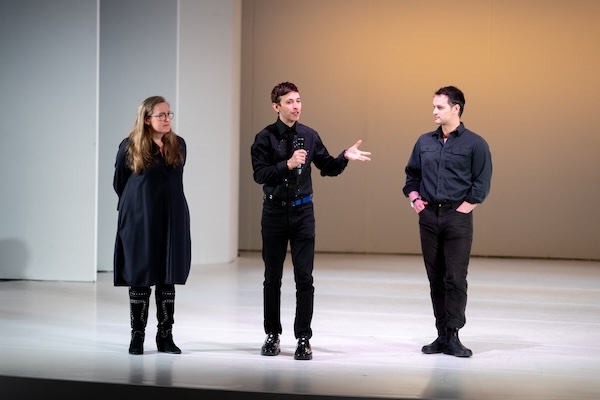
L to r: Sarah Ruhl, Anthony Roth Costanzo, and Zack Winokur in a Works and Process presentation of BLO’s The Seasons. Photo: Titus Ogilvie-Laing
How’s the music? That’s the first question many people ask before attending a contemporary opera. Here the music is no mystery: it is by Vivaldi. The Seasons is the world premiere “reconceiving” of the Vivaldi composition The Four Seasons by Sarah Ruhl and Anthony Roth Costanzo. This collaboration involves a number of talented artists: Helen Epstein focuses on the interaction between playwright Sarah Ruhl and counter-tenor Anthony Roth Costanzo.
How does a high-powered, multimedia collaboration like The Seasons start? In this case, with counter-tenor Anthony Roth Costanzo, who in 2019 asked playwright Sarah Ruhl to collaborate on an opera. Ruhl has written some 20 plays. When she was in her 30s, NYTimes critic Charles Isherwood described the dramatist as “an adventurer who is not afraid to blend the quotidian and the fantastic, deep feeling and airy whimsy.” Reading Smile, her memoir of being stricken with Bell’s Palsy after delivering twins, I was struck by the way Ruhl brings all of herself — artist, wife, mother, sister, daughter, friend, patient — into her work. Also, by her approach to writing memoir: “I’ve always preferred Montaigne’s discursive reflections to Augustine’s self-revelations.”
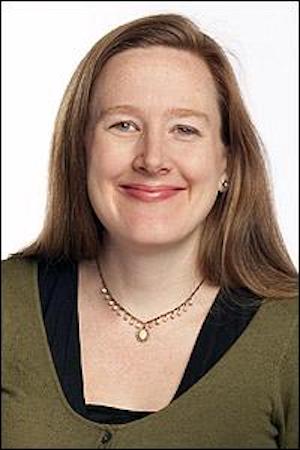
Playwright/librettist Sarah Ruhl. Photo: courtesy of the artist
Ruhl was born in Wilmette, Illinois, in 1974 to theater-loving parents. Her father, Patrick Ruhl, instilled in her a deep interest in and love of words, and her mother, Kathleen Ruhl, sent her young daughter, starting in fourth grade, to Evanston’s Piven Theatre Workshop and to Interlochen Arts Camp. Sarah entered Brown University as an aspiring poet, but after taking classes with playwright Paula Vogel switched to writing for theater. When Ruhl was 20, her beloved father died of cancer, a devastating loss that the playwright would later memorialize in her play and opera Eurydice.
Ruhl’s wide-ranging work is more often built around unusual, quirky situations, in addition to ancient myths and intriguing female characters. Dead Man’s Cell Phone (Arts Fuse review) begins when a man in a café drops dead as his phone rings, leaving a neighboring woman drinking coffee to answer it. The Clean House (Arts Fuse review) centers on two sisters, a housewife and a physician, whose depressed Brazilian cleaning woman tells jokes to the audience in untranslated Portuguese. In the Next Room (or The Vibrator Play) features a doctor, his wife, and a female patient in the 1880s, when the vibrator was developed to treat women diagnosed with hysteria. All three plays contain brilliant lines, provocative ideas, intelligence, wit, and a wealth of female roles.
Ruhl, now 51, first met Anthony Roth Costanzo in person when he sang Orfeo in a workshop of Eurydice at the Metropolitan Opera. Like almost everyone in the performance world, she had long followed Costanzo’s prolific career. Now 42, he was born in 1982 to Philip Costanzo and Susan Roth, both arts-loving psychology professors at Duke University. Early on, his piano teacher recognized he’d be happier singing, and introduced him to Gershwin’s songs. He began singing in musicals in North Carolina and his parents supported his talent, enabling him to move at age 11 to attend NYC’s Professional Children’s School. During that time, he went on national tours with the musicals The Sound of Music, and Falsettos. He also played Miles, the boy soprano in Benjamin Britten’s opera The Turn of the Screw, and a shepherd alongside Luciano Pavarotti in Tosca. When he was 15, a teacher suggested he meet with a professional countertenor. Long confused with castrati (male singers who between the 16th to 18th centuries were castrated before their voices changed so that their voice remained in a high women’s range), countertenors are baritones who can sing like sopranos. As a teenager, Costanzo began learning the traditional repertoire (Cavalli, Handel, Purcell, Vivaldi, Gluck), graduated from Princeton University, and received his master’s from the Manhattan School of Music. Here he is singing what is perhaps the best-known countertenor aria in Baroque opera.
Though he was already immersed in a concert, film, curating, and producing career while still a college student, Costanzo made his major Metropolitan Opera debut relatively late, as the title character of Philip Glass’s Akhnaten. In June 2024, he became the general director and president of Opera Philadelphia.
In person, Costanzo and Ruhl present a striking contrast in appearance, pace, and style. Ruhl is a heterosexual daughter of the American Midwest: self-contained, deliberate, grounded. She made me think of a blonde Senator Amy Klobuchar. Costanzo is gay, boyish, and seductive — imagine a slight, boundary-busting Harry Potter. Both approach their work in notably sly, transgressive ways. Both are recipients of the MacArthur Fellowship, known as the “genius” award.
When the two first met during the Met workshop of Eurydice, Ruhl recalls being struck by Costanzo’s extraordinary stage presence and what she calls his “incandescent voice, but even more by the conversations about opera and writing that we had during breaks.” She saw him perform in Only an Octave Apart with trans woman performance artist Justin Vivian Bond. “We were just coming out of the pandemic then and it was so moving to hear him sing Peter Gabriel’s “Don’t Give Up.” I remember weeping. I loved Anthony’s catholic with a small ‘c’ taste. He sang back-up for Michael Jackson. He loves fashion designers. He runs an opera company. He has so many different collaborative relationships and is able to galvanize many groups of people.”
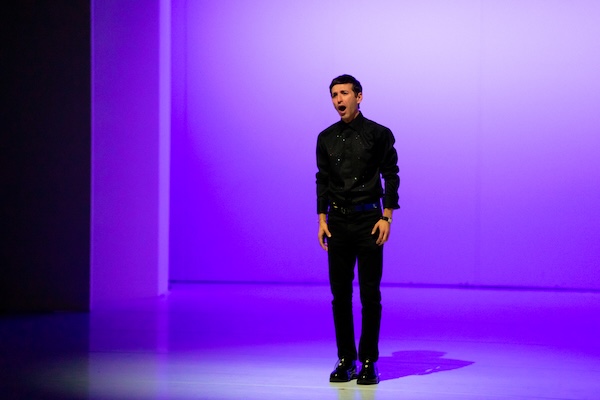
Anthony Roth Costanzo as The Poet in a Works and Process presentation of BLO’s The Seasons. Photo: Titus Ogilvie-Laing
At rest, Costanzo may look like a waif, but once he starts talking or singing, he transforms into a powerful guy with a powerful and multi-octave voice. That voice — which he has described as most useful for music composed before 1750 and after 1950 — carries a shock of the surreal as it ranges freely from full baritone to unearthly countertenor. (Here he is singing for a classroom of kids in an urban elementary school, and here he is tap-dancing to Gershwin’s “I’ve Got Rhythm.”)
Costanzo was originally commissioned to workshop something along the lines of The Seasons by the Metropolitan Opera, and he recalls thinking at the time about a “Baroque pastiche” and starting to collect music in 2019. “I first talked to Sarah about it in 2020 and we spent a couple of years sifting through every Vivaldi aria known to man and starting to assemble the music.” Antonio Vivaldi (1678-1741) was a priest, violinist, and hugely popular composer, during his lifetime and now, who wrote hundreds of pieces of instrumental music, motets, liturgical pieces, and, by his count, 94 operas. Some 40 have survived.
During the Covid pandemic, Ruhl and her family moved from their apartment in New York City to a house in Rhode Island, “closer to the natural world,” where she immersed herself in the music. She constructed a story and characters; then, working through Zoom, she and Costanzo selected “remarkable” arias from “unremarkable” operas as well as choral music. It was Ruhl who thought of using the Four Seasons to structure the libretto. She remembers listening to them as a child on a cassette recording during long car trips with her family from Chicago to Iowa. She remembers looking out the window at the sunshine, rain, changing leaves, or snowstorms when the seasons seemed self-evident. In 2020 they seemed broken up and out of order.
“Though I’m almost a total opera virgin,” she told me, “I understood ‘Baroque pastiche’ to mean a kind of collage, putting together different arias and pieces from Vivaldi’s canon and writing a new story. The synopsis of The Seasons is this: Several artists — a poet, a choreographer, a painter, and a performance artist in need of respite from their professional lives — retreat to a kind of artists’ colony run by a former actress turned farmer to take a break and reconnect with nature. There is also a character called the Cosmic Weatherman. As in real life and most opera, the singers fall passionately in love.
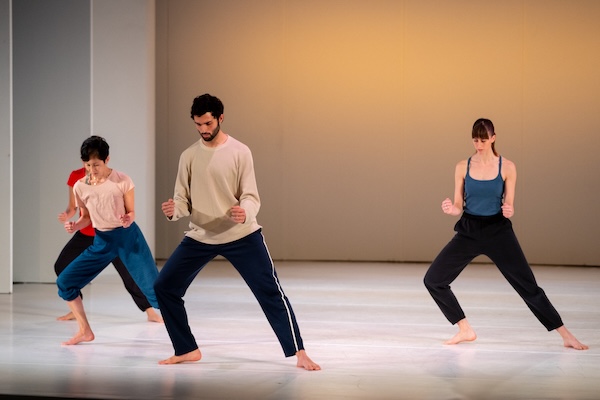
Dancers in a Works and Process presentation of BLO’s The Seasons. Photo: Titus Ogilvie-Laing
“These characters fall in love quickly,” says Ruhl, “almost in the Greek vernacular of Cupid’s arrow piercing the heart; just as the weather changes. I thought, too, of Shakespeare’s romances and the Ovidian speed of love and transformation. We often feel we cannot control love just as we cannot control the weather. And even as larger political and existential questions loom, human beings still find a way to love, and to obsess about it. “
“Also, just as the weather is fluid, so too is sexuality somewhat fluid in this piece, ” Ruhl explains. “One countertenor role is played by a mezzo-soprano in this version, without any change to the story. In opera, ‘pants roles’ (women playing men’s roles) were common — often a contralto playing the role of an adolescent man. In this piece, the gender of the characters could all be changed without a problem, as long as the voice suited the vocal demands of the role. I am passionate about putting love stories on stage that don’t make a big deal of which gender loves which gender; in other words, stories in which gender is not the focal point of love.”
In The Seasons, the subject of gender is made irrelevant by the theme of climate change. Summer fires come; then floods. The power goes out. The Choreographer dies. The Poet is knocked unconscious in a blizzard. The artists who sought nature to restore them now find that it threatens their lives and they are helpless. They try to build a ship, but realize it is too small and leaky to carry them. A children’s chorus arrives with a better boat and they all pray for a better future.
Ruhl learned that Vivaldi had conceived the four concerti as “program music,” in which Vivaldi’s music mimics the sounds of water, birdsong, storms, and fires, and that he had sometimes attached sonnets that further elucidated their meaning. She had never stopped writing poetry, and decided to write haiku for the arias. “I wrote one haiku a day in Rhode Island to mark the transformations outside my window and, like many other people, I noticed birdsong as if for the first time. Observing seasonal changes in the natural world became my preoccupation; marking these momentary transformations with haiku became my practice.”
She substituted Vivaldi’s sonnets with her own poems. “Haiku is about impermanence and change,” Ruhl says, “and while I’m pretty sure Vivaldi had no connection to Taoism, he was also writing about impermanence and change. We wanted to be faithful to Vivaldi’s lyrics but to move between the Latin (of Vivaldi’s liturgical music), the Italian (of his operas), and English. When there was a similar word or sound in both languages I tried to keep it. I also tried to adapt the English text to meet the requirements of melisma — extending a single syllable over multiple notes, which is common in Italian but more difficult in English. It’s also known as a vocal run. Anthony and I tried a million things. We decided to have subtitles. I thought it would be interesting to stop thinking and just stay in the music, whatever the language. We thought of the Italian sections as emotional close-ups and the English ones as longer shots. We tried many things and decided to have subtitles throughout.”
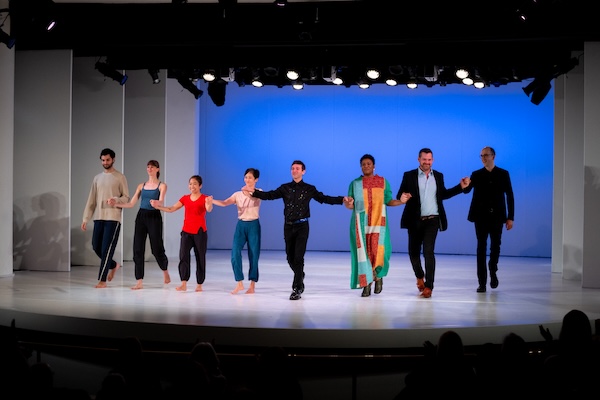
Curtain call at a Works and Process presentation of BLO’s The Seasons. Photo: Titus Ogilvie-Laing
The rehearsal process began as wildfires swept the West Coast. “By day, the creative team listens to arias,” Ruhl wrote two months ago in her introduction to The Seasons libretto. “By night, we check on loved ones and friends [in southern California] who are now, very suddenly, without houses, and have become (what may have seemed like a term of abstraction a year ago for some): climate refugees. This is our new normal… Facing a burning world is so disturbing that people often dissociate, try not to feel anything about the earth’s trajectory. I wanted, with this opera, to see if audiences and collaborators could feel something about our changing weather, in an artistic space. Music opens us emotionally, and the familiarity of Vivaldi’s music reminds me that the seasons themselves used to feel achingly familiar.”
“We had four workshops, one with actors for the libretto, one with dancers for the choreography, one with singers for the music, and one with everyone together,” Costanzo recalls. The Met decided against mounting a full production, so he brought friends from other organizations — former dancer and director Zack Winokur and choreographer Pam Tanowitz — on board. Dance pervades the piece. The Boston Lyric Opera and the MIT Media Lab (which invented a set made up of water and dish detergent) were the final additions to the multidisciplinary team, coming along later in 2023.
“Collaboration can range from the ridiculous to the sublime,” says Ruhl. “It’s like sex — it can be really bad or really good. I’ve been thinking about writing a book called The Art of Collaboration because increasingly it’s what I spend most of my time doing. As a playwright, usually 25% of my time is spent in solitary contemplation. 75% is spent working with other people — and the poet in me really suffers through that. But another part of me thinks: how lucky am I? All this virtuosity in one room. It’s addictive and so exciting. When it goes right, there’s nothing better. On a scale of 1 to 10, collaboration on a play is maybe a 7. Opera is a 12. It’s really shocking how many people are involved, and how much opera costs and then you only do it for five nights. Every layer provides more drama and artistic energy. It’s like the difference between walking one dog and a pack of dogs. And in this case, the person actually walking all those dogs is the director Zack Winokur — not me!”
I caught Zack by phone as he was walking away from the BLO rehearsal space in Fort Point Channel after a long day of rehearsal and asked him about this wide-ranging collaboration. “I like working with dead and live collaborators,” he told me. “This is a scary time for the arts as well as for everyone else. I think we’re moving into this place where a cohort of smaller institutions will be working together to make new work. None of us could do a production like this alone. Instead of being fully commissioned by one large institution, we all contributed to the development, workshopping, and rehearsals over time. But together we are scrappy and good at developing projects. That requires an enormous amount of trust.”
Helen Epstein is the author of the biography Joe Papp: An American Life and 10 other books of nonfiction. She has written for The Arts Fuse since 2010.
Tagged: "The Seasons", Anthony Roth Costanzo, Boston-Lyric-Opera, Sarah-Ruhl, The Four Seasons