
Concert Review: The Many Charms of Pianist Bill Charlap
By Jon Garelick
Put Bill Charlap in that camp of brilliant jazz originals who have plied their trade by playing songs by other people and making them definitively their own.
Bill Charlap at the Regattabar, January 24
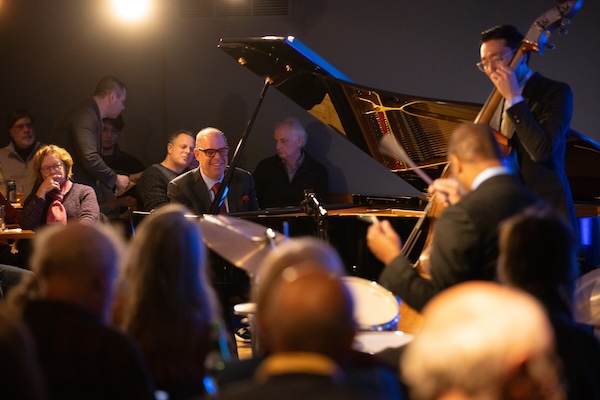
Pianist Bill Charlap with drummer Dennis Mackrel and bassist David Wong at the Regattabar in Cambridge. Photo: Bob Durling Photography
By now, every jazz fan who hasn’t been living under a rock knows of Bill Charlap. The 58-year-old pianist has been “active” since 1989 (according to Wiki) with at least 30 albums under his own name or as co-leader and a slew of others as a sideman. His working trio with bassist Peter Washington and drummer Kenny Washington (no relation) has become “classic,” in the manner of other longstanding collaborations that have carved out a singular body of work, noted not only for the leader’s peerless pianism but the special interplay of the ensemble. (The band is heard to good effect on last year’s Blue Note release And Then Again, recorded live at the Village Vanguard.)
But Charlap, among major jazz artists, is an outlier. For one, he is hardcore mainstream. His repertoire consists almost entirely of Great American Songbook material or blue chip selections from bop and post-bop composers. He is not a composer, and unlike other classic instrumental outfits (Modern Jazz Quartet, Miles Davis Quintets I and II, John Coltrane Quartet), his bands do not produce original material. He is not breaking new ground. He is working securely in an established tradition and making it shine, and making live performances unmissable.
Over the weekend of January 24, Charlap played three shows at the Regattabar, in this case with bassist David Wong and drummer Dennis Mackrel, and packed the 225-seat room for all three. I caught the first show, on Friday and, though most of the program was familiar, the music was full of surprises. The first came when he sat at the piano and immediately banged out a few “warm-up” chords that got a laugh — Strauss’s “Also sprach Zarathustra” (popularly known as the theme from 2001: A Space Odyssey”).
The bass notes of Strauss led to some hard-struck repeated bass notes at, or near, the very bottom of the keyboard, and then a soft shift into the melody of Ellington’s “I’m Beginning to See the Light.” Charlap improvised shimmering arpeggios, with occasional accents in that bottom note, in a medium-slow tempo, to Wong’s steady walk and Mackrel’s soft brush work (with a satisfying cymbal ping at the turnaround of the chorus). As Wong took a solo, Charlap spelled out the changes with spare, soft chording.
Ellington and Juan Tizol’s “Caravan” was up-tempo with double-time passages and a run that went all the way to the tippity top of the keyboard. There were drum-solo breaks, and a coda with Charlap smashing the keyboard with both hands brought from over his head. And then, “We’re going to continue with Ellington … because you can’t go wrong.”
So it was on to “Prelude to a Kiss.” Here was Charlap at his most delicate — stating the melody with a mix of chords, single-note phrases, and subtle pedal work, letting each syllable of the melody hang like that anticipatory prelude. There was a bit of bluesy improv, a passing quote (“Parker’s Mood”?), and a cadenza of floating-chord clouds.
Charlap’s sets develop more through free association than preset repertoire. (In an exchange of voice mails after the show, he credited the knowledge of the trio, and especially Wong, with enabling him to choose from a “a very large library.”) So Duke Ellington led to Vernon Duke, “I Can’t Get Started,” and a quick lecture on Duke’s biography — as a classical composer born Vladimir Dukelsky in Russia, renamed by George Gershwin, and a string of classic songs that include “Autumn in New York,” “Taking a Chance on Love,” and “April in Paris.” The beginning of “I Can’t Get Started,” he pointed out, shares its opening notes with those of Bartók’s first violin concerto, which he demonstrated on the piano, with the final note taking a dissonant Bartókian turn.
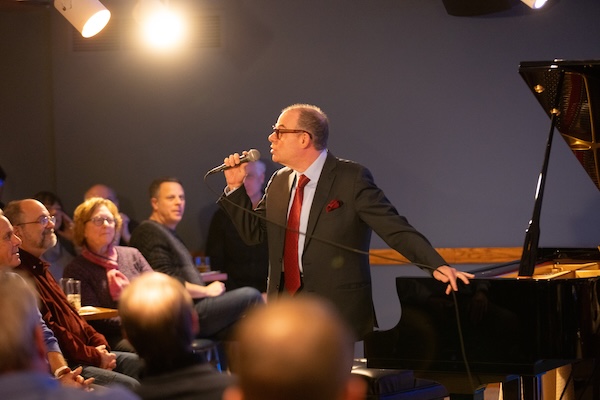
Bill Charlap expounds on songs and songwriters at the Regattabar. Photo: Bob Durling Photography
All of which might make it sound like this was a very talky show. It wasn’t. Charlap moved gracefully between playing and standing up with a handheld microphone, introducing songs, offering bits of composer biographies, quoting snatches of lyrics. The mini-Duke set continued with “Not a Care in the World” (lyrics by John Latouche), “Roundabout” (lyrics by Ogden Nash, “not the one by Jon Anderson, Rick Wakeman, Bill Buford, and Steve Howe”), and then onto “The Duke,” by Dave Brubeck. The effect was to draw the audience into the songs, the writers, and a bit of detail on songcraft (the nine-measure phrases of “Not a Care in the World”).
Irving Berlin’s “The Best Thing for You” was super-fast, with an extended coda and Charlap vocally egging on Wong and Mackrel. But even at fast tempos, the song was always the focus. For the closing up-tempo take on Dizzy Gillespie’s “Wood ’n You,” with Makrel’s light tock on his snare rims, Charlap shaped the climbing chords with a gradual crescendo before a final slam of the keyboard from on high.
But maybe the most moving performance of the night was “Detour Ahead.” Here Charlap took this underplayed ballad standard (credited to Herb Ellis, Johnny Frigo, and Lou Carter) and phrased it with such assurance that I felt like I could almost begin to sing it, even though I didn’t know the lyrics, the connective tissue of chords taking me from one phrase to the next. There was a crescendo and diminuendo that came down to an unresolved silence that left a hush in the crowd.
“That could have mesmerized a roomful of crazies,” said the woman I’d been sharing a table with. “And we’re the crazies.”
It makes sense that Charlap is so attuned to songs — his mother (with whom he has recorded) is jazz singer Sandy Stewart, and his father was the composer Moose Charlap. So put him in that camp of brilliant jazz originals who have plied their trade playing songs by other people and making them definitively their own, not by extravagant reinventions (Coltrane’s “My Favorite Things”) but by taking you deeper into the guts of the song — melody, harmony, rhythm, and even those unsung lyrics.
Set list:
1_ “I’m Beginning to See the Light” (Ellington)
2_ “Caravan” (Ellington/Tizol)
3_ “Prelude to a Kiss” (Ellington)
4_ “I Can’t Get Started” (Vernon Duke/Ira Gershwin)
5_ “Not a Care in the World” (Duke/Latouche)
6_ “Roundabout” (Duke/Nash)
7_ “The Duke” (Brubeck)
8_ “The Best Thing for You (Would Be Me)” (Berlin)
9_ “Detour Ahead” (Ellis/Frigo/Carter)
10_ “Wood ’n You” (Gillespie)
Jon Garelick can be reached at garelickjon@gmail.com.
Tagged: Bill Charlap, David Wong, Dennis Mackrel, Kenny Washington