Director Interview: “He Astonished Me Every Day” — Tony Gilroy on Pedro Pascal and “Behemoth!”
By Tim Jackson
The director returns after a long hiatus with a film built around real session musicians, nine top composers, and a cellist who can’t escape his past.
Behemoth! is Tony Gilroy’s first film as director in 14 years. His earlier directing credits are Michael Clayton (2007), Duplicity (2009), and The Bourne Legacy (2012). He also directed uncredited reshoots for 2016’s Rogue One, on which he shares screenplay credit.
The narrative follows Alex Serian (Pedro Pascal), a gifted cellist who returns to Los Angeles after 20 years on the road. There he takes work performing film scores. Gilroy spent six months interviewing musicians so he could cast actual session players. Nine film composers — Michael Abels, Emily Bear, Lukas Frank, Michael Giacchino, James Newton Howard, Henry Jackman, Nami Melumad, Brandon Roberts, and Alan Silvestri — billed together as the Behemoth Collective, wrote the score. Each wrote music for the fictional films whose scores the protagonist plays.
I asked Gilroy about the film’s structure and what it was like to direct Pascal. Behemoth! arrives in theaters nationwide on December 3.
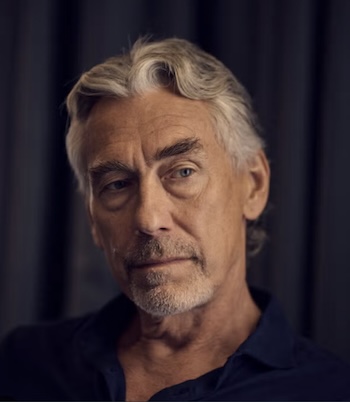
Director/screenwriter Tony Gilroy. Photo: courtesy of the artist
Tony Gilroy: Oh, I don’t even know. I never think that way. I mean, I’ll talk about things that way, but I never think that way. But yeah, I know it’s a very eccentric structure, that’s for sure. We knew how free we were playing.
AF: So where did you start? I believe you said the inspiration was watching the scoring sessions for Andor.
Gilroy: Yeah. When we started on Michael Clayton, I had a relationship with James Newton Howard, who’s just extraordinary. The word “genius” gets thrown around in Hollywood, but James really is an extraordinary talent. We did Clayton, then Duplicity, and then Bourne Legacy. I sit on the cues a lot. We had a rhythm of doing that together and of being around each other up close. We’d go to these sound stages where there were musicians whom I’ve known since Clayton, for 20 years.
AF: You then structured a script around knowing that you were going to be using varied composing styles?
Gilroy: First, I was just obsessed with that environment and ecosystem. I just knew there had to be a movie there. Then I did research for six months after Rogue One, trying to figure things out, trying to learn everything. But I couldn’t find a hook for it.
When we finished Rogue One, I found the hook of a potential daughter with a dynastic aspect to it, and also that it could be about family. There are a bunch of families in that soundstage room. They are second- and third-generation. So I started messing with that.
AF: You developed entire movie scenarios for each composer.
Gilroy: For each. I can give you the story for each project in the show. In other words, there are “Spies Don’t Run” and “Spies Don’t Pray”—“Spies Don’t Run” being the third in a series of the “Spies Don’t” films: “Spies Don’t Pray,” “Spies Don’t Sleep.” Yeah.
I wanted those cues for movies that happen throughout. Henry Jackman (Captain America: The Winter Soldier, Big Hero 6) did the first one, and Alan Silvestri (E.T., The Lion King) did the other. They both have mythical movies with stories that they’re composing scores for. I had to write enough about the fictitious movies underneath so they could get a handle on what to do and what kind of movies they were.
I said to Henry, for the one in the beginning, “This is like a ‘Bourne’ movie. This is gigantic—Tangier, Cairo, Athens, freaking crazy. It can’t be too big.”
And with Alan, I was like, “Okay, this is from like a Dan Brown book, ‘Open World,’ and it’s time-traveling hipsters, and everything’s sexy and groovy until something goes wrong. Make it huge. It’s a franchise movie.” There’s a whole science to how the cues land and how composers score the flashbacks, but with the scale, I wanted them to be just completely wrong.
AF: How far did you go in developing a movie for each piece of the score so the composers had something to hang their hat on? For example, there’s one comically thrilling scene involving a stolen toothbrush.
Gilroy: Yeah, I know. That’s hysterical. It’s meant to be. In Alan’s case, it’s pretty complicated—we have to do a whole story. So with that, I walk through general notes of the scene, like “Anticipation” and “Here comes the guard.” He’s writing in arbitrary beats for a scene that is like stealing the Mona Lisa or something, but all he’s doing is stealing a toothbrush.
But the composers need to know what the vibe is.
AF: Other examples of mythical movies?
Gilroy: “Season of Glass” is about a kid who’s going off to Vietnam, and it’s a summer place, and there’s an older woman who’s doing a Cyrano kind of thing, where she’s helping him earn the love of this young girl and get laid before he goes to Vietnam, and she’s falling in love with him. That’s that movie.
“Tolerance Hill” is a Victorian film about a young woman whose romantic chances are kind of ruined by her father’s abolitionist views; she loses the relationship, then realizes her father was actually cool.
And then the funniest one is “Look Away Jones,” which is what the father composed, and Brandon (Roberts, composer for The Hunger Games and The Last of Us) did that cue. “Look Away Jones” is an Alabama quarterback who wins the Heisman Trophy, but he never looks at his receivers when he throws the ball, so he’s called Look Away Jones. Then he ruins his knee, and he becomes a detective in LA, so it’s “LA Look Away Jones.” It’s like a 1980s TV series.
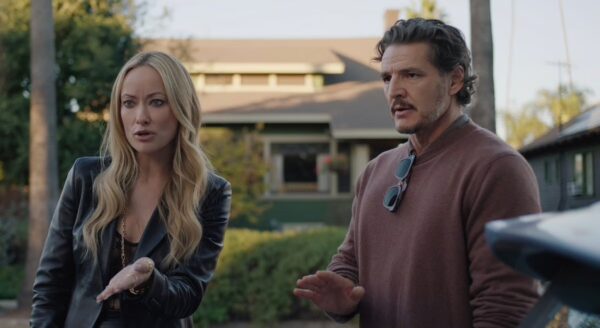
Olivia Wilde and Pedro Pascal in Behemoth!. Photo: Searchlight Pictures
AF: Then there is Will Arnett’s character, Andy, who is in this successful band called Circle Factory. Did you develop something around what that band would be?
Gilroy: Circle Factory. Yeah. They were kind of like all those ’90s pop bands, like the Goo Goo Dolls. I like those bands. We had a lot more information there, like all the titles he used for his podcast, and we had posters for him and everything, but this is not the kind of movie that pops in and shows you a lot of it. There’s a real restricted grammar in this movie. I wanted to make sure that Will knew that his mythical band always played stadiums. Tours, big tours, really. He’s gone cool now, but they were once huge. Now he’s on his ass. But you know how it goes. You know as well as anybody. LA is full of that kind of sadness.
AF: How about developing Alex’s character with Pedro Pascal?
Gilroy: After I got a main character, I wanted to tell a story that takes place over 20 years. I wanted to curate his life. I don’t have unlimited pages. I’ve got to pick my spots. I’ve done flashbacks and stuff before, but then you suddenly realize it’s built in. It’s almost cheesy how easy it is. For you and me, as musicians of a certain age, there are probably a lot of songs that really take us back to where we were at a certain time and place. The same goes for every civilian in the audience, even people who’ve never played music.
For somebody like Alex in Behemoth!, it is even more so . . . His mother was on those stages doing sessions while she was pregnant with him. He’s never not been bathing in music. The idea is that he would have a sort of ultimate gigantic radio telescope callback mechanism. It made sense. I thought, “Wow, I can use the cues to go back and forth.” Memory and music. That’s a pretty groovy idea. It certainly presents challenges while you’re writing, like “How are we going to do this?”
AF: Emotionally, Alex holds his cards very close.
Gilroy: I think he’s very incomplete. It’s really an interesting take. I’ve never written a character like this before, to be honest with you. I’ve never written a character that was this kind. He’s really kind and empathetic if you think about it. There are so many varieties of loneliness available to people now—expanding categories of loneliness. What’s incomplete about him is bandaged every day with music. He doesn’t really have to worry about being isolated, because every single day of his life, he’s going to go out and either go to a rehearsal, or go to a performance, or go to a teaching session or something. It’s intrinsically social, a sanctuary and a place of safety—a safety valve. It kind of lets him off the hook; the alternative is to be incredibly isolated.
Also, he’s really good-looking, and it’s a very sexy job, and he has all of the super slick social skills of someone who’s damaged in a certain way, who’s nomadic. He’s very fluid. People want to be around him, yet he doesn’t want to commit.
AF: There is an early scene, very funny, where three tacky Texas women are trying to charm him.
Gilroy: Right. You see how he turns on that frequency. He can go right there with them, thinking, “You want that, I’ll give you that.” Do you know any kids who go to a different school every year?
I remember an old CIA recruiting story in which one of the things they found attractive, that was high on their list, was kids who had been shuttled around, like Air Force kids who are in a different school every year, or kids whose parents move them all over the place. They end up redefining themselves and are able to give everybody what they want. Now, he maybe can’t give anybody what they need, but he can turn it on instantly if he needs to.
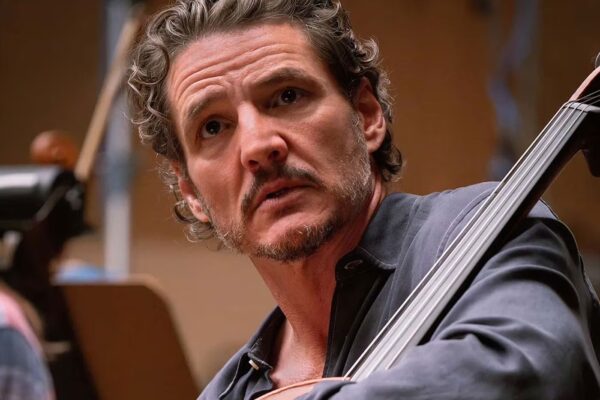
Pedro Pascal in Behemoth!. Photo: Searchlight Pictures
AF: But as an artist, Alex doesn’t actually create or write music.
Gilroy: No, Alex is not a creator. But his ability is such that he could have been a principal soloist. He was on track to do that. He certainly has all the charisma and all the rest of it. He doesn’t even sit first chair by choice, which would be a normal thing for a cellist of that category. But he is a non-auditioning cellist. His reputation is such that when he wants to move from Boston to Chicago, it is not really a big deal, yet he has definitely been hanging back.
AF: A lot is going on beneath the surface of Pascal’s reserved performance.
Gilroy: Yeah. For me, Pedro just astonished me all the way through. There’s a high degree of difficulty in the performance. It’s very brave on his part in some ways, and liberating because there’s a lot of connection in here for him as a person. He himself has been a nomad, and he also has all these host tendencies to perform for people and make them feel comfortable when he’s really not. I can’t say enough about his performance. In interviews, it’s always really unpleasant when people just go, “Oh, he’s so amazing, and this was amazing, and that was amazing.” The easiest thing to say is he astonished me every day. The biggest compliment is that he gave me permission to make the movie in the dizzy fashion I wanted.
AF: How did you talk about character?
Gilroy: A lot of it’s on the page. I would say there were probably three, four, five spots in the script—I do this in a lot of scripts—where I’ll put in some things that are on the bubble for me, about a line that’s too good or a moment that’s too good, literally too strong or too easy. I’ll go, “Wow, I don’t know about this.” There were spots in this film where I was ready to go with a drier or safer version, with moments like “Don’t play sad—give me life here.”
Marcello Mastroianni was a real model for me, and when Pedro came on, I was able to talk about it. I love how Marcello can play a really quiet character, or one that might normally seem passive, but he doesn’t seem passive. He seems like he’s a passenger. Pedro really has that. It’s a very unusual temperature to be able to get at.
AF: So what’s next? Will you take a breath after years of intense work?
Gilroy: No. I mean, it seems like that to everybody, but the post-production on Andor is so . . . the landing is so long. It’s like eight, nine months. So we’re kind of finished doing visual effects and so forth, and it’s gentlemanly. And doing the music is very comfortable, a low-pressure process, and I can work on something else at the same time. So I started trying to figure out this film.
We only started shooting two weeks ago last year. Boy, I tell you, if you do all the music first, the post-production goes really, really quickly. Yeah. I’ve chewed it all up.
What should I do next, Tim? Tell me what I should do next. I don’t know.
AF: When I figure it out, I’ll give you a call. It’s Clayton at 50, and this at 70. At 90, I can only imagine.
This interview is edited from a longer conversation. A second half appears on my Substack.
Tim Jackson was an assistant professor of Digital Film and Video for 20 years. His music career in Boston began in the 1970s and includes some 20 groups, recordings, national and international tours, and contributions to film soundtracks. He studied theater and English as an undergraduate, and has also worked helter-skelter as an actor and member of SAG and AFTRA since the 1980s. He has directed four feature documentaries: Chaos and Order: Making American Theater, which is about the American Repertory Theater; Radical Jesters, which profiles the practices of 11 interventionist artists and agit-prop performance groups; When Things Go Wrong: The Robin Lane Story, and Marblehead Morning: Daring & Stahl: 50 Years in Harmony. He has made two short films as well: Joan Walsh Anglund: Life in Story and Poem and The American Gurner. He is a member of the Boston Society of Film Critics. You can read more of his work on his substack.