Book Review: Why Young Catholics Are Embracing the Latin Mass
By Thomas Filbin
Trads takes traditionalist Catholics seriously, and a one-time seminarian weighs the book’s illuminating findings.
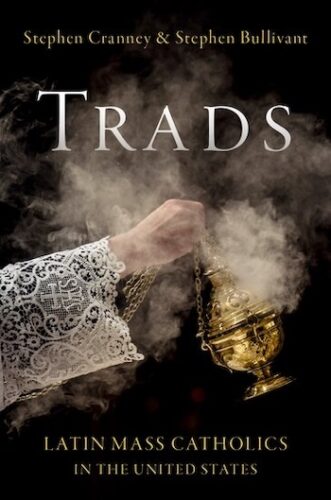
Trads: Latin Mass Catholics in the United States by Stephen Cranney & Stephen Bullivant. Oxford University Press. 247 pp. $29.99.
Boys trained as altar servers in the late 1950s, before Vatican II, had to learn enough Latin to answer the priest’s prayers at Mass. The Catholic world they knew still bore the stamp of the Council of Trent (1545–63), which hardened belief and practice in response to the Protestant Reformation. The Latin Mass, the elaborate ecclesiastical rituals, and the insistence on transubstantiation (defined as dogma in 1215) all signaled that Catholic doctrine was fixed and that doubt amounted to heresy.
Catholicism before Vatican II was monolithic. An unconfessed mortal sin, which could include even masturbation, could send a soul to hell. Fear of damnation, and the lingering smell of fire and brimstone, kept the faithful in line.
Vatican II upset that order. It gave laypeople active roles, such as lector, reading scripture at Mass. It also rattled hidebound conservatives, who saw their beliefs as unchangeable. Cardinal Alfredo Ottaviani (1890–1979), secretary of the Holy Office, which guarded doctrinal unity, opposed reform so bitterly that traditionalists regarded him as the true guardian of the faith. His heirs persist. Some ultra-traditionalists today hold that the church has been in heresy and apostasy since Vatican II, and they reject every pope since then as an antipope who reigns without validity.
Cardinal Ottaviani argued against change at the Council. The reform-minded Cardinal Augustin Bea (1881–1968), a German Jesuit and biblical scholar, bitterly opposed him and had invited the Protestant theologian Karl Barth (1886–1968) to attend. One sardonic joke claimed that Ottaviani hailed a cab to the council and arrived in Trent four hours later.
I spent one year as a Catholic seminarian after high school (1964–65), when traditionalists and reformers were openly at odds. Formal theology, unlike the simple catechism I grew up on, was chockablock with their debates. Much of the wrangling struck me as resting on habit and emotion. I spent more of my time reading history and novels, and I began to see a world larger than the one I knew as a young acolyte.
The first crack in my faith came when I asked my theology professor, who held a doctorate from the Gregorian University in Rome, what the reasons for religious belief were. He looked at me blankly and said, “There are no reasons for belief; you either believe or you don’t.”
That was the start of my withdrawal from Catholic identity. Today I am a secular humanist, a semi-Christian philosophically if not theologically, and I prefer a rational understanding of the world. Michael Palin of Monty Python was English, of Irish descent, and raised Catholic. He has described his own state best: “Agnostic… (long pause), with doubts.” Even pure agnosticism seems as dogmatic to me as religion.
All of this is background for my thoughts about Trads, a perceptive book about retro-Catholics who want yesterday’s world restored, above all through the Latin Mass. The study is by two religious studies professors. Stephen Cranney teaches at the Catholic University of America and is a non-resident scholar at Baylor. Stephen Bullivant is a professor at St Mary’s University in the UK and a research fellow at the University of Notre Dame Australia. The book looks deeply into minds and hearts of the Traditional Latin Mass (TLM) community. A lazy assumption would be that it glances at the mindset of stubborn deniers of modernity. But the authors take the sociology and philosophy of these outliers seriously and examine their culture and values with admirable objectivity which will give open-minded readers a fresh view.
Traditionalists deserve a hearing, however outdated they may seem. My old seminary rector, Monsignor Granville, often scolded me for my errant behavior, but he wasn’t always wrong. He said, “Be not the last to leave the new untried, nor the first to cast the old aside.”
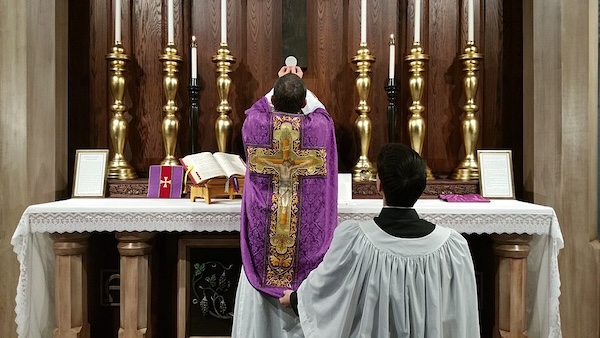
A view of the traditional Latin Mass — Elevation. Photo: Servants of the Holy Family
The book’s chapters cover the history and background of the TLM community, how it plays out in America, how many Trads there are, their effect on the current church, and what their future might be. As good social scientists, the authors do not treat beliefs as free of cultural anchors.
One might assume Traditionalists are simply older people unwilling to let go of the beliefs and habits of their youth. That is no doubt true of some of the TLM brigade. But the authors’ central point is that many young Catholics have embraced the movement. Age is statistically significant: “…relative to their fellow parishioners, those who go to TLM are younger than average.” For Trads, traditionalism is not a rejection of new ideas but an affirmation of more established ones.
Cranney & Bullivant have meticulously examined surveys of American Catholics of all stripes. They find that the different groups are comfortable with Mass in either Latin or English. Politically, Trads lean toward conservatism and Republican identification: “It is clear that the perception that TLM-attending Catholics tend to be politically Republican, or at least conservative, is borne out in the data…especially when issues are viewed through a ‘culture war’ framework.”
The book touches on birth control. The survey data show that Trads have statistically more children, though not by much, and Americans generally have smaller families than they did early in the 20th century. One observer noted that priests seldom preach on birth control anymore. They know they have lost that debate when they look out at congregations with one or two children, not six or seven.
True to form, the authors rely heavily on data and tables. The appendices detail how the surveys were constructed, the interview prompts, extensive statistical notes, and comparisons of church attendance between Latin and vernacular Mass attendees.
The future of the Latin Mass in America rests largely with the bishops of the nation’s 196 Catholic dioceses. The authors speculate that Rome could intervene, but for now Rome and the American bishops seem to have adopted a “may a thousand liturgical flowers bloom” attitude. Cranney and Bullivant note that many bishops make a point of visiting a TLM celebration now and then, to show they do not consider the Latinists outliers.
Anyone interested in history knows that language is fluid. Jesus (Yeshua ben Yosef) spoke Aramaic and Hebrew, heard a bit of Greek, and perhaps knew some Latin, since Judaea became a Roman province early in the first century. Language follows culture more than it follows decrees from above.
This well-written book wisely explores modern trends and habits in a very old faith.
Thomas Filbin’s reviews have appeared in The New York Times Book Review, The Boston Sunday Globe, and The Hudson Review. His novella Carousels has recently been published.
Tagged: Catholic Liturgy, Council of Trent, Latin Mass, Oxford University Press, Roman Catholicism, Sociology of Religion, Stephen Bullivant, Stephen Cranney, Thomas Filbin, Traditional Latin Mass, Traditionalist Catholics, Trads, book review, culture-wars