
Film Review: “Misty Green” — Hollywood Dreams, Bitter Aftertaste
By Neil Giordano
A stellar Rosalind Eleazar anchors this sour Hollywood parable, but Chris Rock’s performance and an overstuffed screenplay undermine its bite.
Misty Green, written and directed by Chris Rock. Screening at AMC Boston Common 19, Landmark Kendall Square, Alamo Drafthouse Seaport, and AMC Causeway.

Rosalind Eleazar in Misty Green. Photo: A24
Depending on your age, you may know Chris Rock best from his early-1990s stint on Saturday Night Live or as the voice of Marty the zebra in the Madagascar movies. His career has also taken him into music, through collaborations with a pre-controversy Kanye West, and television, with the hit sitcom Everybody Hates Chris. Along the way, his fortunes have risen and fallen with the industry’s familiar caprices. Little wonder that disenchantment has become a hallmark of his filmmaking. In his previous directorial outing, the clever, cynical Top Five (2014), perhaps his best film, Rock cast himself as a mid-tier movie star struggling to be taken seriously.
With Misty Green, Rock takes another pass at the demons that haunt life in “the business.” That the follow-up took more than a decade is a commentary in itself. The film revisits the struggles explored in Top Five but ventures further from Rock’s own experience. The results are decidedly mixed, though its downbeat portrait of Hollywood exposes some ugly truths.
British actress Rosalind Eleazar (Slow Horses) shines as the title character, a thirtysomething actress desperate for a comeback. Misty is no easy colleague—or friend. Headstrong and confident, she knows her worth but still lives like a party girl. Drugs and a devil-may-care attitude make her her own worst enemy; her arrogance has supplied plenty of others.
Years after her most notable role, on the fictional TV series Red Eye, Misty still gets recognized most days. But recognition isn’t work: she was famous, just not famous enough. Around her, Hollywood’s ubiquitous billboards and posters display smiling actresses, all white. Some people remember Misty only as “the Black one” on Red Eye, a casual dismissal that brings another obstacle into focus. One audition asks her to embody a particularly degrading stereotype of Black women: the crack whore. Her reading crackles—she can act with the best—but her face betrays her ambivalence about both the role and the profession.
Then a possible route back to stardom opens up: a remake of Dreamgirls. It helps that Misty can sing. Enter Rock as director Jordan Green, who needs a comeback of his own. The two worked together years earlier, until Misty was fired and thrown off the set after a tussle with a crew member. Can he risk working with her again?
Once Rock enters his own film, however, the story begins to fray. Misty’s trajectory narrows, leaving even Eleazar only so much room to maneuver. Rock’s performance doesn’t help. Acting outside comedy has never been his strength, and although he gives Jordan and Misty some sharp, funny exchanges, his delivery keeps slipping into the unmistakable rhythms of his stand-up.
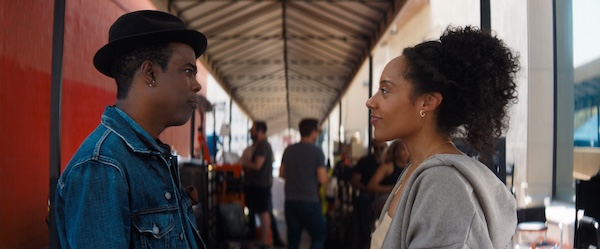
Chris Rock and Rosalind Eleazar in Misty Green. Photo: A24
The screenplay also introduces several subplots, notably one involving Misty’s brother, who has schizophrenia and, for some unfathomable reason, is also named Jordan Green. Played by a stellar Daniel Kaluuya, this second Jordan deepens our sense of Misty’s struggles, though his scenes sometimes feel pasted in from another movie. Meanwhile, a sensational story dominates the news: a beautiful white USC student has been shot and killed in a carjacking, and her white boyfriend blames a Black man. Bostonians familiar with the Charles Stuart case will see what’s coming a mile away. When these plotlines converge, the resolution is too convenient to satisfy.
What comes across most forcefully is Hollywood’s pervasive nastiness. Misty learns early that nobody in the business is really “friends”; every relationship is a transaction, every connection a means of getting a project made. When she and Jordan, the director, begin to form an actual friendship, circumstances conspire to snuff it out. Adam Driver, as a sleazy director and Misty’s occasional bedmate, and Anna Kendrick, as her best friend with a thing for Black guys, stir the pot in small roles that mostly deepen the gloom. Hollywood has often portrayed itself as a dream factory where reality exacts a price, but Misty Green offers a remarkably somber variation.
Rock, a comedian at heart, intermittently punctures that gloom. An offhand complaint about British Black actors taking roles from their American counterparts delivers a knowing wink: the film’s two standouts, Eleazar and Kaluuya, are British actors sporting convincing American accents. Their casting turns the joke back on the film itself. Developed further, that self-awareness might have fueled a blistering satire, but Rock seems unable to turn it into one. Misty Green remains stranded between satire and psychodrama, neither sharp enough to cut nor probing enough to unsettle.
Neil Giordano teaches film, creative writing, and journalism in Newton, Mass. His work as an editor, writer, and photographer has appeared in Harper’s, DoubleTake, Newsday, Literal Mind, and other publications. He is currently in production on Betweens, a documentary about artist Michael C. Thorpe.
Tagged: Adam Driver, Anna Kendrick, Black cinema, Chris Rock, Daniel Kaluuya, Hollywood satire, Misty Green, Neil Giordano, film reviews, hollywood
