
Book Review: John Berger, Indivisible
By Thomas Larson
Tom Overton’s lively, intimate biography follows the critic, novelist, artist, activist, and lifelong insurgent through a career that remade the ways we see.
John Berger: From Life by Tom Overton. New York: Verso Books, 382 pages. $34.95

1 / If one word describes John Berger—the versatile author-advocate who died far from his English birthplace in 2017, as did his peripatetic fellow exile D. H. Lawrence—it is indivisible. For all Berger’s originality, exile could not scuttle his Englishness. He carried its class hegemony and attendant sensibilities into his humanist causes and radical commitments. The plural matters. Lawrence sought to re-spiritualize the body through the fleshy adventures of his novels and poems; Berger’s appetite for radical social change produced a capacious body of work, on the page and on BBC television, alive to a startling range of voices.
Novelist, reporter, biographer of working-class professionals, art critic, screenwriter, television lecturer, photographer’s collaborator, cooperative member, 50-year farmer in a Swiss village, champion of displaced Palestinians and Mexican revolutionaries, pistol-prose comrade in Che’s motorcycle gang, and one of his era’s great listeners and table talkers, Berger could let activism propel—and sometimes outrun—his literary spark.
A writer in crisis and a writer for hire, he became what I call transliterate: a McLuhanite before most of us had absorbed the medium’s all-embracing message. Transliterate artists collaborate across established and emergent forms while remaining recognizably themselves—culture chameleons such as Leonard Bernstein, Ai Weiwei, and Berger: all OGs.
Today, Julian Schnabel—painter and filmmaker—and Christopher Nolan—writer, director, producer of immersive spectacles—fit the type: artists whose films are unmistakably their own even as they require epic collaboration and hundreds of millions of dollars. Nolan, in particular, keeps returning to Homeric male quests, turning missionary heroes into colossal cinematic spectacle.
Verso biographer and Berger archivist Tom Overton, a friend during Berger’s final decade, uncovered a trove of material in a shed beside the family’s home in the Swiss Alps near Geneva, working with one of Berger’s children. Given the British Library archive—thousands of letters, many to and from former lovers—John Berger: From Life might easily have sprawled for hundreds more pages. Instead, it is brisk and tightly composed: a tendentious, month-by-month roadmap of its subject’s hectic life, one that values Berger the left-wing crusader more highly than Berger the writer.
Overton adequately maps Berger’s prodigious output, but his book comes most alive in its friendships: with Berger’s parents; with collaborators and critics such as the Marxist Ernst Fischer, whose The Necessity of Art remains a neglected classic; with the socially grounded art historian Frederick Antal; and with Jean Mohr, Berger’s photographer-partner on probing profiles of tradesmen and migrants. In the Berger-Mohr books, text and image fuse: paintings become readable, prose visible. These figures, and many others, are romantic fellow travelers who enlarge Berger’s transliterate heft.
Berger’s central theme, as I see it, is a repertoire of anti-capitalist, anti-colonialist, pro-worker “stances,” which can at times overwhelm his critical penetration—his stronger suit. Overton does not overindulge his nonagenarian subject’s at times problematic political subjectivity. Through daring shifts in point of view and a clippity narrative tempo, he shapes his quarry into an affectionate, excited paean to a friend.
2 / Born in Stoke Newington, near London, in 1926, John Berger was the first son of Stanley, a gifted accountant, and Miriam, a cakemaker. Both were middle-class, non-practicing Jews intent on rising. Their talented son liked to roam, finding sanctuary in neighborhood kitchens, family farms, small studio sheds, the homes of arts-and-crafts workers, and among outsider artists. As Marxism took hold, he downplayed his own caste and made capitalism his antagonist, chiefly by attacking painting’s “fine-art tradition” as a visual ledger of exploitation.
His father was equally formative. Stanley saw action in the million-casualty Battle of the Somme and, after the armistice, helped plan burials for British dead where they fell. He received the Military Cross and an OBE. His fixation on war’s anonymous masses gave Berger an enduring obligation: to historicize the subjugated dead in books about communities and their inheritances.

John Berger in 1959. Photo: Wikimedia
Hoping to propel their gifted son up the class ladder, his parents sent him to a “crammer” school. At nine, he moved on to boarding school in Forest Row, where parental care was remote and, for Berger, the love he wanted went unrequited. The “boarding-school syndrome” has drawn a century of sociological attention, but George Orwell anatomized it best in his searing memoir-essay “Such, Such Were the Joys.” Its deadening rituals of abuse produce survivors who later insist that the institution’s discipline of learning and athletic competition yielded benefits only activated in adulthood.
Overton conveys the system’s loneliness, though Berger seems rarely to have mourned a stolen childhood. He loved drawing classes and French, half-aware that he and his pals were being groomed as colonialists. “I could only displace the cold and incomprehension around me with intelligence,” he later recalled.
Berger then spent several years at St. Edward’s School, Oxford, a boys’ school for ages 13 to 18, during the Blitz. There, literature seduced him—above all Joyce’s Ulysses. His fiction was initially in thrall to Joyce’s intelligently bawdy style, smitten by the Irish knockabouts who form Bloom’s “low company” and, in a sense, Joyce’s intended audience. Berger was fascinated by the working class tableaux Joyce lifted to mythic-realist heights, especially by how picaresque momentum could propel an invented adventure.
He next turned to art: its aesthetic force and its historical role in the West. Two years at London art schools made him a capable painter but a sharper critic — he scratched out a meager living at the New Statesman. Berger favored social realism rather than socialist propaganda. He was onto something something more elusive: a structuralist, if not humanist, way of reading books and art. György Lukács, the Hungarian Communist, was crucial. His theories urged artists to dramatize working-class professionals: the figures around whom the proletariat could cohere and could recognize as heroic.
Berger’s finest book in this mode is A Fortunate Man, an immersive, photograph-rich essay on a country doctor’s daily travails—a grounded counterpunch to Fleet Street’s superficial political journalism.
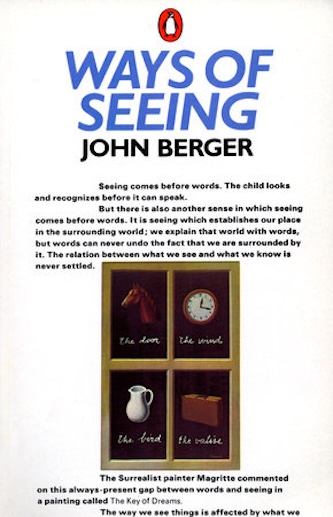
To organize his subject’s capacious output, Overton places it against the ideological and social turbulence of Berger’s decades: the Blitz; Picasso’s over-haloed achievement; our strange confinement of, and gawking at, animals; and feminism. Berger’s art writing of the mid-1960s and early 1970s produced three career-making provocations: The Success and Failure of Pablo Picasso—the gall!—the quintessential Bergerian performance, the four-part television series Ways of Seeing, perhaps the best Marxist-bent art lectures ever broadcast and still evergreen; and the Booker Prize-winning novel G.
Overton’s treatment of The Success and Failure of Pablo Picasso goes off-kilter. He presses half a century of revolutionary élan into a one-dimensional reading, reducing Berger’s book to class critique: Picasso failed, finally, because “the people” could not find themselves in his art. “There was a global transition from free competition to monopoly capitalism at the beginning of the twentieth century,” Overton writes, “creating the conditions for the ‘experimental’ art which made Picasso’s name.”
That seems overstated. The same logic could be applied to any number of artist-entrepreneurs—Van Gogh or Georgia O’Keeffe, for instance—whom the market elevated and converted into brands. Here, I am not sure Overton and I have read the same book. Berger’s study begins with Picasso’s wild creativity in the Blue, Cubist, and Guernica periods, then tracks the artist as he lazily assembly-lines his recurrent motifs: erotic obsession, one-line drawings, the Minotaur, fractured perspective. Does that history reduce to market share? Hard to prove. What Berger offers instead is a charged account of vitality curdling into mannerism, in which 124 reproductions and tight, erudite prose find that Picasso eventually xeroxed himself.
The Cubists . . . created in art the possibility of revealing processes instead of static states of being. Cubism is an art entirely concerned with interaction: . . . the interaction between the unambiguous signs made on the surface of the picture and the changing reality which they stand in for. [And on his isolation:] Picasso’s painting does not fit into [the Western] tradition. It makes no reference to the contemporary world, and ignores any development of knowledge or feelings. In the very broadest sense of the term, it is unconcerned with culture. . . . It is a painting not about sensations—which do indeed bring us very close to animals—but about an idea: the idea that we would all be happier if we had no ideas.
That’s Berger: pushy, penetrating, dazzling on the page. No wonder the BBC soon enlisted him, with producer Mike Dibb, to turn that inventiveness into television. In 1972, Ways of Seeing arrived as four half-hour color broadcasts, with a companion book of text and black-and-white images. Berger is everywhere in it: mod clothes, bedhead curls, scintillating intelligence, and a voice confident enough to make viewers return for the argument, not merely its slogans.
Ways of Seeing unfolds across four episodes:
- The aura of the traditional, museum-housed, one-of-a-kind artwork, weakened under capitalism by mechanical and exploitative reproduction.
- The distinction between the naked woman and the nude in painting: “men looking at women who watch themselves being looked at,” a structure carried into advertisements, posters, and rock-star glamour.
- The dominance of oil painting from 1400 to 1900, bankrolled by patrons who commissioned images of “ownership and private possessions”—including family portraits positioned to preside over a lordship’s stairwell.
- Advertising’s use of “radiantly beautiful people” to exploit “our fear of being unenviable,” packaging inadequacy as exotic nomadism, with worry dissolved amid drinking and carousing among British whites.
Berger’s great insight is that the status fantasy still pulsing through commercials about the high life has a lineage in museum painting. Or, as he puts it more sharply, publicity “turns consumption into a substitute for democracy.”
Overton rightly calls the series cultural analysis. It is more than a lecture; it makes its viewers participants. Berger shows how synthesized music transforms a television advertisement; invites schoolchildren to read a Caravaggio (seeing homoeroticism that the academics miss); and talks with five women, including his wife Anya, about the “male gaze” and women’s objectification. He is a master of the extemporaneous idea—accessible, self-questioning, responsive to his own claims. He hears himself think, admits doubt, and raises counterarguments.
He also takes on Kenneth Clark’s Civilisation, the landmark British educational-TV series that preceded Ways of Seeing. Clark—the classicist don—made the programs under David Attenborough’s direction. Berger’s book and television series are juicily Marxian but never merely preachy: an investigation of art’s troubling patronage, powered by his recognition that for half a millennium fine artists have served as aristocracy’s hostages.
After recounting the production history, Overton notes that the series has drawn “millions of views” on YouTube—an unusual afterlife for an outsider work. Elsewhere, he both punctures and burnishes Berger’s fame with domestic detail: the solace of his parents’ home, the “deliberate disorder” of his studio, and the women in England and on the Continent to whom he was easily fetched. Much of this account of home, work, and love comes from letters to his “mistresses” and to Anya, the mother of two of his three children.

Writer and critic John Berger — his reevaluation of Western masters posed questions that scholars were forced to answer. Photo: via Flickr user Antonio Marín Segovia.
3 / Overton’s best chapter, “The Watershed,” tracks the diverging fortunes of Ways of Seeing and G., Berger’s epic, cross-European, pre–World War I erotic picaresque, thick with authorial intrusion. For the novel’s renewed force, see Ben Lerner’s recent introduction to the novel’s New York Review of Books reissue. Overton has little to say about G.’s literary achievement. Instead, he dwells on the brawl surrounding its scandalous Booker Prize win in 1972.
Booker Connell Ltd. made its fortune in Caribbean sugar, using enslaved labor. The Booker Prize, launched in 1969 to reward the year’s best English-language novel, put that corporate name on what was meant to be a monument to literary prestige. Accepting the prize for G. three years later, Berger attacked the company’s record—drawing hoots from some jealous scribes in the room—and announced that he would divide the money between the British Black Panthers and a new project on migrant workers.
Prize-stage politics had a conspicuous precedent: Jean-Paul Sartre’s 1964 refusal of the Nobel. Ever since, the bourgeois contest — fueled by sudden fame, a modest award, and causes célèbres — has too often focused on an author’s identitarian proclamations, not literary value. To whose benefit?
This is a seminal juncture for Overton, who slips midway through the chapter from third-person indirect discourse into the direct second person. He begins a heart-to-heart with his late friend: “[I]t suddenly seems ridiculous not to talk to you directly, John. You’ve been reading over my shoulder just as I’ve been reading over yours.” The maneuver works because it is rare. It creates an illusory but persuasive intimacy between the two men, a filial note that lets Overton foreground the personal within Berger’s political writing and activism.
Back to the women. Berger’s version of 1970s “free love” was recurrent romantic upheaval: leaving Anya and the children, then returning to their emotional nest. Overton tabulates liaisons with Nuala O’Faolain, Edna O’Brien, Lorraine Gill, Eve Figes, and Beverly Bancroft, an 18-year-old New Yorker descended from Hugh Howe Bancroft, who built UC Berkeley’s library in the late 1890s.
Beverly became Berger’s durable live-in love, though the Ukrainian collaborator Nella Bielski regularly displaced her. In 1974, John and Beverly—whether she accepted his serial roving, Overton does not say—settled in the farming commune of Mieussy in the French Alps. They had a child and, for four decades, lived partly off the land and through their labor in the community.

Mieussy did not calm Berger’s mental restlessness. The village valued him as a helping hand; he saw in it a microcosm of peasant society—small plots, thatched houses, a regional storehouse of farming lore. His sensibility lay in the preindustrial past, in the dignity Jean-François Millet gave 19th-century field laborers: workers who carried the memory of inherited communities. Berger saw centuries of peasant life alive in Millet’s earthy paintings, just as oil painting preserves five centuries of elite gardens and portraits.
Mao Zedong collectivized China’s farmers before industrialization fully took hold, and Berger found in that project a parallel road backward: toward a preservation of community and soil, where his Marxist pastoral could take root.
In the 1970s and 1980s, Berger’s fiction reached its maturity in the Into Their Labours trilogy, though at the same time he continued to dispatch the art criticism readers loved to the New Statesman and New Society. He was developing a social way of seeing art and tradition, one that helped propel the decade’s turn toward structuralist and materialist aesthetics. Overton quotes Berger’s “Historical Afterword” to Pig Earth, the trilogy’s first volume: “Neither Adam Smith nor Marx had foreseen the actual historic role of capitalism,” which, for Berger, was “to destroy history, to sever every link with the past and to orientate all effort and imagination to that which is about to occur.” Capital must do this to survive, because “its present reality is dependent on its future fulfillment.” Against capitalist product-desire, Berger draws a red line.
In the same essay, Berger names an autochthonous dimension of class history that Marx overlooked. Peasants, he writes, possessed a “conservatism not of power but of meaning. It represents a depository (a granary) of meaning preserved from lives and generations threatened by continual and inexorable change.” Whatever the grisly fate of late capitalism, industrial and agrarian collectives preserved precious farming knowledge — it is the currency of a village’s DNA. Such a robust code may give them an advantage in the dire future to come, when husbanding deteriorating resources, because of the accelerating climate crisis, will be an essential part of an existential skill set.
4 / Berger’s final three decades brought nonstop activism, occasionally misguided. In response to the fatwa against Salman Rushdie over The Satanic Verses, he embarrassed himself by supporting the book’s ban. Overton reports that Berger urged Rushdie to withdraw the novel. His explanation—one Christopher Hitchens, no Berger admirer, also thought ludicrous—was that Rushdie had committed a “disrespect felt in the lives of often illiterate people for whom all meaning came through Islam.”
Raised in a Bible-cushioned culture, where traditional Christian art shaped the religious impulse, Berger may have privileged the prohibitions of durable faiths over modernist unbelief. Rushdie wisely replied that migrants such as himself change the cultures they enter. Even when “welcoming” societies cede power to refugees, newcomers retain their customs, including those rooted in religious delusion. Berger seemed more alert to slights against non-Christians than to the conflicts produced by non-assimilation.
Berger’s late interests ranged from aphoristic books and new-media-adjacent projects to denunciations of Zionism. Shedding the writer-artist-critic role, he rechristened himself a “storyteller”: a conduit for the dead, whom he believed speak through and guide their successors—community activists like himself. He increasingly paired his own work with the experiences of others, embracing collaborative filmmaking, teaming up for political tracts and narratives, and editing volumes of like-minded writers.
Among the standouts: his friendship with Geoff Dyer, first his biographer and acolyte, then an editorial companion; his correspondence and summit with Subcomandante Marcos in support of Mexico’s Zapatista rebellion in the 1990s; and the “resistance” essays of Hold Everything Dear (2007), written for the Palestinian cause. Overton notes that, for Berger, Yasser Arafat represented his people “tragically, not democratically.”

Strangest among Berger’s late works is To the Wedding, a novel about—though he insisted it was “not about”—the AIDS death of his son Jacob’s wife. The loss prompted Jacob to make a grudging feature film about “the human turnover” in his father’s work, using family intimacies to dramatize Lukács’s “individual types.” His French film, Aime ton père (“Love Your Father”), crisply retitled in English as A Loving Father, casts Gérard Depardieu and his real-life son Guillaume as the warring pair.
Each work partakes of bitterness and recrimination. Whiplash scenes include argument, abduction, and a violent vehicle chase and crash. In novel and film, father and son charge each other with making a “sacrificial victim” of the other at the altar of art. Together, the works estrange them. Berger’s indivisible love of the people—those impaled by authority, shouting that they will never be defeated—bewilders a son who respects his father’s certainty but feels excluded from the “oppressed”: the innumerable commoners, past, present, and to come, who comprise Berger’s truest family.
Cancer took Beverly a few years before it took John. Berger’s disciplined variety, his biographer argues, let him retool his ways of seeing and telling until the end, still unfinished at 90.
Overton concludes that the radical writer found a final sociological purpose in mortality: Berger saw himself as “a mediator between the dead and the unborn.” It is an honorific summation. Berger took pride in the British Library archive, where he would live in “the company of the past”—perhaps the surest way to be equal among equals.
Having templed this man of “a long life of short books,” Overton turns to Berger’s final compact essay collection, Confabulations. One section is dedicated to Rosa Luxemburg. Berger saw the German communist revolutionary as a model for enduring the bracing vicissitudes of an oppositional life:
We are not points on a line, [but] we are the centers of circles. The circles surround us with testaments addressed to us by our predecessors from the Stone Age. Sustained by what we have inherited from the past and what we witness, we will have the courage to resist and continue resisting in as yet unimaginable circumstances. We will learn how to wait in solidarity.
Cultural critic and memoirist, Thomas Larson, archives on his website nearly 500 publications over the past 30 years, including his 80 longform feature stories for the San Diego Reader. His new book, On Listening & Not Listening—a multipart essay on the relentless noise in American culture, media, and politics from the listener’s perspective—is due later this year from Bloomsbury. He lives in San Diego, CA, with his partner, Suzanna.
Tagged: "John Berger: From Life", "Ways of Seeing", British literature, John Berger, Marxism, Tom Overton, art criticism, biography, cultural criticism, literary biography