
October Short Fuses — Materia Critica
Compiled by Arts Fuse Editor
Each month, our arts critics — music, book, theater, dance, television, film, and visual arts — fire off a few brief reviews.
Concert Preview

Suzanne Vega. Photo: Ebru Yildiz
From the very beginning, with 1985’s “Marlene on the Wall” and 1987’s “Luka” on the second floor, Suzanne Vega has been a deft, daring, and incisive storyteller, creating relatable characters who are trying to find their way in a noisy and confusing world. Drawing inspiration from Lou Reed, she revolutionized the female singer/songwriter genre by writing songs that were introspective but clothed in abstraction. Though recent releases are less well known than her earlier work, as a composer Vega continues to wield a sharp pen.
She returns to the area this month as part of an ongoing tour supporting her most recent record, Flying With Angels; this tour began in June 2025 and stops at the Bombyx Center for Arts and Equity in Northampton, MA, on October 20, and the Center for the Arts in Natick, MA, on the 21st.
Arts Fuse interviewed Vega last year as her tour was kicking off, and she explained the creative genesis of the songs on the new record. “Each song on the album takes place in an atmosphere of struggle,” she says now. “Struggle to survive, to speak, to dominate, to win, to escape, to help someone else, or just live.” Vega will be accompanied on stage by her longtime guitarist, Gerry Leonard, as well as cellist Stephanie Winters.
In addition to the Massachusetts shows, she is making five other stops throughout New England (for whatever reason, New Hampshire is not on the itinerary); find one and go hear a master storyteller at the top of her craft:
October 23, Barre, VT Barre Opera House
October 24, Arundel, ME, Vinegar Hill Music Theatre
October 25, Westerly, RI, United Theatre
October 27, Old Saybrook, CT, The Kate
October 29, Fairfield, CT, Sacred Heart University Community Theatre
— Jason M. Rubin
Experimental Electronic R&B

Cover art for Creole Culture
Dawn Richard’s “groove city” imagines a paradise on New Orleans’ outskirts, where “all you gotta do is let your hair down and be free/no special pattern to follow, just do your own thing/be what you want to be.” Music, in her vision, is the foundation of a gentler society. Her latest album, Creole Culture (Merge), completes a trilogy narrated by her alter ego, King Creole. Through the character, Richard has explored her own and her parents’ experiences while honoring New Orleans’ musical legacy—too often reduced to tourist bait.
“Creole Culture Intro” starts as jazz-inflected soul, driven by tuba, Hammond organ, and Rhodes piano, then swerves into bounce rap. In only a few minutes, Richard moves through startling shifts, making room for multiple forms rooted in New Orleans. The dubby effects and a Sister Nancy sample on “enough” also evoke the influence of New Orleans R&B on Jamaican music.
Creole Culture is restlessly mobile. Drummer Greg Paul treats his kit as a polyrhythmic engine. Though he plays live, his approach draws on the programmed grooves of Mannie Fresh, Cash Money Records’ house producer; Paul’s group, Katalyst, backs Richard throughout. Acoustic and electronic textures interlock. Richard’s soaring melisma repeatedly gives way to a digitally modulated, robotic timbre. The tracks flow into one another: the final words of “enough” set up “only fans.”
After stints in Diddy-created groups Danity Kane and Diddy–Dirty Money, Richard’s solo career has been a campaign to realize her own vision within an industry notoriously abusive to Black women. She is an outlier at Merge, a label more closely associated with indie rock and Americana. Creole Culture refuses an easily marketable slot; often, its individual songs do too. Richard pushes “roots music” into the future.
— Steve Erickson
Film
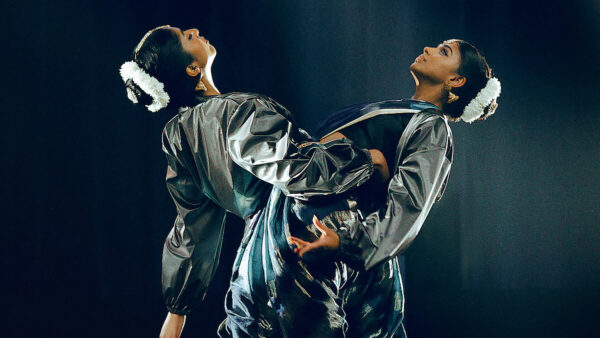
A scene from Best of the Best. Photo: Amir Hamja
A professor once told me that the best stories are universal, told through a specific lens. Director Lena Khan’s Best of the Best embraces that idea: a familiar college coming-of-age story made fresh by its sharp cultural specificity.
Maya (Maitreyi Ramakrishnan) and Anjali (Priyanka Kedia) are best friends and Bollywood dancers eager to reinvent themselves as UCLA freshmen after a humiliating high-school talent-show mishap. Joining the university’s Bollywood dance team puts that friendship under strain.
The team is led by Ronak (Ankur Rathee), who, after being dumped by a rival dancer at USC, is desperate to win. Controlling and relentlessly competitive, he clashes with the rebellious Maya while finding Anjali easier to mold into his ideal lead. The resulting divide gives the film its emotional stakes.
Best of the Best has much in common with Pitch Perfect: both take place in collegiate subcultures, center outsiders entering highly particular new worlds, and build toward showcase-style competitions. Pitch Perfect has sing-offs; Best of the Best has dance-offs. Both also offer lovable supporting characters and an ultimately heartwarming arc. But Khan’s film has a cultural texture all its own.
Most of its cast is Indian, and the story is distinctly SWANA-American. Its humor ranges from academic probation and parental discipline to a rivalry between leaders of two SWANA student organizations—one Hindu, one Muslim. A dispute over the celebration of “Eid 1 and 2” made me laugh out loud; as the child of a Muslim parent, I never expected to encounter that joke in an American film.
Written by Hasan Minhaj and his Patriot Act co-writer Prashanth Venkataramanujam, the film combines collegiate comedy with pointed political satire. “AI is here, your degrees are worthless, you’ll never own a home—back to practice!” Ronak declares. The script also folds in Indian history, affectionate jabs at white teammates, and plenty of brisk, biting humor.
As a dancer, I was especially struck by the choreography. The numbers are crisp, inventive, and richly staged, fusing modern movement with traditional Indian styles. Each has its own visual identity, costume palette, and thematic idea.
Most moving, though, is Maya and Anjali’s bond. Their love for one another is platonic but profound, and Ramakrishnan and Kedia make their rupture—and reconciliation—the film’s sweetest achievement. Friendship, self-discovery, and growing up may be universal; Best of the Best shows why the particular lens matters.
— Sarah Osman
Books
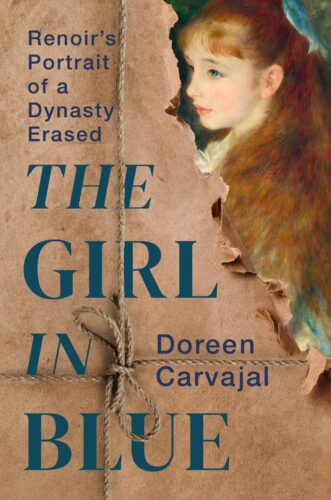
Inanimate objects are silent witnesses to history. Pierre-Auguste Renoir’s La Petite Irène, his 1880 portrait of Irène Cahen d’Anvers—a young Jewish girl in a blue ribbon—has passed through a remarkable series of hands and historical upheavals. In The Girl in Blue: Renoir’s Portrait of a Dynasty Erased, New York Times journalist Doreen Carvajal gives the painting a compelling voice. Her book offers an annotated chronology of the work’s turbulent journey: commissioned, stolen, recovered, and acquired by powerful figures before finding its current home in Zurich’s E. G. Bührle Collection.
La Petite Irène was commissioned by Louis Cahen d’Anvers, a French Jewish banker whose fortunes rose during the Belle Époque. Before World War I—and until France’s descent into fascism in the 1930s—Paris stood at the center of an extraordinary flowering of Jewish culture. Carvajal’s opening section examines the world of the Jewish elite: its social codes, cotillions, lavish parties, and extravagant weddings designed to secure family lines. She argues that the Dreyfus Affair exposed dormant social antisemitism, deepening a fear that caused divisions within Jewish communities.
The book’s second section turns to fractures within the Jewish aristocracy and the rise of Nazism, as the seizure and looting of Jewish property became normalized. Carvajal emphasizes the indifference with which the SS processed Jewish possessions, including La Petite Irène, which by the book’s final chapters had become a coveted object for Hermann Göring. She then traces the painting’s convoluted, decades-long passage through Europe amid the chaos of Vichy France—a period in which Jews were forced into hiding, persecution, and resistance.
The Girl in Blue contains a dizzying, exhaustive wealth of material on the Cahen d’Anvers family; Jewish identity and antisemitism in French culture; the Holocaust in France; and the systematic campaign to conceal family heirlooms so their original Jewish owners and descendants could never reclaim them. The informational abundance can make Carvajal’s narrative dense, but it is carefully organized and usefully chronological. Moreover, the sharp tonal shifts between sections give this account of dispossession and victimization an elegiac force.
— Douglas C. MacLeod

Brigid Brophy’s re-released 1953 satirical novella Hackenfeller’s Ape (Dalkey Archive Press) is a dusty debate about animal rights carried out by forgettable characters whose attempts at humor make the reader shrug rather than chuckle.
Professor Clement Darrelhyde is an unlikely animal liberator. For one thing, he’s constantly singing “The Marriage of Figaro” to himself. Ha.
But when Percy, a sexually shy Hackenfeller’s ape whose mating habits the professor is supposed to be studying, is scheduled to be sent into space in the name of science, Darrelhyde’s lukewarm pity kicks in while he eats his favorite meal: a burnt steak. Ha.
Darrelhyde meets with a merry-go-round of bug-eyed anthropocentrists and politically catatonic activists. They all make your eyes roll. “The more consciousness any culture has, the more it enjoys cruelty,” cries an academic. Hmmm.
Brophy’s scenes are stretched out like Silly Putty until they sag. Darrelhyde waiting patiently for his research subjects to do their rarely observed but “poetic” mating is humorous, though his parting words—“When my species has destroyed itself, we may need yours to start it all again”—take the air out of the whoopee cushion.
The novella picks up a puff of steam when a woman strolls up to the professor and tries to pick his pocket. Gloria is the only character whose dialogue doesn’t make you frown: “What do you want to carry all that [cash] round for? It isn’t fair. It’s putting temptation in people’s way.”
After Gloria convinces Darrelhyde to commit the jailbreak seen coming a mile away, monkey business commences. Then the novella ends not with a bang, but with a plop.
Hackenfeller’s Ape rambles rather than swings. Brophy’s classic essay “The Rights of Animals” has more wit and weight while being a hundred pages shorter. Aspiring ecoterrorists, save a tree by skipping this book.
— Dan Dellechiaie
 For Hernan Diaz, point of view provides the linchpin on which the narrative turns. Certainly in his last novel Trust, in which various versions of the same tale are related by different participants with the differences delivering a potent twist. But point of view proves transcendent in his new work, a not entirely successful venture into science fiction about a device so powerful that not only might it obliterate the space/time continuum but also propels the story from first person to third person – and beyond.
Unlike his first two novels In the Distance (2017) and Trust (2022) which take place in the past, Ply (Riverhead Books) is set in a derelict New York City centuries into a dystopian future. As an attempt at world-building – or deconstruction – it meets with mixed success. It’s kind of like A Canticle for Liebowitz without the Church (though with a workshop of monk-like myrmidons), or Flow (2024) with nasty feral cats, or Life Without People, but with a few people.
The latter live off the remnants of the past, or off each other, as this world seems the apotheosis of today’s have/have-not society, as a handful of oligarchs control the means of production and exploit the poor who survive through bartering and bricolage. But some resist, like the unnamed girl known only as “the Pincher,” an orphan who surreptitiously steals, or “pinches,” electricity from the privately owned grid, stores it in homemade batteries or “bricks,” and trades it to others.
This inevitably gets her into difficulties with the powerful and after one punishing scrape she takes refuge with Pola, a wealthy, paranoid, and quite mad scientist who enlists the Pincher in her experiment. Pola is creating a machine that, as she puts it in one of the sometimes pedantic monologues that clog the narrative, “will change everything…that will alter the fabric of reality itself.”
Does Pola’s experiment succeed? The results are both ambiguous and irrevocable, evoking the Borges stories “The Aleph” and “The Zahir” (Diaz wrote a study of his fellow Argentinian in 2012: Borges, Between History and Eternity). As for Diaz’s experiment, it is not as accomplished as his other two novels, but it is breathtakingly ambitious.
– Peter Keough
 At 83, the British literary theorist, Marxist critic, and public intellectual Terry Eagleton has decided it is time to contemplate intimations of his own mortality. In his latest book, A Death of One’s Own (Yale University Press), he meditates—sometimes illuminatingly, sometimes haphazardly—on what it means for the Big Light to go out: not only for him but for the rest of us.
This is no neatly ordered survey of extinction, from the Greeks to Freud, though Eagleton invokes them in passing—emphasizing the latter’s death instinct—along with Wordsworth, Auden, and two of my favorite playwrights, Edward Bond and John Arden. Instead, the book ricochets hither and yon, taking in, among other detours, an account of Eagleton’s recovery from alcoholism. Its governing claim is that “the problem is to acknowledge death without domesticating it. One must feel it at the heart of human experience without stifling its strangeness.” Put another way: how does one make exactly the right ado about nothingness? “It is a question of living death to the end,” Eagleton advises, “enacting rather than simply enduring it.”
Predictably, Eagleton falls short of articulating death’s weirdness—“Death is both unremarkable and inconceivable”—but he has plenty of interesting things to say about the various teeter-tottering states of death-in-life: “The paradox, then, is that the more civilized we become, the more we tear ourselves apart.” He is most persuasive when dressing down thinkers and poets who, in their various ameliorative ways, have tried to mitigate or corral death’s nullity—particularly Kant and Yeats. His sections on the status of corpses and the relationship between death and children, as well as on tragedy and expiration, are stimulating as they whiz by.
Ultimately, though, Eagleton’s moralizing Marxism clarifies what he means by enacting death in an age of polycrisis—as we live with intimations of obliteration via global nuclear war or climate catastrophe. “Most inhabitants of the planet have led lives of unremitting toil for the benefit of the few,” he points out. That conviction leads to a moving conclusion: keeping death perpetually in mind means working to better a future that will be without us, and imagining the challenges of those who will have to face that perhaps horrifying prospect. “There is the question of how those we love, not least the frail and disabled who cannot fend for themselves, are to be protected from the storms that might rage in the future, when we are no longer there to fold them in our arms.”
— Bill Marx
Jazz
 The title of this second release from the Kris Davis Trio, Lost in Geneva (4166 Records), reportedly refers to a moment on a recent tour that somehow reinforced the threesome’s artistic chemistry. It is certainly a tight group, circling a musical center created by three strong instrumental voices.
An associate program director of creative development at the Berklee Institute of Jazz and Gender Justice, pianist-composer Davis has earned a reputation for playing with intelligence while retaining the expressive energy of a committed jazz musician. On Lost in Geneva, she returns with trio mates of the highest order.
A central figure on various Marsalis-family recordings since the 1980s, bassist Robert Hurst shows no signs of flagging as he moves through the late 2020s. Drummer Johnathan Blake, here and on his own releases, continues to prove himself a phenomenal, powerhouse percussionist.
“The Subtext” moves in and out of linearity, establishing silid parameters for the trio’s intensity while making room for pungent bass and drum solos. Hints of “outside” improvisation peek through openings by the means of a fast postmodern-bop framework. “The Deer Fly” sets an ominous tone, while “Nature Piece 5,” Davis’s arrangement of a Morton Feldman composition, sharpens the edge of the original’s minimalist theme.
Perhaps apropos of the album’s title, Davis’s “Where Does the Tunnel Go?” begins with a simple piano motif that gives way to Hurst and Blake’s hard attack before settling into the gentle mood of the following piece, “The Ballerina.”
“Congestion Pricing” builds tension as it accumulates layers of sound. A sweet, Ahmad Jamal–ish interlude offers one of the disc’s more inviting moments. But the beat elbows in until tumbling chaos ensues. The reflective title cut softens the album’s overall spirit, as does “Northern Flicker,” a group composition full of pensive mystery. On these tracks, the threesome uses just a few notes, taps, and plucks to tell the story.
This is one of the year’s best trio releases: versatile, driven, and capable of equal forcefulness and quiet sensitivity.
— Steve Feeney

Halloween has somehow escaped having its own musical tradition. Perhaps it’s because it’s an outdoor holiday, a rare time when people go for walks without their headphones on. Families singing together just isn’t very scary.
Saxophonist Michael Blake attempts something even rarer—see what I did there?—a jazz Halloween album. There have been few since Philly Joe Jones’s Blues for Dracula (1958). The premise is clever, and the repertoire is eclectic and spirited. But Halloween Tales is far more than a seasonal novelty: it stands on its own as an excellent jazz record, propelled by the expressive playing of Blake and fellow masters Gary Versace on piano, Ben Allison on bass, and Michael Sarin on drums.
A few songs are familiar: Guaraldi’s “Great Pumpkin Waltz,” Ellington’s “Anatomy of a Murder,” and the beautiful “Transylvanian Theme” (which will haunt you until you realize it is from Young Frankenstein). The record’s only genuinely creepy track is not “The Creep” — Blake’s sole original — but “Halloween Theme,” from Halloween. There has always been something spooky about hearing that dissonant arpeggio repeated insistently under a depressed sustain pedal.
All of these players are at the top of their game, but pianist Versace deserves special mention. On “Sally’s Song,” from The Nightmare Before Christmas, his accompaniment is delicate and thoughtful, at times nearly a simultaneous solo. He responds to Blake’s phrases, echoing and extending them. On Cy Coleman’s standard “Witchcraft,” Versace’s tasteful arpeggios are small marvels.
Blake has a Wayne Shorter-like sound on soprano, less so on tenor, and his solos follow their own oblique logic. Check out his playing on “Anatomy of a Murder,” arranged here as a blues grind over a modal riff.
A whole Snickers bar to Blake for NOT covering the only real Halloween standard, Bobby “Boris” Pickett’s execrable “Monster Mash.”
— Allen Michie

You can jump in just about anywhere in tenor saxophonist Rich Halley’s long discography and find something compelling—provided you are open to his approach to making music, which is largely free of the encumbrance of conventional harmony.
A Distant Land (Pine Eagle Music), is the eighth release by the Rich Halley 4. It combines originals by the leader with free improvisations by a foursome closely attuned to one another’s musical strengths. In addition to Halley, the quartet includes his son, Carson Halley, on drums; Michael Vlatkovich on trombone; and Andrew Jones on bass.
The album title may mislead listeners expecting anything with geographic specificity. Halley was educated as a field biologist, but this is an excursion into the Oregon-based saxophonist, bandleader, and composer’s free-jazz worldview. Concrete locations are suggested only in passing.
The dissonances generated by the reedman’s borderline abrasive saxophone tone when it is set against the trombonist’s more inviting timbre can grate at first. In truth, a fingernails-on-the-blackboard reaction may well be part of the point — these players are determined to push their concept of interplay to a higher level of roughhousing. Nonetheless, the quartet’s occasional invocations of African, Caribbean, and plain-old blues idioms help pull things together, especially on the stronger cuts.
The Halley original, “Subterfuge,” features the leader’s most assertive, least structurally entangled, and most go-for-broke excursion in spontaneous blowing. Vlatkovich adds a bit of groundwork—oddly but effectively—to the back end of the piece. “Mismatch” swaggers into a gritty blues groove that feels both playful and heartfelt. The rhythm-first approach is again palpable on “Crossways Logic.”
“Message from Maputo,” referencing the capital of Mozambique, suggests a faraway destination, while “South of South,” a group improvisation, recalls Sonny Rollins’s seminal tropical excursions. Halley’s hard tone, coupled with the dancing pulse suggested by Jones and drummer Carson Halley, makes for feel-good listening when the quartet takes it down a notch. But when the tracking goes full tilt, tell your ears to hold on tight.
“Harnessing the Churn” brings free bop to the fore, ending the disc on a high note as Halley tears into one last solo.
— Steve Feeney
 On their luscious new album The Midnight Hour, Boston-based, internationally renowned pianist and composer Yoko Miwa and the excellent young singer Mikayla Shirley create a warm, pensive atmosphere that befits the album’s title. The duo format might be a spare pairing, but the interplay of Miwa’s sensitive accompaniment and Shirley’s honeyed vocals turns this 13-track set of standards and not-so-standards into an engaging late-night conversation you want to keep listening to.
The set kicks off with Bacharach/David’s twisty ballad “Alfie,” beautifully paced, with a cliffhanger ending that departs from the 1960s hit version by Dionne Warwick. The duo dip into the Broadway songbook with a jaunty “On the Street Where You Live,” with Miwa’s chunky chording behind Shirley’s agile scatting conjuring a 1950s sound. Miwa’s muscular take on Brian Wilson’s “God Only Knows” gives that pop/rock hit a hymnlike feel, with Shirley’s vocal ranging from earthy to ethereal. A sassy, swinging “But Not for Me” finds the pair trading eights in a lively call-and-response. Here, and throughout the album, Shirley shows how much she’s learned from jazz maestras Ella and Sarah — but her tasteful, expressive phrasing and beautiful tone are her own.
Three of the cuts have Brazilian origins. On Ivan Lins’s lovely ballad “Love Dance,” Shirley sings the English lyrics (by Paul Williams). The other two, by Antônio Carlos Jobim, are sung in Portuguese, which can be a tall order for English speakers. Here, a couple of lyric mix-ups and mispronunciations mar, for me, the ubiquitous bossa nova “Garota de Ipanema” (Girl from Ipanema). But on the second — the lesser-known “Modinha” — Shirley nails the pronunciation and movingly conveys the dark sadness of this minor-key lament.
Among the tunes were two that were new to me: the wistful “Too Late Now,” by Alan Jay Lerner and Burton Lane, from the 1951 film Royal Wedding, and the gospel/R&B-tinged “Song of Joy” by Billy Preston and Rasputin Boutte, a perfect track to end with. The lyrics proclaim the players’ joy at making music — a joy this accomplished duo obviously shares —and, happily, shares with us.
Note: Yoko Miwa brings her longtime trio with drummer Scott Goulding and bassist Will Slater and special guest Mikayla Shirley to Scullers in Boston on October 2.
— Evelyn Rosenthal
Classical Music
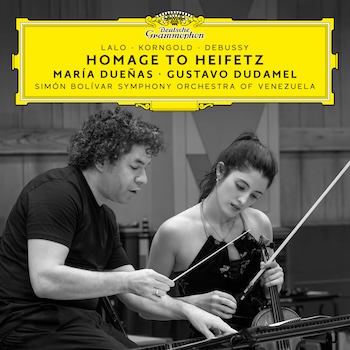 It’s been nearly forty years since Jascha Heifetz died in Los Angeles and well over fifty since his last concert, also in that city.
Yet the Russian-American violinist casts a long shadow, as María Dueñas’ new album, Homage to Heifetz (Deutsche Grammophon), reminds us. Her release pairs a couple of big items associated with her forebear—Lalo’s Symphonie espagnole and Korngold’s Violin Concerto—as well as four encores (two of which Heifetz arranged); three of the latter collection are played on the icon’s “Heifetz, Piel” Stradivarius.
For all the tribute being paid, Dueñas, who’s accompanied in the orchestral items by the Simón Bolívar Symphony Orchestra of Venezuela and Gustavo Dudamel, is very much her own violinist. Her tempos are a touch broader than Heifetz’s in his recordings of both concertante selections, and, in general, she brings a slightly more theatrical approach to her program than not.
It’s an approach that works very well, especially as the album’s points of overlap between the violinists are captured with abundant clarity: Dueñas’ technique is outstandingly Heifetz-esque, her musicianship similarly brilliant. Her performance of the Lalo is downright operatic, its filigree sparkling like fireworks and the Andante emerging as an episode of unexpected weight and pathos.
The Korngold also gets a reading of terrific sweep and warmth. Dueñas’ playing here is as impassioned in the music’s grand, Romantic gestures as in its relatively subdued cadenzas, while, as in the Lalo, Dudamel and the orchestra provide an accompaniment that’s equal parts tonal depth and rhythmic muscle.
There’s a similar freedom and grandeur to Dueñas’ readings of the encores (Debussy’s “La fille aux cheveux de lin,” “La plus que lent,” and “La chevelure” plus Ponce’s “Estrellita”). The last three are heard on the “Heifetz, Piel,” whose dusky tone conjures its namesake’s ghost with astonishing immediacy.
— Jonathan Blumhofer
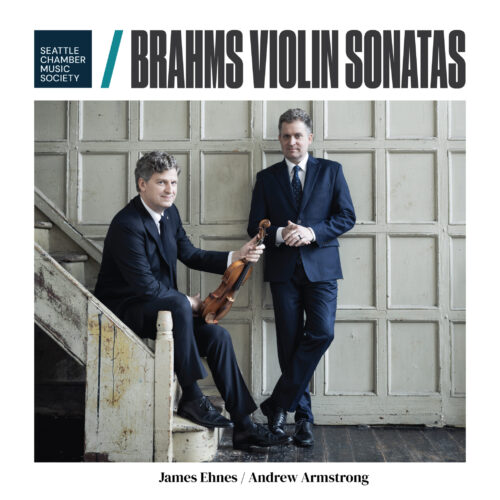
There’s a story that Brahms, when asked to autograph a fan belonging to the wife of his contemporary and good friend, Johann Strauss, scribbled down the opening bars of the Blue Danube Waltz and captioned the excerpt “unfortunately not by Johannes Brahms.” Whether or not that tale had any bearing on how violinist James Ehnes and pianist Andrew Armstrong approached the younger composer’s three violin sonatas, the duo has managed a traversal of the set that is uncommonly balletic and naturally dramatic.
The qualities that mark their account of the G-major Sonata apply equally to their takes on the A-major and D-minor installments: expansive, lyrical, full of beautifully balanced dialogues between piano and violin, and consistently tapping into the essence of the music.
No. 1’s opening movement—a waltz in spirit, if not name or structure—trips with incandescent finesse. The Adagio is hypnotically inward, the finale an absorbing study in accretion, dissipation, and, ultimately, radiance.
In the Sonata No. 2, the pair draw out the music’s stark contrasts, in the process vibrantly illuminating Brahms’s monumentally ingenious command of variation techniques. And the stormy Third highlights both the thematic compactness of the composer’s materials and the singularity of the score’s instrumental combinations. The cumulative effort, basically note-perfect yet fired with urgency, is as inviting and insightful as it is alluring and refreshing.
Ehnes and Armstrong let loose, too, in the Scherzo Brahms contributed to the “F-A-E” Sonata, written in 1853 with Albert Dietrich and Schumann. In this performance, the number, for all its turbulence, evinces a rollicking spirit of zip and schwung.
— Jonathan Blumhofer
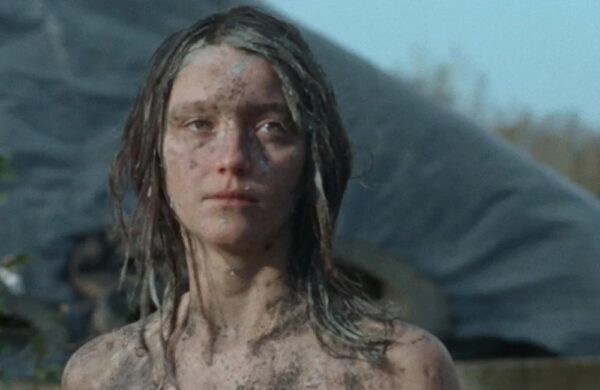
A scene from Her Will Be Done.
Just in time for spooky season, Her Will Be Done, an unsettling and compelling French/Polish film that has been earning rave reviews at festivals since 2025, is now available on demand. Director Julia Kowalski’s own French/Polish roots inform this naturalistic yet slightly supernatural story, set in a small French farming village.
The film opens with an eerie flashback: a fire is lit in a forest, and a woman’s clothing and handbag are burned while a man and three young children look on. The voice of Nawojka (Maria Wróbel, in a powerful performance) tells us that her mother was possessed by an evil force. Cut to the present: scenes of rural village life unfold in a setting that is anything but pastoral or bucolic.
A spare, folky guitar is heard, shaded with an odd jazz overtone; Daniel Kowalski’s original score is striking. The music collides nicely with the atmospheric, vintage-style cinematography by Simon Beaufils (Anatomy of a Fall). Nawojka—whom everyone calls Naw—works hard to keep the family farm from going under: mucking out the barn, caring for the cows, and making dinner for her ungrateful brothers, who taunt and boss her around. While her father is kind and caring, he is noncommittal when she asks about attending veterinary school in a distant town. Naw seems trapped in a life of menial, exhausting drudgery.
A stranger moves in next door. Sandra (Roxane Mesquida) is clearing out the unoccupied house that belonged to her parents. She wears revealing clothes and does not suffer fools gladly, including Naw’s brothers, who gawk at her. The older villagers shun Sandra for a shadowy reason that is connected to her family. She wears a leg brace and bears a large, ugly scar, but these only seem to intensify her sultry allure. She senses that Naw is bored and extends grudging tokens of friendship. Naw is fascinated but wary.
After an odd affliction starts causing the cows to die one by one, Naw begins to have disturbing nightmares and visions. Her father gives her a Saint Benedict medal, warning that she must not succumb to her mother’s fate. The witchy vibes are everywhere, and the film deftly balances themes of superstition, rebellion, and misogyny. This place, these people, this life: they are not kind to women who challenge the status quo.
Naw’s journey is disturbing to watch, and Wróbel is compelling in the role, supported by a solid supporting cast. Her Will Be Done is hard to categorize by genre, but I suggest folk horror because the rural location is so central to the story. Kowalski crafts a cautionary tale about how dark episodes and cruel misdeeds of the past can seep unendingly into the present—like sickness, like poison, like a curse.
— Peg Aloi
Design

MIT’s School of Architecture and Planning. Photo: Iwan Baan, courtesy of MIT
When I drove up Cambridge’s Vassar Street toward Massachusetts Avenue in search of the newly renovated Metropolitan Storage Warehouse—built in 1894 and completed in 1923—I saw only the old, 500-foot-long, fortress-like, turreted brick structure. I drove across Mass Ave. and farther up Vassar Street without an inkling of where the much-ballyhooed new home of MIT’s School of Architecture and Planning actually was.
The answer: its entrance façade is on the north side. This placement permits massive windows to flood the design studios with marvelous light—hopefully encouraging expansive student and faculty creativity.
Since MIT purchased the warehouse in 1962, there have been numerous studies and recommendations about how to integrate this landmark building into the Institute’s campus. But nothing seemed to gain real traction. Several years ago, it was suggested that the site, if not the structure itself, would be perfect for a major dormitory. But that idea fizzled through its many iterations.
The recently opened project—which encompasses classrooms, studios, offices, meeting rooms, and research labs—is spectacular.
Designed with thoughtful exuberance by the firm Diller Scofidio + Renfro, the adaptive-reuse project makes an appropriately bold statement. According to MIT School of Architecture and Planning Dean Hashim Sarkis, “It sends a very good message that this vanguard school of architecture is moving into a historic building and adapting it for the future.” Sarkis also said, “That transformation enables the things we want, which include collaborative work, while also combining instruction and research.”
Now referred to as “The Met,” the building reflects more than a cosmetic conversion. Architect Ben Gilmartin said, “It wasn’t just about converting the building’s shell. It was about trying to find a balance and determining how much was already there [structurally] that we could use as a fabric.”
MIT campus leaders say they are delighted with the outcome. Still, perhaps MIT’s campus wayfinding needs improvement?
–Mark Favermann
Tagged: "A Death of One's Own", "A Distant Land", "Best of the Best", "Creole Culture", "Flying With Angels", "Hackenfeller’s Ape", "Halloween Tales", "Her Will Be Done", "Lost in Geneva", "Ply", "The Girl in Blue: Renoir’s Portrait of a Dynasty Erased", "The Midnight Hour", Andrew Armstrong, Brigid Brophy, Dawn Richard, Gustavo-Dudamel, Hernan Diaz, James Ehnes, Julia Kowalski, Kris Davis Trio, Lena Khan, MIT’s School of Architecture and Planning, Maria Wróbel, María Dueñas, Michael Blake, Mikayla Shirley, Rich Halley, Rich Halley 4, SEATTLE CHAMBER MUSIC SOCIETY, Suzanne Vega, Terry Eagleton