
Film Festival Reviews: Blame Canada — TIFF’s Homegrown Films Find Comedy, Trauma, and National Identity
By David D’Arcy
From Matthew Rankin’s delirious Brian Mulroney spectacle to Ashley Duong’s intimate family history, TIFF’s Canadian slate offered films unlikely to draw attention anywhere else.
As some in the White House consider Canada’s status as an eventual 51st state—or the 52nd, should Greenland get there first—it is striking how clearly commercial cinema reveals the intimacy of the two countries, or at least the intimacy they once took for granted.
American films and television shows are made across Canada in such volume that California studios and municipalities are panicking as work migrates north. Canadians are ubiquitous in Hollywood, even at its highest levels, as are performers from Ryan Reynolds and Martin Short to Jim Carrey and Pamela Anderson. When Jeff Bezos sought maximum publicity for his trip into space, he invited William Shatner, the Canadian best known as Captain Kirk, to come along.
The Canadian program at the Toronto International Film Festival, which ended on September 20, had what I tend to seek there: films that I might not see anywhere else.
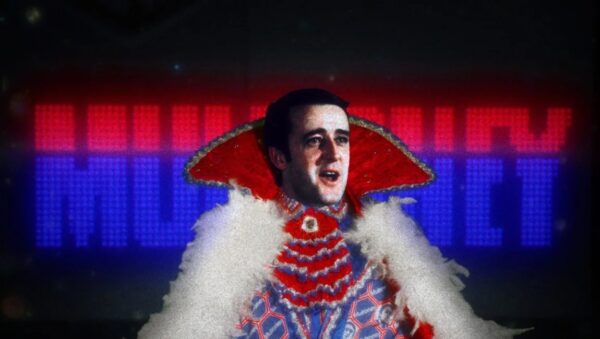
A scene from Ladies and Gentlemen, Mr. Brian Mulroney. Photo: TIFF
My favorite this year was Ladies and Gentlemen, Mr. Brian Mulroney, directed by Matthew Rankin. The film, built around the emergence of a Canadian politician who became prime minister (1984-93), is best described as a documentary, but that characterization is loose. The film is full of kaleidoscopic quasi-fictional invention—a mix of comic-book aesthetics, anti-charisma, conservative nerdiness, and all the grandeur of an outtakes reel. Its savage take on politics is infused with Canadian mock politeness — it won a People’s Choice Award at TIFF in the Midnight Madness section, the right category.
Matthew Rankin comes from Winnipeg, Manitoba. One of his key influences is fellow Winnipeg native Guy Maddin, the maker of films with grand lyrical imagination and minimal budgets. Rankin’s previous film was the much-praised Universal Language (2024), in which Persian and French are the major languages of Canada. Calling this vision an alternate reality understates the case.
In a 2024 interview, Rankin said, “I’m not a narrative filmmaker. It’s the language of cinema that really interests me.” With that in mind, Ladies and Gentlemen can be seen as his version of the Tower of Babel.
Its main character, Brian Mulroney (1939–2024), was a conservative politician from an isolated paper-mill town in northeastern Quebec, where his English-speaking father worked. The fact that few in the U.S. will remember Mulroney should be a reminder of how little Americans know about Canada. Donald Trump is one of those Americans.
Mulroney had his eyes set on politics, and he was raised speaking English and French. His Progressive Conservative Party—what a name—needed votes from Quebec, a place and culture it disdained, to win nationally, and it got some. Once Mulroney swept past a hopelessly uninspiring rival in his own party, he found an issue that embarrassed his Liberal Party opponent and won in a landslide. All of this happens as if we are watching it in a funhouse.
Rankin ends his film there. Mulroney went on to preside over a poor economy and scandals that drove him from office. Ladies and Gentlemen makes a wild spectacle out of pettiness and flash. All the elements of a sequel are here, perhaps with another Canadian politician. There’s a long list.
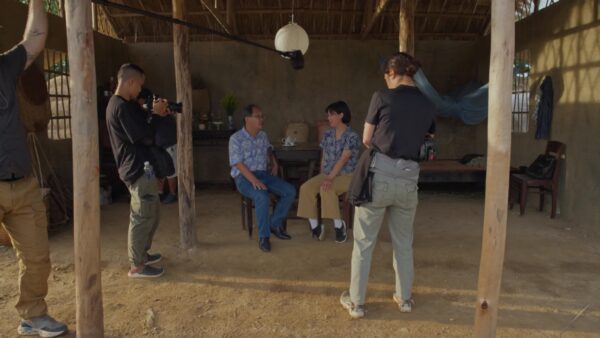
A scene from Ba’s Book. Photo: TIFF
Ba’s Book is a new Canadian documentary in which Ashley Duong directs a film about her father, Anh Duong, and his family in Vietnam, as well as his eventual passage to Canada. Her personal film is probing and heartfelt.
Anh Duong had already published a book about his life, Dear Da-Lê: A Father’s Memoir of the Vietnam War and the Iranian Revolution (2024). It takes the form of long letters to his daughter, whom he calls Da-Lê: the volume found an avid audience in Canada.
Ashley Duong calls her film Ba’s Book—“Dad’s Book”—to make clear that this is no adaptation. Seeking more of a group portrait than an individual narrative, she structured her effort as a “making-of” documentary of a scripted film about the family, much of it shot in the central region outside Huế, the historical capital, where her father grew up and endured the long war with the United States. She cast members of Anh Duong’s extended family to play his peers when they were younger. An actor plays Anh Duong.
Beyond its Brechtian sense of lives reconstructing the past, the film lets family members who remained in Vietnam recall being trapped—hiding underground in farmland between Viet Cong fighters and American troops who fired at anyone in sight. That brutal conflict is only one chapter in a longer continuum of memory. Ultimately, the film shifts from dramatic reconstruction to an extended family reunion after decades of separation. Ashley Duong’s project becomes a bridge between her father—whose quiet stoicism sustained him—and the relatives he left behind in the mid-1970s.
His second life began when he left home: a journey shaped by war, exile, and improbable turns of fate. He escaped Vietnam amid the American withdrawal in 1975, traveled to Iran under the shah, spent years there as revolution gathered force, and then looked for another way out. In a dramatized scene, Ashley Duong depicts his meeting with a Canadian diplomat. The young Vietnamese man, lacking a degree, applies for a visa by pointing to his ability to draw.
When the skeptical official asks for proof, he borrows a pencil and produces an accomplished portrait of the man. It works. He reaches Canada in 1980, beginning a long third chapter in the oil business.
The story can seem miraculous—and much of his life has been. But it is not without loss or fracture. He notes that his daughter struggles to speak Vietnamese, while he still speaks imperfect English.
By the end of Ba’s Book, father and daughter—he a man who once dodged American bullets—have carried us across multiple generations.
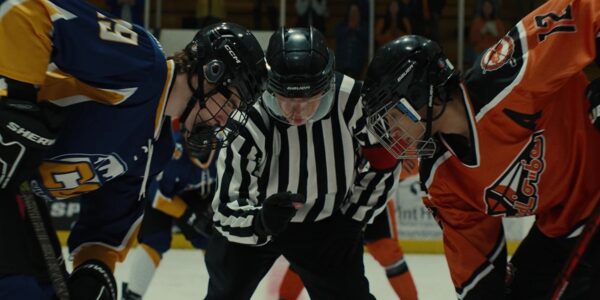
A scene from Smudge the Blades. Photo: TIFF
On the more commercial side, there is Smudge the Blades, directed by Cody Lightning, the saga of a struggling—and mostly losing—Indigenous hockey team in northern Alberta. The team has been ejected from its league because of one player’s excessive roughness. To make matters worse, its white coach quits.
“First you take our land, then you take our ice,” one of the young men yells at a league official. It is one of the film’s few lines without a spurt of obscenities.
The young players—including one girl, played by Paula Alexis, who can out-curse them all—are a disrespectful bunch, deploying fuck in every grammatical form between gulps of alcohol. Their parents, as one of the kids understates it, have problems of their own. The punchy script gives the boys great lines that carry the grit of those experiences. They are also real hockey players, which makes the game sequences credible and fun to watch.
Enter Willie Gladue, played by Lightning—the director, co-writer, and a member of the Cree Nation. Willie is a paunchy man who claims to have played for a New York Rangers farm team in Hartford and now wants to coach the boys. Who knew? More to the point, who knows? the skeptical kids ask. He is also pursuing the mother of a gifted but undisciplined player. Before long, the team discovers that Willie drove the Zamboni—the ice-smoothing machine—at a local rink. He becomes the butt of their jokes, but he urges them to play as rough as they can. What, at this point, do they have to lose?
Somehow, the team begins winning. Things falter when the players and Willie’s new honey learn that he is an American who abandoned his own children in the United States and hid out in Canada. The revelation is a pointed reminder of how much family matters in this community.
Yet, propelled by outsiders’ fuck-it-all pride, the team keeps outplaying its opponents. That is not nothing in a landscape where people and places are failing. The character Lightning plays so convincingly has all the attributes of a loser—a comic blend of ineptitude and slovenliness—but his better intentions prevail.
Smudge the Blades, which won TIFF’s Best Canadian Discovery prize, is a triumph-through-adversity saga: a familiar small-town tale in the tradition of The Bad News Bears and its ilk. But the bleak setting and unrestrained performances make the difference. It should play in both Canada and the United States; the terrain could as easily be northern Minnesota or Michigan as Alberta. Forget network television, given the language. But, for now, even kids on hockey skates can still say whatever they want on American streaming platforms.
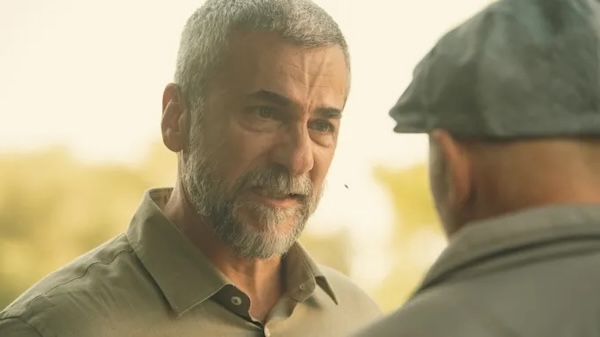
A scene from The Betrayers. Photo: TIFF
The Betrayers, which premiered at TIFF, was written and directed by David Bezmozgis and adapted from his 2014 novel of the same title, a book that helped establish the Latvia-born writer as a literary force in Canada.
The story reaches back to the era of the refuseniks: dissidents, largely Jewish, who publicly protested Soviet repression at the risk of arrest and imprisonment. Many landed in the gulag before eventually making their way to Israel. There, the film’s central character built a political career that ended in scandal. We meet him in Yalta, the Black Sea resort that is nothing if not a site of historic encounters. Roosevelt, Stalin, and Churchill convened there in 1945 to divide up Europe, months before Nazi Germany’s surrender.
The characters in this drama reach back almost that far, to refusenik protests in the Soviet era that sent some of them to prison, often after informers turned them in. Relocated to Israel, they still nurse old grievances—and remain capable of betraying one another.
Built around an encounter between two old enemies, The Betrayers reminds us that resentments can coexist with noble motives, and often outlast them. In the hands of a more seasoned filmmaker, that truth might register more deeply. Bezmozgis, 53, still has time.
David D’Arcy lives in New York. For years, he was a programmer for the Haifa International Film Festival in Israel. He writes about art for many publications, including the Art Newspaper. He produced and co-wrote the documentary Portrait of Wally (2012), about the fight over a Nazi-looted painting found at the Museum of Modern Art in Manhattan.
Tagged: "Ba’s Book", "Ladies and Gentlemen Mr. Brian Mulroney", "Smudge the Blades", Ashley Duong, David Bezmozgis, Matthew Rankin