
Classical Album Review: Film Composers in the Concert Hall
By Jonathan Blumhofer
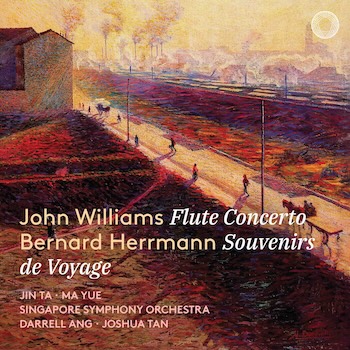
A Singapore Symphony Orchestra recording of compositions by John Williams, Bernard Herrmann, and Hugo Friedhofer quietly punctures old prejudices about film composers and “serious” music.
The touchy relationship between film music and concert music over much of the 20th century reads, a quarter of the way into the 21st, as increasingly strange. Was anyone bothered that Beethoven provided incidental music for Goethe’s Egmont? Or that Mendelssohn contributed a score to accompany A Midsummer Night’s Dream? What’s the dividing line between those classics and what, say, Rozsa and Korngold contributed to Hollywood? Why, often enough, has association with the movies been held against these and other composers’ more abstract efforts?
The fundamental absurdity of such attitudes reemerges in a new recording from the Singapore Symphony Orchestra that brings together instrumental works by a trio of Oscar winners: John Williams, Bernard Herrmann, and Hugo Friedhofer.
Williams is, these days, the most widely familiar of the triptych, and he’s represented here by a couple of early efforts: 1965’s Essay for Strings and 1969’s Flute Concerto. The latter is an accomplished, virtuosic vehicle that, like much of the composer’s concert music, bears little surface resemblance to his crowd-pleasing movie hits. (Underneath, its thematic and motivic complexity isn’t far removed from the composer’s action-themed style.) It gets a lucid, bracing performance from flautist Jin Ta, who navigates its flourishes, bent notes—Williams was much influenced by Japanese shakuhachi techniques while writing the concerto—and attacks them with vigor and precision.
Throughout, the reading is shapely and attentive to myriad details; the score’s fascinating plays of color and character are bracing, and the third-movement cadenza for flute and percussion is particularly absorbing. Though very disjunct, the finale’s dance-like quality emerges strongly.
An assured sense of direction also informs Williams’ Essay, which begins fervently before winding its way towards a stormy ending. Here, the playing of the Singapore string section is tonally rich and impressively balanced.
If the Williams numbers represent a young composer with bright days ahead, Herrmann’s Souvenirs de Voyage hails from a different career perspective. Written for clarinet quintet in 1967, the three-movement effort dates from the last decade of the composer’s life (he died in 1975). Heard in Hans Sørensen’s 2021 arrangement for clarinet and string orchestra, the music retains its essentially elegiac character and conversational aspect.
Much praise is due to the luminous playing of clarinetist Ma Yue, who brings out the genial songfulness of Herrmann’s writing with warmth and understanding. Joshua Tan draws playing from the Singapore strings that only occasionally feels big-boned. Most of the time, instead, there’s a notable freshness and agility to the interpretation: the first-movement climaxes are commendably light on their feet, while the finale’s scherzando passagework sparkles. In between comes a dreamy, languorous account of the lovely Berceuse.
Friedhofer, who won an Academy Award for his music to William Wyler’s The Best Years of Our Lives, is, in terms of name recognition, the odd-man-out in this program. The liner notes point out that The New York Times Arts & Leisure editor hadn’t heard of him when told of the composer’s death and, ironically, his name doesn’t appear on this album’s cover. Be that as it may, Friedhofer’s Wind Quintet is cut from a similar musico-intellectual cloth as the disc’s Williams items—which is to say, it’s richly and uncompromisingly chromatic.
If its seven movements are a touch repetitive in gesture and tone, the score is craftily put together and, especially in its up-tempo sections, full of personality: the march is droll and crisp, the finale cheeky. Again, the performance—from flautist Ta, oboist Rachel Walker, clarinetist Yue, bassoonist Christoph Wichert, and hornist Marc-Antoine Robillard—is technically accomplished and alive to the Quintet’s nuances of dynamics and phrasing.
Jonathan Blumhofer is a composer and violist who has been active in the greater Boston area since 2004. His music has received numerous awards and been performed by various ensembles, including the American Composers Orchestra, Kiev Philharmonic, Camerata Chicago, Xanthos Ensemble, and Juventas New Music Group. Since receiving his doctorate from Boston University in 2010, Jon has taught at Clark University, Worcester Polytechnic Institute, and online for the University of Phoenix, in addition to writing music criticism for the Worcester Telegram & Gazette.
Tagged: Bernard Herrmann, Hugo Friedhofer., Jin Ta, John Williams, Ma Yue, Pentatone, film music