
Jazz Album Reviews: Live Sets from Four Modern Masters
By Michael Ullman
Archival releases document the contrasting styles and shared brilliance of pianists Bill Evans, Ahmad Jamal, Thelonious Monk, and Cecil Taylor on the bandstand.
Bill Evans: At the BBC, March 19, 1965 (3 LPs, Elemental)
Ahmad Jamal, At the Jazz Showcase: Live in Chicago (2 LPs, Resonance, 1976)
Thelonious Monk: Live in Paris, 1967, Volume One (LP, Rhythm-a-Ning)
Cecil Taylor Unit: Fragments: The Complete 1969 Salle Pleyel Concerts (3 LPs, Elemental)
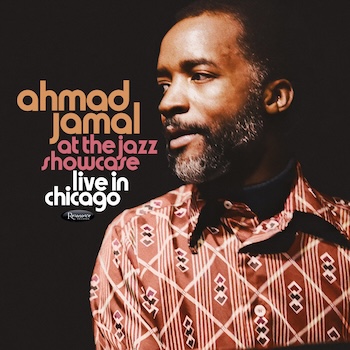
Here are four previously unissued sets, all on LP, by some of the most influential pianists in modern jazz. They represent radically different styles and sounds and, in at least one case, a style in transition. Fans of Ahmad Jamal might remember fondly, as I do, his stripped-down versions of “Poinciana” and “But Not for Me” from his 1958 recording But Not for Me: Ahmad Jamal at the Pershing. On that “But Not for Me,” Jamal plays a single phrase repeatedly for almost a chorus. To my adolescent ears, this was the height of coolness — he didn’t need to rush us with new ideas. Nor did he sound like either Bud Powell or Thelonious Monk, then my favorite pianists.
Later, Jamal became more expansive. I was nonetheless a little surprised by the wild splashes and rapid scales with which he opens his “Ahmad’s Song” on At the Jazz Showcase: Live in Chicago, accompanied by bassist John Heard and drummer Frank Gant. But then, almost two decades had passed.
Jamal’s “Ahmad’s Song” seems to come in two contrasting sections: he opens with a gently descending phrase that seems to promise romance. Eight minutes later, after some delicate single-note lines and playful trills, the pianist warns us that something else is coming when he erupts with a single dissonant crash. Soon, he returns to his initial delicate approach. Then, 10 minutes in, Jamal decides to let us have it with a sometimes crashing, rumbling solo that, surprisingly, contains a few bars of boogie-woogie. The live crowd reacts enthusiastically, which prompts him to end with a kind of coda.
Jamal’s repertoire suggests that, over the years, he has kept listening creatively. As expected, Jamal focuses on ballads such as “Prelude to a Kiss” and “A Nightingale Sang in Berkeley Square,” which he introduces indirectly in a manner that nonetheless sounds purposeful. The pianist also plays Herbie Hancock’s “Dolphin Dance,” which the composer had introduced in 1965 on his Maiden Voyage. Jamal introduces Hancock’s piece teasingly, out of tempo; later, he plays hard-hitting chords in his left hand, block chords, and, toward the end, a few bars of near cacophony before he strips his playing down to eccentrically spaced chords. It’s almost as if he were accompanying the bass. He sounds different — but still hip to my ears.
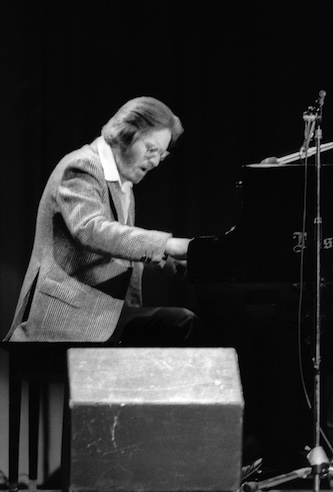
Pianist Bill Evans in performance. Photo: Michael Ullman
Bill Evans’s At the BBC, March 19, 1965 is introduced by a genial but overly talkative announcer who tells us, among other things, that Evans’s sessions at the London club Ronnie Scott’s were eagerly attended, especially by pianists. The announcer also informs us that these musicians were overwhelmed by the performances, reeling away from the club date in a state between elation and despair. Who could compete with the subtle interactions of Evans’s trio, which here features bassist Chuck Israels and drummer Larry Bunker? He points out that, despite his relative youth, Israels had done such wonders as accompany Billie Holiday. Israels was born in 1936 to a musical family whose parents, for instance, produced a concert by the Louis Armstrong All-Stars.
The value of a live session such as the BBC set is that the trio can stretch out. Most of the 16 numbers on the three LPs go on for over five minutes. I get the feeling that Evans would have felt that anything longer would be self-indulgent. The repertoire is familiar territory: Evans moves from “Summertime” to “Come Rain or Come Shine” before landing on my favorite among the ballads he habitually returned to, “My Foolish Heart.” He also plays “Nardis,” which Evans had brought to the Cannonball Adderley quintet in 1961 before recording it on his album Explorations. Evans and the trio still sound fresh on this set. Thanks are in order to the BBC for producing and recording this session.
 On Live in Paris 1967, Thelonious Monk performs with his working quartet of tenor saxophonist Charlie Rouse, Larry Gales, and Ben Riley, supplemented on the extended versions of “Epistrophy” and “Evidence” by a gaggle of horns: trumpeter Ray Copeland, alto saxophonist Phil Woods, and trombonist Jimmy Cleveland. It’s a treat to hear enterprising solos from these horns. The performances are composed mostly of a sequence of solos with occasional riffs by the accompanying horns. Only previously available on bootlegs, the session captures the band in what I hear as a good mood. On “Evidence,” as Monk lays out, Copeland takes a playful solo with odd-sounding trills. Monk’s percussive solo sounds like it was performed with straight fingers poking at the keyboard. His unexpected accents, use of pauses, and tonal clusters often sound humorous. Monk gives the band space; for instance, he lays out during Woods’s solo on “Evidence.” Yet the music always sounds like itself. As Rouse plays the melody of Monk’s best-known ballad, “Ruby, My Dear,” the pianist pokes around in the background as if he didn’t want to take the potentially sentimental piece too seriously. In the same vein, bassist Larry Gales quotes “Honeysuckle Rose” during the 14-minute “We See.” Ben Riley’s crisp, active drumming also seems a perfect strategy for someone accompanying Monk.
I didn’t fully appreciate Cecil Taylor until I saw him live, which I was lucky to do repeatedly. The first sighting was in Detroit at a cooperative space called the Strata West. (Some listeners might remember the short-lived record label Strata East, created by pianist Stanley Cowell and trumpeter Charles Tolliver.) Before he showed up that night, Taylor seemed impossibly elusive: he was advertised a few times before he actually showed up to play at his own date. One night, for instance, trumpeter Charles Moore met me at the door with disappointing news: Taylor would not be in attendance. The compensation was that I got to talk to Moore and his musician friends for a few hours before heading back to Ann Arbor.
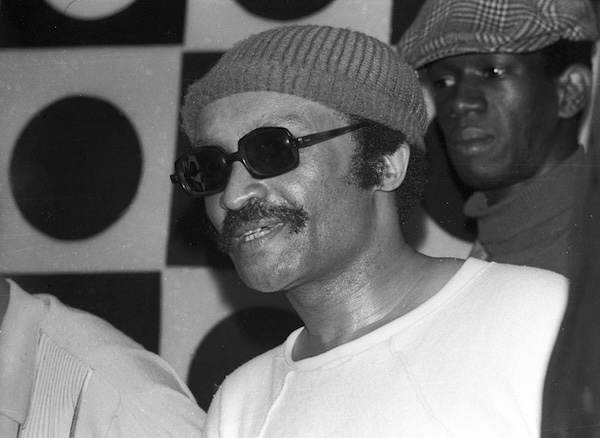
Pianist Cecil Taylor in Detroit. Photo: Michael Ullman
When I finally found myself in the same room as the pianist, I was astounded by Taylor’s energy, particularly the fluidity and range of his phrases. Always on the verge of rising from the bench, he seemed to be dancing with the piano, at times his arms stretching way out as he played rapid fire lines, often high in the treble, that could sound like bells ringing. It was free playing, nervous and often elated. He was indefatigable. Later I heard Taylor play solo at little Carnegie Hall (if I remember correctly). He played the piano so furiously without a break that I was exhausted. Then, after about two hours, Taylor stood up and announced that he would take a short intermission.
Though it wasn’t always easy to hear the connection, Ellington, Taylor said, was his master. He recorded pieces by Duke and his associates as well: the six sides of the LP collection Fragments of a Dedication to Duke Ellington comprise one of his most expansive tributes to Duke. These fragments were taped from two long sets recorded at the 8th Paris Jazz Festival on November 3, 1969. The band was unusual: saxophonist Sam Rivers (tenor, soprano, and flute), alto saxophonist Jimmy Lyons, and drummer Andrew Cyrille. There was no bass present; predictably, the whole set tilted toward the treble. The musicians knew each other’s playing well. For long periods, Taylor dominates; but then he lets the saxophones perform freely together. It sounds like a cliché, but I have always found Taylor’s playing electric. It supplies a kind of jolt. The extended pieces here add to his legacy. They’ll wake you up.
Michael Ullman studied classical clarinet and was educated at Harvard, the University of Chicago, and the U. of Michigan, from which he received a PhD in English. The author or co-author of two books on jazz, he has written on jazz and classical music for the Atlantic Monthly, New Republic, High Fidelity, Stereophile, Boston Phoenix, Boston Globe, and other venues. His articles on Dickens, Joyce, Kipling, and others have appeared in academic journals. For over 30 years, he has written a bimonthly jazz column for Fanfare Magazine, for which he also reviews classical music. He is emeritus at Tufts University, where he taught mostly modernist writers in the English Department and jazz and blues history in the Music Department.