Film Review: “Friend” or Foliage?
By Peter Keough
Visually beguiling, Silent Friend probes the mysteries of consciousness, but it has little on its mind.
Silent Friend. Directed by Ildikó Enyedi. With Tony Leung Chiu-wai, Luna Wedler, and Léa Seydoux. Screening at the Coolidge Corner Theatre beginning May 22.
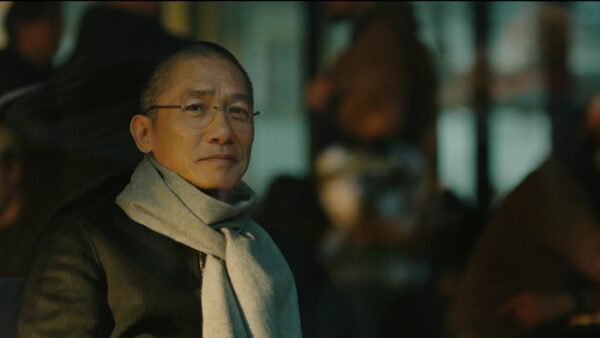
Dr. Tony Wong (Tony Leung Chiu-wai) in scene from Silent Friend. Photo: Films Boutique
When gazing admiringly at a magnificent tree, do you ever get the uncanny sense that it is looking back at you? That’s part of the premise of Hungarian director Ildikó Enyedi’s provocative but disappointing Silent Friend, a time-bending, multinarrative composite reminiscent of Mascha Schilinski’s The Sound of Falling (or D.W. Griffith’s 1916 epic Intolerance, for that matter). But instead of a house providing a linking device, here it is a majestic tree, and instead of four periods, the narrative covers only three, passing over the troubled years of the two world wars. Despite the film’s often sublime images, Enyedi’s vision lacks the subtlety and depth of Schilinski’s. The story’s structure is programmatic and erratic, its ideas derivative and undeveloped. Lacking drama and mystery, the effort amounts to a dazzling, but shallow, diversion.
In 2020, Hong Kong neurologist Dr. Tony Wong (Tony Leung Chiu-wai) is investigating the mental activity of preverbal infants. In a creepy scene at the beginning of the film, he holds up puppets in front of a baby who has a nest of electrodes sprouting from its head. The colorful skein of the child’s brainwaves lights up a monitor.
Babies, Wong explains drawing heavily on the ideas of Michael Pollan, have “lantern consciousness.” They can perceive the world in its totality but lose that ability when they learn a language and are thenceforth doomed to dwell in a narrowly focused “spotlight consciousness.” That leads to his claim that “babies are high all the time,” a state of mind the film tries to evoke with its stunning imagery by cinematographer Gergely Pálos and hallucinogenic, incantatory soundtrack by Kristóf Kelemen and Gábor Kereszt.
Invited to Marburg University in Germany, Wong arrives just as Covid strikes. Everyone else is sent home and, like Paul Giamatti in The Holdovers, he finds himself stranded on campus with just the grumpy custodian Anton (Sylvester Groth) for company. But there is also a giant, ancient ginkgo tree, which we become increasingly aware of because it is so photogenic and, more importantly, because of the spooky shots of the people around it — apparently taken from the tree’s point of view.
These are ominous visions, at least at first, redolent of the gaze of a serial killer or a predatory monster. Day of the Triffids, anyone? The baleful-seeming presence is underscored when Wong, after eating some meaty local delicacy at a reception, throws up at the base of the tree. The camera, Lynch-like, probes into the soil where the rootlets noisily suck up his vomit (later we learn that female gingko trees sprout berries in the autumn that smell like puke).
Wong takes note of the tree and it occurs to him that, with no babies available, maybe he could study its neurological activity, if any. He attaches an assortment of sensors to the bark and in the soil surrounding it, hoping to catch activity on the monitors. Zoom calls with Alice (Léa Seydoux), a Paris botanist, clue him in on the physiology, life cycle, and sex life of the gingko. She offers tips on how he might better achieve some kind of mind-meld (i.e., instead of taking a shower when the tree is in a rainstorm, drink some water). All goes well until the luddite Anton, jealous of “his” tree, decides to intervene.
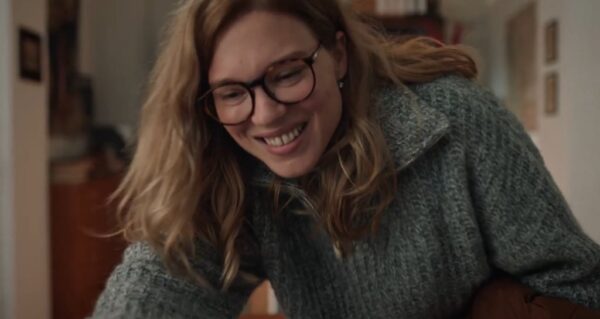
Alice (Léa Seydoux) in Silent Friend. Photo: Films Boutique
But it turns out Wong is not the first person to notice the uncanny presence of the tree — or be noticed by it. Back in 1908, a period rendered in luminous monochrome, Grete (Luna Wedler), an aspiring botanist and feminist, faces down an obnoxiously sexist panel of professors to become the first person to attend the school (here, as elsewhere, Enyedi is not subtle in her takedowns of macho shitheads and misogyny). Tossed out of her rooming house for the sin of suspiciously walking in the botanical garden off-hours, she takes up lodging with a kindly old photographer who teaches her his trade. Like a prototype of Robert Mapplethorpe, she uses her new skills to take ravishing pictures of various vegetation — and then some.
Jump ahead to a polychromatic 1972, where Marburg student Gundula (Marlene Burow) engages in a more primitive version of Dr. Wong’s project, hooking up her geranium to a polygraph device. She enlists as an assistant Hannes (Enzo Brumm), a shy student fresh from the farm (though he is reading Rilke’s The Duino Elegies). Taken aback by her advances and initially scoffing at her highfalutin notions about vegetation, he warms to her geranium and even apologizes to it when churlish and uncomprehending student activists (precursors perhaps of Anton) use its pot for an ashtray.
Will these souls, separated by time, their stories left undeveloped and inconsequential, ever unite with the epoch-spanning ginkgo tree that watches over them all with benign indifference — other than by means of glib intercutting? Will it stroll to the university greenhouse, where the peyote mushrooms are kept, in order to achieve true awareness? For films offering more genuine bonding between vegetation and humans, not to mention a more profound look into the nature of consciousness, I’d recommend Wim Wenders’s Perfect Days (2023), Terrence Malick’s The Tree of Life (2011), and Victor Erice’s Dream of Light (1992).
Peter Keough writes about film and other topics and has contributed to numerous publications. He was the film editor of the Boston Phoenix from 1989 to its demise in 2013 and has edited three books on film, including Kathryn Bigelow: Interviews (University Press of Mississippi, 2013) and For Kids of All Ages: The National Society of Film Critics on Children’s Movies (Rowman & Littlefield, 2019).