
Film Review: In “Amrum,” Innocence Meets Fascist Ideology
By Tim Jackson
Amrum, directed by Fatih Akin. Screening at the Lexington Venue though May 14.
Fatih Akin’s Amrum traces a boy’s quiet moral awakening as Nazi Germany falls, blending lyrical imagery with unsettling historical clarity.
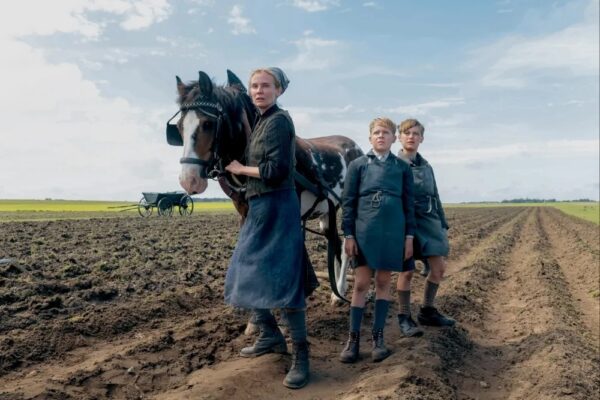
A scene from Amrum. Courtesy of Bombero International/Rialto Film/Warner Bros. Entertainment/Mathias Bothor
Amrum, Fatih Akin’s latest film, takes place on the German island of Amrum in the spring of 1945, where 12-year-old Nanning (Jasper Billerbeck) helps his mother feed the family as his father serves as a lieutenant colonel in the German army. His mother (Laura Tonke) is a devoted fascist who dreams of German glory under Hitler. She shares a house with her sister (Lisa Hagmeister) and is expecting her third child; Nanning is the oldest.
In the opening scene, an aerial shot of the island pulls back to reveal vast potato fields, where Nanning and his friend Hermann (Kian Köppke) are planting potatoes. They watch a squadron of German planes swooping in to offload ordnance into the nearby ocean. At the same time, a group of immigrants arrives from Silesia and East Prussia, a horse-drawn cart trailing behind them. Tessa (Akin regular Diane Kruger), the overseer of the land, asks the cart driver, “Is that them? There’s two of them for every one of us.” “What are you going to do?” he replies. “They are all German, and the Russians are 50 kilometers from Berlin.” “At least it will be the end of Hitler’s damn war,” she says. Nanning looks at her curiously. Then he and Hermann head off with their backpacks to feed the chickens and attend to chores.
In this way, the film quickly and effectively establishes its central tensions and historical context. Even on this isolated North Sea island, the collapse of Nazi Germany generates fear, resentment, and political division. For Nanning, political ideology, the influx of immigrants, and racial divisions are just abstract concerns. Back home, his friend asks to borrow Melville’s Moby-Dick. The family bookshelves are filled with volumes by Nanning’s father, which include Biological Betrayal: Past Facts, Future Prevention. The family’s ideology is chillingly clear. The inclusion of Melville’s novel feels like an odd choice for an 11-year-old, though it echoes larger themes of fate, fanaticism, and blind obsession.
Hermann’s family harbors a secret radio, on which they listen to American jazz. At one point, Nanning is told that his Grandpa Arjan has said that Ahab is like Hitler and the ship is like Germany. “So who’s the white whale?” Nanning asks. “The Russians, or maybe the Americans,” Hermann replies. Then, after a pause: “Maybe Moby-Dick is supposed to be God.”
Moral dilemmas are quietly woven into the screenplay, co-written by Akin and Hark Bohm, who spent his childhood on the island. The stakes may be global, but the story unfolds on a child’s level, exploring life and death, prejudice, and the paradoxes and inequities of existence. Meanwhile, as the oldest of three children, Nanning must care for his mother, who, upon hearing of Hitler’s downfall, has fallen into depression. His task is to secure the only thing she wants to eat: white bread with honey. The quest sends him searching for the ingredients, which is a challenge, because butter, sugar, flour, and honey are all in short supply.
He visits a one-armed baker in search of bread and a doctor for flour. Both seem wary of helping, but do so. Nanning’s mother—one of the island’s devoted fascists—has the power to “report” traitors. This pressure is a subtle but telling detail of what it is like to live under authoritarianism. Later, when Nanning visits his uncle Onno, another fascist, to ask for butter, the man is dressed in his Hitler Youth uniform. Onno claims he has none to spare, but ends up offering a little sugar, measuring out three teaspoonfuls into a small cup. He suddenly pulls the cup back: “Recite the motto of the Hitler Youth Jungvolk,” he demands. Nanning hesitates, but when Onno threatens to take the sugar away, the boy quickly blurts out the words. Does he do so out of resentment at being bullied, or from a growing awareness of fascism’s inequities?
Akin’s directorial strategy is to bring a storybook quality to the narrative, never losing sight of real-world consequences. The lyrical flow of the scenes invites viewers to absorb understated moments of considerable power. The score by Hainbach (Stefan Paul Goetsch), an electronic composer and artist, is restrained as well, never underlining the emotional atmosphere. Karl Walter Lindenlaub’s painterly cinematography often places figures low in the frame. These people are dwarfed by the island’s quiet expanses—nature is serenely indifferent to humanity’s racism, tribal divisions, fleeting cruelties, and the painful weight of historical trauma.
Billerbeck, discovered through a casting call at his sailing school in 2023, registers the character’s emotions with remarkable restraint, conveying the agile psychological drama with quiet force. As the film ends, Hitler is dead, Germany defeated, and the family shunned. They depart the island in the same cart that—in the opening scene—brought in the refugees. The story ends, memorably, with three brilliant shots that fuse recognition, sadness, joy, and epiphany. They complete Amrum’s delicately observed portrait of a world not unlike our own—a time of moral and historical flux.
It is a shame that this superb film, one of the year’s best by an acknowledged world-class director, has been given such limited distribution. It plays through Thursday at the Lexington Venue. Let’s hope it will receive wider screenings.
Tim Jackson was an assistant professor of Digital Film and Video for 20 years. His music career in Boston began in the 1970s and includes some 20 groups, recordings, national and international tours, and contributions to film soundtracks. He studied theater and English as an undergraduate, and has also worked helter-skelter as an actor and member of SAG and AFTRA since the 1980s. He has directed four feature documentaries: Chaos and Order: Making American Theater, which is about the American Repertory Theater; Radical Jesters, which profiles the practices of 11 interventionist artists and agit-prop performance groups; When Things Go Wrong: The Robin Lane Story, and Marblehead Morning: Daring & Stahl: 50 Years in Harmony. He has made two short films as well: Joan Walsh Anglund: Life in Story and Poem and The American Gurner. He is a member of the Boston Society of Film Critics. You can read more of his work on his substack.